Units, prefixes, and how precise an answer can be
What this lesson covers
- A solution to a calculation cannot be more precise than the least precise number used in that calculation.
- Conversions between different-sized metric units may be needed to give the appropriate units for a measurement or calculation.
- The metric prefixes kilo–, mega–, giga–, and tera– signify a unit that is one thousand, one million, one billion, and one trillion times larger than the base unit.
- The metric prefixes centi–, milli–, micro–, and nano– signify a unit one hundredth, one thousandth, one millionth, and one billionth the size of the base unit.
- Derived units (e.g. cm², km/h) reflect a relationship (a product or quotient) between two different measurements.
A measurement is a number and a unit
- Neither half means anything without the other.
- Say 4.5 and nobody knows what you measured.
- Most measurement mistakes are unit mistakes, not arithmetic.
The prefixes that scale up
- Kilo is a thousand. Mega is a million.
- Giga is a billion, tera is a trillion.
- You already use three of those for file sizes.
| Prefix | Means | Power | Seen in |
|---|---|---|---|
| kilo | × 1000 | 10³ | kilometre, kilogram |
| mega | × 1 million | 10⁶ | megabyte, megawatt |
| giga | × 1 billion | 10⁹ | gigabyte |
| tera | × 1 trillion | 10¹² | terabyte |
And the prefixes that scale down
- Centi is a hundredth. Milli is a thousandth.
- Micro is a millionth. Nano is a billionth.
- Each one is the mirror of a prefix on the other list.
| Prefix | Means | Power | Seen in |
|---|---|---|---|
| centi | a hundredth | 10⁻² | centimetre |
| milli | a thousandth | 10⁻³ | millimetre, millisecond |
| micro | a millionth | 10⁻⁶ | microgram |
| nano | a billionth | 10⁻⁹ | nanometre |
Look at the third column of both tables
- Every prefix is a power of ten. Every single one.
- That is the ladder you built in Year 8, with names on the rungs.
- So this is not a new topic. It is place value with labels.
Converting is one multiplication
- 2.5 km into metres. Kilo means a thousand, so times 1000.
- 2500 metres.
- 1500 grams into kilograms goes the other way: divide by 1000.
| Convert | Reasoning | Answer |
|---|---|---|
| 2.5 km to m | kilo means × 1000 | 2500 m |
| 1500 g to kg | going up, so ÷ 1000 | 1.5 kg |
| 45 mm to cm | 10 mm in a cm | 4.5 cm |
| 250 mg to g | milli means ÷ 1000 | 0.25 g |
Which way round, without memorising it
- Going to a smaller unit means you need more of them.
- So the number gets bigger. Going the other way, smaller.
- Then look at your answer and ask if it is sensible.
| Direction | Think | So |
|---|---|---|
| Smaller unit to bigger | fewer of them | the number goes down |
| Bigger unit to smaller | more of them | the number goes up |
| Check | does your answer look sensible? |
Now the one everybody gets wrong
- One metre is a hundred centimetres. Everyone agrees.
- So how many square centimetres are in a square metre?
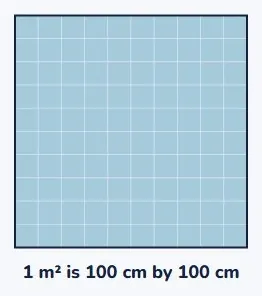
- Not a hundred. Ten thousand. Look at the square.
Because both sides got converted
- A square metre is 100 cm along one side and 100 cm along the other.
- A hundred times a hundred is ten thousand.
- For volume it happens three times. A cubic metre is a million cm³.
| Line | Working | Note |
|---|---|---|
| 1 m | 100 cm | the length conversion |
| 1 m² | 100 cm × 100 cm | |
| So 1 m² | 10 000 cm² | not 100 |
| Why | both sides were converted |
Units made out of other units
- cm² is not a name. It is centimetres times centimetres.
- km/h is kilometres divided by hours.
- The unit is telling you what calculation produced it.
| Unit | Built from | Kind |
|---|---|---|
| cm² | cm × cm | a product |
| m³ | m × m × m | a product |
| km/h | km ÷ h | a quotient |
| g/cm³ | g ÷ cm³ | a quotient |
Which means a unit can rebuild a formula
- Forgotten how speed works? The unit is kilometres per hour.
- Per means divided by. So speed is distance over time.
- The formula was written on the unit the whole time.
Picking a unit that reads well
- A height in kilometres is technically correct and useless.
- Choose the unit that gives a number a person can hold.
- Roughly: between one and a thousand.
| Measuring | Sensible unit | Not |
|---|---|---|
| A person’s height | metres or centimetres | not kilometres |
| Distance between cities | kilometres | not millimetres |
| Mass of a vitamin tablet | milligrams | not kilograms |
| Width of a virus | nanometres |
Last idea, and it will feel wrong at first
- Sometimes you have to write down fewer digits than you calculated.
- That feels like throwing away accuracy. It is the opposite.
- The extra digits were never real.
A rectangle measured to one decimal place
- 12.4 cm by 5.2 cm. The calculator says 64.48 square centimetres.
- But 12.4 means somewhere near 12.4. It is not exact.
- So the answer cannot be either. Report 64.5.
| Step | Value | Note |
|---|---|---|
| Measured | 12.4 cm by 5.2 cm | both to 1 decimal place |
| Calculator says | 64.48 cm² | |
| But | the inputs were not that precise | |
| Report | 64.5 cm² | one decimal place |
The same rule, on an addition
- 2.5 plus 1.25. One is to one decimal place, the other to two.
- The roughest measurement sets the limit. That is the 2.5.
- So 3.75 gets reported as 3.8.
| Step | Detail | |
|---|---|---|
| 2.5 + 1.25 | one is to 1 dp, one to 2 | |
| Calculator says | 3.75 | |
| Least precise | 2.5, to 1 dp | |
| Report | 3.8 |
What to take away
- Six things, and the fourth one is the classic lost mark.
| Every prefix | is a power of ten |
| kilo, mega, giga, tera | thousand, million, billion, trillion |
| centi, milli, micro, nano | hundredth, thousandth, millionth, billionth |
| 1 m² | is 10 000 cm², because both sides convert |
| A derived unit | tells you which operation made it |
| An answer | cannot be more precise than the roughest measurement in it |
Your turn
- Pause here and try all four.
- Answers are in the description.
| Question | |
|---|---|
| 1 | Convert 3.6 km to metres. |
| 2 | Convert 250 mg to grams. |
| 3 | A rectangle is 12.4 cm by 5.2 cm. Give the area sensibly. |
| 4 | What does the prefix micro mean? |
Show answer
1. 3600 m. Kilo means a thousand, and you are going to a smaller unit, so the number gets bigger. 2. 0.25 g. Milli means a thousandth, and you are going to a bigger unit. 3. 64.5 cm². The calculator says 64.48, but both measurements were only given to one decimal place, so the answer cannot be better than that. 4. One millionth, or 10 to the minus six.
The answers
- Smaller unit, so the number gets bigger.
- The calculator says 64.48, but the inputs were 1 dp.
- Micro is ten to the minus six.
| Answer | |
|---|---|
| 1 | 3600 m |
| 2 | 0.25 g |
| 3 | 64.5 cm² |
| 4 | One millionth |
Is your child on track?
Take the free placement test