Circles, parallel lines, and moving shapes about
What this lesson covers
- A circle is the path traced out by a point moving in a plane and always a fixed distance (the radius) from a central point.
- Angles between parallel lines and a transversal can be corresponding, co-interior, or alternate; corresponding angles are equal, and alternate angles are equal.
- A set of points in a plane can be transformed by translation, reflection about a line, and rotation about a fixed point.
Four topics, and one question for all of them
- Circles, angles, moving shapes, and folding up nets.
- They are genuinely four different things.
- Ask the same question of each: what is staying the same?
A circle is defined by what does not change
- Pick a point, and pick a distance.
- Mark every place that is exactly that far from the point.
- That set of places is a circle. The distance is the radius.
| Step | Detail | |
|---|---|---|
| Pick a centre | and a fixed distance | |
| Mark every point | exactly that far away | |
| What you get | is a circle | |
| The fixed distance | is the radius |
The parts, and how they relate
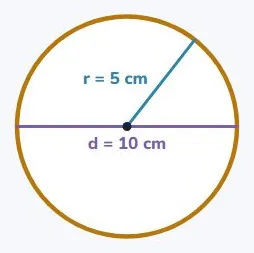
- Radius to the edge, diameter all the way across.
- A chord joins two edge points but need not pass the centre.
- Which makes the diameter the longest chord there is.
All four, written down
- The diameter is always twice the radius.
- The circumference is 2 pi r, from the measuring lesson.
- Every one of them is measured from that same fixed centre.
| Part | What it is | Size |
|---|---|---|
| Radius | centre to the edge | r |
| Diameter | right across, through the centre | 2r |
| Chord | joins two points on the edge | need not pass the centre |
| Circumference | the distance all the way round | 2πr |
| So the diameter | is the longest chord there is |
Angles: start with one crossing
- Two lines cross. Angles on a straight line add to 180.
- So 70 on one side means 110 on the other.
- And the angle opposite is equal. One angle gives you all four.
| Rule | Why | Example |
|---|---|---|
| On a straight line | angles add to 180 | 180 − 70 = 110 |
| Vertically opposite | always equal | 70 and 70 |
| So one angle | gives you all four |
Now a line crossing two parallel lines
- That crossing line is called a transversal.
- Three relationships worth knowing, and they make shapes.
- F is corresponding, Z is alternate, C is co-interior.
| Name | Shape it makes | Relationship |
|---|---|---|
| Corresponding | an F shape | equal |
| Alternate | a Z shape | equal |
| Co-interior | a C shape | add to 180 |
Two of those are equal. One is not
- Corresponding and alternate angles are equal to each other.
- Co-interior angles add to 180. They are not equal.
- Look at the C: both angles are on the same side. That is why.
One given angle unlocks the diagram
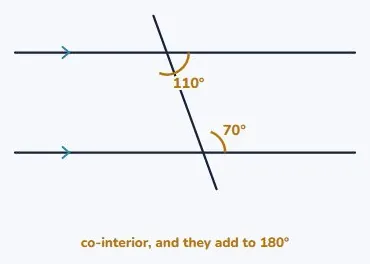
- The transversal makes 70 degrees. Corresponding angle: 70.
- Alternate angle: also 70.
- Co-interior: 180 minus 70, which is 110.
| Angle wanted | Reasoning | Size |
|---|---|---|
| Given | the transversal makes 70° | |
| Corresponding angle | equal | 70° |
| Alternate angle | equal | 70° |
| Co-interior angle | 180 − 70 | 110° |
Now run it backwards: are they parallel?
- Usually you are told the lines are parallel and find an angle.
- Here you get the angles and have to decide about the lines.
- 70 and 110 add to 180, so yes. 70 and 105 do not, so no.
| Given | Check | Verdict |
|---|---|---|
| Angles of 70 and 110 | co-interior, so check the sum | 180. Parallel |
| Angles of 70 and 105 | the sum is 175 | not 180. Not parallel |
| The point | do not assume parallel | the angles prove it |
A diagram that looks parallel is not evidence
- Drawings are not to scale, and 105 looks a lot like 110.
- The angles are the proof. Nothing else is.
- That is what the word verifying is doing in the question.
Three ways to move a shape
- Translation slides it. Reflection flips it over a line.
- Rotation turns it about a point.
- And in all three the shape itself does not change at all.
| Transformation | What it does | Note |
|---|---|---|
| Translation | slide it | no turning, no flipping |
| Reflection | flip it over a line | like a mirror |
| Rotation | turn it about a point | by a given angle |
| In all three | the shape is unchanged | only its position moves |
What happens to an actual point
- Start at (2, 3). Slide 4 right and 2 down: (6, 1).
- Reflect in the y-axis and the x flips sign: (−2, 3).
- Reflect in the x-axis and the y flips instead: (2, −3).
| Transformation | What changes | Result |
|---|---|---|
| Start at (2, 3) | ||
| Translate 4 right, 2 down | add 4, subtract 2 | (6, 1) |
| Reflect in the y-axis | the x flips sign | (−2, 3) |
| Reflect in the x-axis | the y flips sign | (2, −3) |
| Rotate 90° clockwise about O | (3, −2) |
Which coordinate flips, and why it feels backwards
- Reflecting in the y-axis changes x, not y.
- The axis you reflect in is the one that stays put.
- Points on that axis do not move at all. That is the test.
Nets: a solid, unfolded
- A net is every face of a solid, laid out flat.
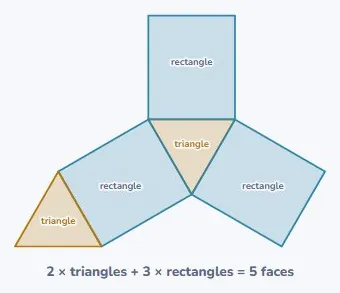
- A triangular prism: two triangle ends and three rectangles.
- Folding it up moves the faces. It does not change them.
Counting faces, edges and vertices
- A rectangular prism has 6 faces, 12 edges, 8 vertices.
- A triangular prism has 5, 9 and 6.
- A square-based pyramid has 5, 8 and 5.
| Solid | Faces | Edges and vertices |
|---|---|---|
| Rectangular prism | 6 faces | 12 edges, 8 vertices |
| Triangular prism | 5 faces | 9 edges, 6 vertices |
| Square-based pyramid | 5 faces | 8 edges, 5 vertices |
| Folding | does not change the faces | only where they sit |
What to take away
- Six things, and the fourth is the one people get wrong.
| A circle | is every point a fixed distance from the centre |
| The diameter | is twice the radius, and the longest chord |
| Corresponding and alternate | angles are equal. F and Z |
| Co-interior | angles add to 180. C |
| To prove lines parallel | check the angles, do not assume |
| Translate, reflect, rotate | move a shape without changing it |
Your turn
- Pause here and try all four.
- Answers are in the description.
| Question | |
|---|---|
| 1 | A transversal cuts parallels at 65°. Co-interior? |
| 2 | Reflect the point (4, 1) in the y-axis. |
| 3 | How many faces does a triangular prism have? |
| 4 | Two co-interior angles are 60° and 120°. Are the lines parallel? |
Show answer
1. 115°, because co-interior angles add to 180 rather than being equal. 2. (−4, 1). Reflecting in the y-axis changes the sign of the x coordinate and leaves y alone. 3. Five. Two triangular ends and three rectangles. 4. Yes. They add to 180, which is exactly the condition for parallel.
The answers
- Co-interior angles add to 180, not equal.
- Reflecting in the y-axis flips the x.
- 60 and 120 add to 180, so parallel.
| Answer | |
|---|---|
| 1 | 115° |
| 2 | (−4, 1) |
| 3 | Five |
| 4 | Yes |
Is your child on track?
Take the free placement test