Speed, distance, time, and the 2.30 trap
What this lesson covers
- There is a fixed relationship between speed, distance, and time: speed = distance/time.
- In position-time graphs, the gradient represents speed.
- Decimal measures are used for very small durations (e.g. milliseconds); the rest of time measurement uses a different system, based principally on 12 and 60.
Almost nothing in this lesson is new
- Rates, derived units, and gradient. You have all three already.
- This is where they meet.
- Plus one mistake that ruins more answers than anything else here.
The formula is written on the speedometer
- The unit is kilometres per hour. Per means divided by.
- So speed is kilometres divided by hours.
- Distance over time. You did not have to remember that.
| Step | Reasoning | Note |
|---|---|---|
| The unit is | kilometres per hour | |
| Per means | divided by | from the rates lesson |
| So speed is | kilometres ÷ hours | |
| Which is | distance ÷ time | no memorising needed |
One relationship, three questions
- 240 km in 3 hours is 80 km per hour.
- At 80 for two and a half hours, you cover 200 km.
- 300 km at 60 takes five hours. Same relationship each time.
| Finding | Working | Example |
|---|---|---|
| Speed | distance ÷ time | 240 km ÷ 3 h = 80 km/h |
| Distance | speed × time | 80 km/h × 2.5 h = 200 km |
| Time | distance ÷ speed | 300 km ÷ 60 km/h = 5 h |
You may have been shown a formula triangle
- It is a memory aid for something you can rebuild in seconds.
- And it hides the units, which is where the errors actually live.
- Read the unit instead. It never lies to you.
On a distance-time graph, the gradient is the speed
- Gradient is rise over run. You had that in algebra.
- Here the rise is distance and the run is time.
- So rise over run is distance over time, which is speed.
| Part | Meaning here | Value |
|---|---|---|
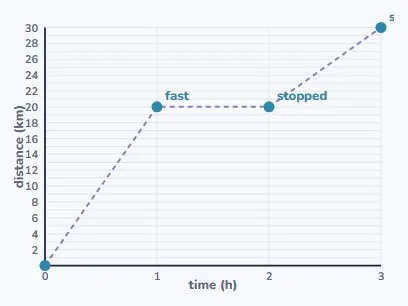
| Rise | distance travelled | 20 km |
| Run | time taken | 1 h |
| Rise over run | 20 ÷ 1 | 20 km/h |
| Which is | exactly distance over time |
So the shape of the line is a description of the journey
- Steep means a lot of distance in little time. Fast.
- Shallow means slow.
- And flat means the distance is not changing. That is a stop.
A flat line is not nothing happening
- Time is still passing. The clock has not stopped.
- It is the distance that is not changing.
- Gradient zero, so speed zero. Parked.
| Line | What it means | Speed |
|---|---|---|
| Steep line | lots of distance in little time | fast |
| Shallow line | little distance in lots of time | slow |
| Flat line | time passing, distance not changing | stopped |
| Steeper again | a faster section |
Now the thing that catches everyone
- Every other measurement you have met runs on powers of ten.
- A thousand metres in a kilometre. A thousand grams in a kilogram.
- Time does not. Sixty seconds, sixty minutes, twenty-four hours.
| Measurement | Based on | Example |
|---|---|---|
| Length, mass, volume | powers of ten | 1000 m in a km |
| Time | 60 and 24 and 12 | 60 min in an hour |
| So 2 h 30 min | is not 2.30 hours | it is 2.5 hours |
Which is why 2.30 is not two and a half hours
- 180 km in 2 hours 30. Type 2.30 and you get 78.3 km/h.
- Use 2.5 and you get 72 km/h. That one is right.
- Six kilometres an hour out, and the working looks perfect.
| Step | Working | Answer |
|---|---|---|
| 180 km in 2 h 30 min | ||
| Typing 2.30 | 180 ÷ 2.30 | 78.3 km/h. Wrong |
| Using 2.5 | 180 ÷ 2.5 | 72 km/h. Right |
| The gap | over 6 km/h | and nothing looks wrong |
The dangerous part is that it looks fine
- Seventy-eight kilometres an hour is a perfectly normal speed.
- Nothing in your working will look wrong.
- So the only defence is converting the minutes first, every time.
Minutes into hours: divide by 60
- 15 minutes over 60 is 0.25 of an hour.
- 45 minutes is 0.75. Twenty minutes is about 0.333.
- Do that before anything goes into the calculator.
| Duration | Working | In hours |
|---|---|---|
| 15 minutes | 15 ÷ 60 | 0.25 h |
| 20 minutes | 20 ÷ 60 | about 0.333 h |
| 45 minutes | 45 ÷ 60 | 0.75 h |
| 1 h 15 min | 1 + 0.25 | 1.25 h |
And below a second, it goes decimal again
- A second is a thousand milliseconds. A clean power of ten.
- So 0.25 seconds is 250 milliseconds.
- Because there was never a unit below a second to split by 60.
| Duration | Equals | Note |
|---|---|---|
| 1 second | 1000 milliseconds | |
| 0.25 s | 250 ms | |
| A sprint of 10.34 s | 10 340 ms | |
| Why decimal here? | no unit below a second | to split by 60 |
So time runs two systems at once
- Above a second: sixties and twelves and twenty-fours.
- Below a second: straight powers of ten.
- No other measurement in this course changes its mind halfway.
What to take away
- Six things, and the last one is worth more marks than the rest.
| The unit | tells you the formula, so do not memorise one |
| Speed | is distance divided by time |
| On a position-time graph | the gradient is the speed |
| A flat line | means stopped, not means nothing |
| Time is not decimal | above a second, it runs on 60 |
| 2 h 30 min | is 2.5 hours, and never 2.30 |
Your turn
- Pause here and try all four.
- Answers are in the description.
| Question | |
|---|---|
| 1 | A car travels 150 km in 2 hours. What is its speed? |
| 2 | How far does a car at 60 km/h travel in 45 minutes? |
| 3 | How long does 200 km take at 60 km/h? |
| 4 | How many milliseconds is 0.4 seconds? |
Show answer
1. 75 km/h, from 150 divided by 2. 2. 45 km. Convert first: 45 minutes is 0.75 of an hour, and 60 times 0.75 is 45. Using 0.45 would have given you 27 km. 3. 3 hours 20 minutes. The division gives 3.333 hours, and the 0.333 of an hour is 20 minutes, not 33 minutes. 4. 400 milliseconds, since a second is 1000 of them.
The answers
- 45 minutes is 0.75 of an hour, not 0.45.
- The division gives 3.333 hours.
- And 0.333 of an hour is 20 minutes.
| Answer | |
|---|---|
| 1 | 75 km/h |
| 2 | 45 km |
| 3 | 3 h 20 min |
| 4 | 400 ms |
Is your child on track?
Take the free placement test