Circles, and every area formula as a rectangle
What this lesson covers
- The constant π is found by dividing a circle’s circumference by its diameter.
- For a circle of radius r, the circumference is 2πr.
Two halves, and one idea holding them together
- Circles first, then the area of some awkward shapes.
- Every area formula here comes back to a rectangle.
- So there is a lot less to remember than it looks.
Pi is something you can measure
- Take any circle. Measure around it, and measure across it.
- Divide the first by the second. You get 3.14.
- Do it with a different circle. Still 3.14. Every time.
| Circle | Measurements | Around ÷ across |
|---|---|---|
| Circle A | around 31.4 cm, across 10 cm | 3.14 |
| Circle B | around 15.7 cm, across 5 cm | 3.14 |
| Any circle | around ÷ across | always 3.14... |
That number is pi, and it is a fact about circles
- Nobody chose it. It is what circles do.
- Pi is the circumference divided by the diameter.
- Which means the circumference is pi times the diameter.
Two ways to write the same formula
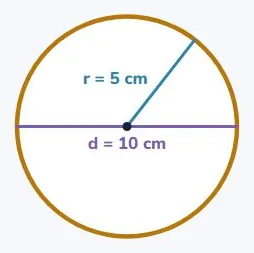
- C = pi d if you were given the diameter.
- The diameter is twice the radius, so C = 2 pi r.
- Same formula. Use whichever matches what you were told.
| Version | Formula | Why |
|---|---|---|
| Using the diameter | C = πd | because π is C ÷ d |
| Using the radius | C = 2πr | because d = 2r |
| They are the same | pick whichever you were given |
Two quick ones
- Radius 5: two times pi times five, about 31.4 cm.
- Diameter 12: pi times twelve, about 37.7 cm.
- Watch which one you were given. That is the only trap.
| Given | Working | Answer |
|---|---|---|
| r = 5 cm | 2 × π × 5 | about 31.4 cm |
| d = 12 cm | π × 12 | about 37.7 cm |
Now walk around a semicircle
- Radius 6. Start at one corner and go round the curve.
- That is half the circumference, about 18.85 cm.
- But you are not home yet. You have to walk back along the flat.
| Step | Working | Distance |
|---|---|---|
| Radius 6 cm | ||
| Round the curve | half of 2πr, so π × 6 | about 18.85 cm |
| Back along the flat | the diameter, 12 cm | |
| Total perimeter | 18.85 + 12 | about 30.85 cm |
So it is not half the circumference
- Half the circumference is 18.85, and that is only the curve.
- Cutting the circle in half created an edge that was not there.
- Perimeter means all the way round. Add the diameter.
| Claim | Value | Verdict |
|---|---|---|
| Half the circumference | 18.85 cm | only the curve |
| The cut made a new edge | the straight 12 cm | |
| Perimeter means | all the way round | so both |
A quarter circle gets two straight edges
- Radius 4. The curve is a quarter of the circumference, 6.28.
- Then back along one radius, and up the other. Four each.
- About 14.28 cm. Walk the outline and count what you cross.
| Step | Working | Distance |
|---|---|---|
| Radius 4 cm | ||
| The curve | a quarter of 2πr | about 6.28 cm |
| Two straight edges | both radii, 4 cm each | 8 cm |
| Total | 6.28 + 8 | about 14.28 cm |
Second half. Start with the easiest shape there is
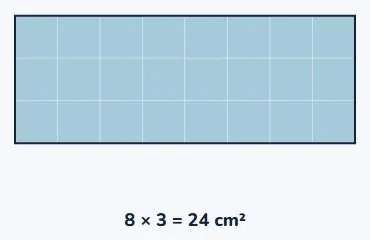
- A rectangle 8 by 3. Area is base times height. 24.
- You have known that for years.
- Every formula in the rest of this lesson comes back to it.
A parallelogram is a rectangle, pushed over
- Cut the triangle off one end and slide it to the other.
- What you are left with is a rectangle. Same base, same height.
- So the area is base times height. Nothing new.
| Step | What happens | Result |
|---|---|---|
| Cut the triangle off one end | slide it to the other | |
| You now have a rectangle | same base, same height | |
| So the area | base × height | 8 × 3 = 24 cm² |
| Careful | height means perpendicular height | not the slanted side |
One warning about that height
- The height is the perpendicular height. Straight up.
- Not the slanted side, which is longer.
- Using the slant is the most common error in the topic.
A trapezium is a rectangle whose width is the average
- Parallel sides of 10 and 6. It is wide at one end, narrow at the other.
- On average, it is 8 wide. And the height is 4.
- So the area is 8 times 4, which is 32.
| Step | Reasoning | Result |
|---|---|---|
| Parallel sides 10 and 6 | the average is 8 | |
| Height 4 | ||
| Area | 8 × 4 | 32 cm² |
| Written as a formula | (a + b)/2 × h | the average, times the height |
And a kite fills half its rectangle
- Draw the rectangle that just encloses the kite.
- Its sides are the two diagonals: 10 and 6, so 60.
- The kite is exactly half of it. Thirty.
| Step | Reasoning | Result |
|---|---|---|
| Diagonals 10 and 6 | draw the rectangle round it | 60 cm² |
| The kite fills | exactly half of it | |
| Area | (10 × 6)/2 | 30 cm² |
And when there is no formula at all
- An L-shaped room is not any of these shapes.
- For perimeter, it does not matter. Add up every side.
- Perimeter never needs a formula. It is just the walk.
| Shape | Method | Answer |
|---|---|---|
| An L-shaped room | sides 10, 4, 6, 3, 4, 7 | |
| Perimeter | add every side | 34 m |
| No formula needed | just walk all the way round |
What to take away
- Seven things, and the third one is the mark people drop.
| π | is circumference divided by diameter, for every circle |
| Circumference | is πd, which is the same as 2πr |
| A semicircle perimeter | is the curve plus the diameter |
| A quarter circle | is the curve plus two radii |
| Parallelogram | base × perpendicular height, like a rectangle |
| Trapezium | the average of the parallel sides, times the height |
| Kite | half of the rectangle that encloses it |
Your turn
- Pause here and try all four.
- Answers are in the description.
| Question | |
|---|---|
| 1 | Find the circumference of a circle with radius 7 cm. |
| 2 | Find the perimeter of a semicircle with radius 5 cm. |
| 3 | Trapezium: parallel sides 9 and 5, height 6. Area? |
| 4 | A parallelogram has base 12 cm and height 5 cm. Area? |
Show answer
1. About 44.0 cm, from 2 × π × 7. 2. About 25.7 cm. The curve is π × 5, which is about 15.7, and then add the diameter of 10. If you answered 15.7 you forgot the straight edge. 3. 42 cm². The average of 9 and 5 is 7, and 7 × 6 is 42. 4. 60 cm². Base times perpendicular height, exactly like a rectangle.
The answers
- Two pi r, with r as seven.
- On the semicircle, add the diameter.
- Average 9 and 5 to get 7, then times 6.
| Answer | |
|---|---|
| 1 | About 44.0 cm |
| 2 | About 25.7 cm |
| 3 | 42 cm² |
| 4 | 60 cm² |
Is your child on track?
Take the free placement test