Scientific notation, and three names for one number
What this lesson covers
- A number written in scientific notation has the form a × 10^k, where 1 ≤ a < 10 and k is an integer.
- Repeated division can be summarised using exponent notation with a negative exponent.
- There are an infinite number of rational numbers between any two numbers; these can be represented by terminating decimals, recurring decimals, and fractions.
The number does not change, the writing does
- Every number in this lesson is a point on the number line.
- Scientific notation, fractions, decimals, percentages.
- All of them are names. None of them move the point.
A number you cannot read
- The Earth is about 149 600 000 km from the Sun.
- How many digits is that? You had to count.
- That is the problem worth solving.
| Written out | 149 600 000 km |
| How many digits? | you have to count them |
| In two pieces | 1.496 × 10⁸ km |
Two pieces: the digits, and the size
- Scientific notation splits a number in two.
- The digits that carry the information, times a power of ten.
- Written a × 10 to the k.
| Part | What it is | The rule |
|---|---|---|
| a | the digits | at least 1, less than 10 |
| 10 | the base | always ten |
| k | the exponent | any integer, positive or negative |
Why a has to sit between 1 and 10
- 3140 can be written three ways, and all three are true.
- Only one is allowed, and that is the whole point.
- One allowed form means two numbers can be compared.
| Written as | Value | Verdict |
|---|---|---|
| 0.314 × 10⁴ | 3140 | a is below 1 |
| 3.14 × 10³ | 3140 | allowed |
| 31.4 × 10² | 3140 | a is 10 or more |
Small numbers: the exponent goes negative
- Last year the ladder ran below the ones. Same ladder here.
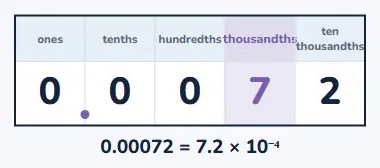
- Each step down the list divides by ten once more.
- The exponent counts the divisions.
| Scientific notation | Ordinary form | Meaning |
|---|---|---|
| 7.2 × 10⁻¹ | 0.72 | divided by ten once |
| 7.2 × 10⁻² | 0.072 | divided by ten twice |
| 7.2 × 10⁻³ | 0.0072 | three times |
| 7.2 × 10⁻⁴ | 0.00072 | four times |
Reading it in either direction
- 7.2 × 10⁻⁴ is 0.00072. Four divisions by ten.
- Going back, count how far the digits sit from the ones column.
- That count is k. Its sign says which way.
The comparison almost everyone gets wrong
- Which is bigger, 9.9 × 10³ or 1.2 × 10⁴?
- Most people say the first one, because 9.9 beats 1.2.
- The exponent decides first. Always.
| Number | The digits | Actual value |
|---|---|---|
| 9.9 × 10³ | a is 9.9 | 9900 |
| 1.2 × 10⁴ | a is 1.2 | 12 000 |
| Bigger? | the exponent decides first | 1.2 × 10⁴ |
Ordering, once you check in the right order
- Sort by the exponent. Only if two match, look at the digits.
- 10 to the 1, then 10 squared, then 10 cubed.
- The digits never overturn a bigger exponent.
| Number | Value | Place |
|---|---|---|
| 9.9 × 10¹ | 99 | smallest |
| 4.2 × 10² | 420 | |
| 1.1 × 10³ | 1100 | largest |
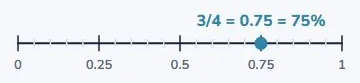
Three names for one point
- A fraction, a decimal and a percentage can be the same number.
- Three quarters, nought point seven five, seventy-five percent.
- One point on the line, three ways of saying it.
| Fraction | Decimal | Percentage |
|---|---|---|
| 3/4 | 0.75 | 75% |
| 2/5 | 0.4 | 40% |
| 7/8 | 0.875 | 87.5% |
Moving between them
- A fraction is a division waiting to happen. Do the division.
- A percentage is just a fraction whose bottom is 100.
- Each move is one step, and it always works.
| To go | Do this | Example |
|---|---|---|
| Fraction to decimal | divide the top by the bottom | 7 ÷ 8 = 0.875 |
| Decimal to percentage | multiply by 100 | 0.875 becomes 87.5% |
| Percentage to fraction | put it over 100, then simplify | 75/100 = 3/4 |
Multiplying by a disguised 1
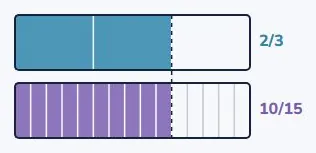
- Five fifths is 1. So is three thirds, and a hundred hundredths.
- Multiplying by 1 cannot change a number.
- So 2/3 and 10/15 are the same point, written differently.
Simplifying is the same move, backwards
- If multiplying top and bottom is safe, so is dividing them.
- 18 and 24 share a factor of 6.
- Simplest form means no shared factor is left.
| Step | Working | Note |
|---|---|---|
| 18/24 | both parts divide by 6 | |
| 18 ÷ 6 | 3 | |
| 24 ÷ 6 | 4 | |
| 3/4 | simplest form | no common factor left |
Top-heavy fractions and mixed numbers
- 17/5 is not wrong. It is seventeen fifths, and that is a number.
- Divide to see how many whole ones are hiding in it.
- Three whole ones, two fifths over. Which is also 3.4.
| Form | Reading | |
|---|---|---|
| 17/5 | seventeen fifths | |
| 17 ÷ 5 | 3 remainder 2 | |
| 3 2/5 | three whole ones and two fifths | |
| 3.4 | the same point again |
What to do with what is left over
- Seven divided by two is three and a half. Or 3.5. Or four.
- The arithmetic is identical in all three.
- What is being divided decides which answer is right.
| The situation | The answer | Why |
|---|---|---|
| 7 metres of rope, cut in two | 3.5 m | a decimal fits |
| 7 pizzas shared by 2 | 3 1/2 each | a fraction fits |
| 7 people, 2 per car | 4 cars | round up, or someone walks |
There is always another number in the gap
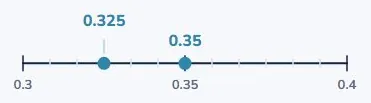
- Between 0.3 and 0.4 sits 0.35.
- Between 0.3 and 0.35 sits 0.325. And it never stops.
- Between any two numbers there are infinitely many more.
When the decimal runs out and the fraction does not
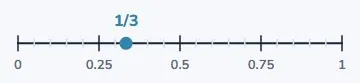
- A third is 0.333, going on forever. A recurring decimal.
- Written as a decimal you have to stop somewhere and be wrong.
- Written as 1/3 it is exact. That is what fractions are for.
What to take away
- Six things, and the first one carries the rest.
| Scientific notation | a × 10 to the k, with a from 1 up to 10 |
| One allowed form | which is what makes comparing possible |
| Compare | exponent first, then the digits |
| Fraction, decimal, percentage | three names for one point |
| Equivalent fractions | multiply by a disguised 1 |
| Remainders | the context decides the form |
Your turn
- Pause here and try all four.
- Answers are in the description.
| Question | |
|---|---|
| 1 | Write 0.00045 in scientific notation. |
| 2 | Which is bigger, 8.7 × 10⁴ or 2.3 × 10⁵? |
| 3 | Simplify 24/36. |
| 4 | Write 9/4 as a mixed number and as a decimal. |
Show answer
1. 4.5 × 10⁻⁴. Four divisions by ten take 4.5 down to 0.00045. 2. 2.3 × 10⁵, which is 230 thousand against 87 thousand. The exponent settles it before the digits get a say. 3. 2/3. Both parts divide by 12. 4. 2 1/4, and 2.25.
The answers
- Four divisions by ten take 4.5 to 0.00045.
- On question 2 the exponent settles it first.
- Both parts of 24/36 divide by 12.
| Answer | |
|---|---|
| 1 | 4.5 × 10⁻⁴ |
| 2 | 2.3 × 10⁵ |
| 3 | 2/3 |
| 4 | 2 1/4, or 2.25 |
Is your child on track?
Take the free placement test