Powers of two, unit fractions, and roots on the line
What this lesson covers
- Multiplying a fraction by an equivalent form of 1, such as 3/3, results in an equivalent fraction.
- When giving a fraction as an answer, there should be a positive or negative integer in the numerator and a positive integer in the denominator.
- Numbers, including fractions, decimals, and percentages, can be represented using number lines.
Some numbers are worth knowing by heart
- Not because memorising is good for you.
- Because they are what you measure other numbers against.
- Three sets of landmarks, and then a line to put things on.
The powers of two, up to 1024
- Ten numbers. You will meet all of them this year.
- Two, four, eight, sixteen, thirty-two.
- Then sixty-four, one twenty-eight, and on to 1024.
| Power | Value | Power | Value |
|---|---|---|---|
| 2¹ | 2 | 2⁶ | 64 |
| 2² | 4 | 2⁷ | 128 |
| 2³ | 8 | 2⁸ | 256 |
| 2⁴ | 16 | 2⁹ | 512 |
| 2⁵ | 32 | 2¹⁰ | 1024 |
You already know how to rebuild them
- Every one is the one before it, doubled.
- So forgetting 2⁸ costs you nothing. Count up from 2⁵.
- A table you can rebuild is worth more than one you memorised.
| Step | Value | Note |
|---|---|---|
| Start at | 2 | |
| Double it | 4 | that is 2² |
| Double again | 8 | that is 2³ |
| Keep going | 1024 | that is 2¹⁰ |
Where you have seen 1024 before
- A kilobyte is 1024 bytes, not 1000.
- Computers count in twos, so their round numbers are powers of two.
- That is the whole reason for the odd-looking figure.
A negative power, with the base set free
- Last year: 10⁻² is one over ten squared, which is a hundredth.
- Look at 3⁻². One over three squared. One ninth.
- Nothing in that argument was ever about ten.
| Written | Means | Value |
|---|---|---|
| 10⁻² | 1/10² | 1/100 |
| 3⁻² | 1/3² | 1/9 |
| 2⁻³ | 1/2³ | 1/8 |
| 5⁻¹ | 1/5¹ | 1/5 |
| 4⁻² | 1/4² | 1/16 |
One rule, whatever the base
- A positive power multiplies a by itself that many times.
- A negative power is one over that same thing.
- a to the minus n equals one over a to the n. Always.
| Case | Written | What it means |
|---|---|---|
| Positive power | aⁿ | multiply a by itself n times |
| Negative power | a⁻ⁿ | one over that same number |
| Which means | a⁻ⁿ = 1/aⁿ | whatever a is |
The second set of landmarks: perfect squares
- One, four, nine, sixteen, twenty-five, and up to 144.
- These are the numbers whose square roots are whole.
- Everything else gets placed between two of them.
| 1² = 1 | 5² = 25 | 9² = 81 |
| 2² = 4 | 6² = 36 | 10² = 100 |
| 3² = 9 | 7² = 49 | 11² = 121 |
| 4² = 16 | 8² = 64 | 12² = 144 |
Trapping a root between two squares
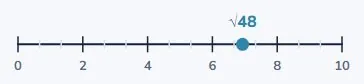
- Take √48. Which perfect squares sit either side of 48?
- 36 below it, 49 above it.
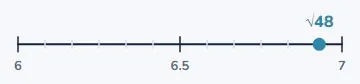
- So √48 is somewhere between 6 and 7.
| Below it | 36 | √36 = 6 |
| Above it | 49 | √49 = 7 |
| So √48 is | between 6 and 7 | |
| 48 is 12 above 36 | and only 1 below 49 | so it is nearly 7 |
Between is not the answer. Which one is it nearer?
- This is the step people skip, and it is the one that matters.
- 48 is twelve above 36, but only one below 49.
- So √48 is barely under 7. Not halfway. Nearly seven.
Three more, same two questions each time
- Which squares trap it? Then: which gap is smaller?
- √30 sits between 25 and 36, gaps of five and six.
- Nearly equal, tilted low. Just under five and a half.
| Root | Trapped by | The two gaps | So it is |
|---|---|---|---|
| √30 | 25 and 36 | gaps 5 and 6 | just under 5.5 |
| √70 | 64 and 81 | gaps 6 and 11 | about 8.4 |
| √90 | 81 and 100 | gaps 9 and 10 | about 9.5 |
Multiplying by a disguised 1, one more time
- Last lesson: three thirds is 1, so multiplying by it changes nothing.
- That rule has one more job to do.
- It is how you tidy up where a minus sign has landed.
Where the minus sign belongs
- Three over minus seven is a real number, but it is not tidy.
- Put the sign on top: minus three over seven. Same value.
- And if both parts are negative, the signs cancel out.
| Written | What is happening | Verdict |
|---|---|---|
| 3/(−7) | the bottom is negative | not the tidy form |
| (−3)/7 | the top is negative | this is the form to give |
| (−5)/(−8) | both negative | the signs cancel: 5/8 |
All of it lands on one line
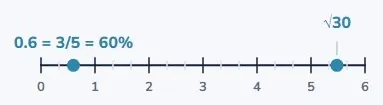
- A fraction, a decimal and a percentage can be one point.
- Three fifths, nought point six, sixty percent.
- And a root is a point on that same line, like anything else.
| Written | Reading | Note |
|---|---|---|
| 3/5 | three parts of five | |
| 0.6 | divide 3 by 5 | same point |
| 60% | sixty per hundred | same point |
Placing four numbers without a calculator
- Nought point six, three fifths and sixty percent: one point.
- √30 is just under five and a half, from the squares either side.
- No calculator was involved in either of those.
What to take away
- Six things, and the landmarks are the point of all of them.
| Powers of two | up to 1024, known by heart |
| Each one | is the one before, doubled |
| Negative power | is one over the positive one, any base |
| Perfect squares | are the landmarks for roots |
| Locating a root | compare the gap below with the gap above |
| A fraction answer | keeps the minus sign on top |
Your turn
- Pause here and try all four.
- Answers are in the description.
| Question | |
|---|---|
| 1 | What is 2⁸? |
| 2 | Write 4⁻² as a unit fraction. |
| 3 | Between which whole numbers is √30, and which is it nearer? |
| 4 | Rewrite 3/(−7) with a positive denominator. |
Show answer
1. 256. Doubling from 2: 2, 4, 8, 16, 32, 64, 128, 256. 2. 1/16, because 4 squared is 16. 3. Between 5 and 6, and nearer 5. 30 is 5 above 25 but 6 below 36, so the lower gap is smaller. It is about 5.5, just under. 4. −3/7. Moving the sign to the numerator does not change the value.
The answers
- Doubling from 32: 64, 128, 256.
- Four squared is 16, so it is one sixteenth.
- 30 is 5 above 25 but 6 below 36.
| Answer | |
|---|---|
| 1 | 256 |
| 2 | 1/16 |
| 3 | Between 5 and 6, nearer 5 |
| 4 | −3/7 |
Is your child on track?
Take the free placement test