Joint events, and why you cannot just add probabilities
What this lesson covers
- In joint events, events can be dependent or independent.
- Probabilities for joint events cannot simply be added, because doing so would double-count outcomes that are common to both events.
- Mutually exclusive events cannot occur together.
- The estimated probability of an event from an experiment is the number of times the event happens divided by the total number of trials in the experiment (i.e. the relative frequency for that event).
A calculation that proves something impossible
- Correct arithmetic, reasonable method, absurd answer.
- Watching it fail is the fastest way to learn the rule.
- So here it is.
Roll a die. Even, or greater than three?
- Even is 2, 4, 6. That is three out of six, so a half.
- Greater than three is 4, 5, 6. Also a half.
- Add them and you get 1. So it is certain.
| Event | Outcomes | Probability |
|---|---|---|
| P(even) | 2, 4, 6 | 3/6 |
| P(greater than 3) | 4, 5, 6 | 3/6 |
| Add them | 3/6 + 3/6 | 1 |
| So it is certain? | roll a 1 and it is neither | so no |
Except it clearly is not certain
- Roll a 1. It is not even, and it is not greater than three.
- So the event failed, and we just calculated it could not.
- The arithmetic was right. The method was wrong.
Look at what got counted twice
- Even was 2, 4, 6. Greater than three was 4, 5, 6.
- The 4 and the 6 are in both lists.
- Adding counts each of them once, and then again.
| List | Outcomes | Note |
|---|---|---|
| In the even list | 2, 4, 6 | |
| In the over-3 list | 4, 5, 6 | |
| In both | 4 and 6 | counted twice |
| So subtract them once | 3/6 + 3/6 − 2/6 | 4/6 |
So list them and count once
- Either event happens for 2, 4, 5 and 6.
- Four outcomes out of six. Two thirds.
- And the 1 is in neither, which is exactly why 1 was impossible.
| Step | Detail | Value |
|---|---|---|
| Either event happens for | 2, 4, 5, 6 | 4 outcomes |
| Out of | 6 | |
| So | 4/6 | 2/3 |
| And the 1 | is in neither | which is why 1 was wrong |
But sometimes adding is exactly right
- Roll a 2, or roll a 5. Can both happen on one roll? No.
- No shared outcomes, so nothing gets double-counted.
- A sixth plus a sixth is two sixths, and that is correct.
| Events | Overlap | Result |
|---|---|---|
| Roll a 2, or roll a 5 | no outcome is in both | mutually exclusive |
| So | 1/6 + 1/6 | 2/6 |
| Even, or odd | nothing is both | also exclusive |
| So | 1/2 + 1/2 = 1 | and that one is correct |
One question to ask before you add
- Can both of these happen at the same time?
- If no, they are mutually exclusive and you can add.
- If yes, there is an overlap and you must take it off once.
| Answer | What to do | |
|---|---|---|
| Ask | can both happen at once? | |
| No | mutually exclusive, add freely | |
| Yes | there is an overlap, so subtract it | |
| Not sure | list the outcomes |
Now a completely different question
- Does one event change the probability of the other?
- Two coin tosses: no. The second is a half regardless.
- Drawing counters and keeping them out: yes, it does.
| Kind | Meaning | Example |
|---|---|---|
| Independent | one does not affect the other | two coin tosses |
| Dependent | one changes the other | drawing without replacing |
| Bag of 5 red, 3 blue | first draw is 5/8 red | |
| Keep the red out | second draw is 4/7 | the odds moved |
Five red and three blue in a bag
- First draw: five reds out of eight, so five eighths.
- Take a red out and keep it. Now there are four reds of seven.
- The first draw changed the second. That is dependence.
And these two words are not the same thing
- Mutually exclusive: can both happen at once?
- Independent: does one affect the other?
- Different questions. They get confused constantly.
| Term | The question it answers | Note |
|---|---|---|
| Mutually exclusive | about whether both can happen | |
| Independent | about whether one affects the other | |
| Even and odd | mutually exclusive | |
| Are they independent? | no. Even tells you it is not odd | the opposite |
In fact they are close to opposites
- Even and odd are mutually exclusive. Obviously.
- Are they independent? Knowing it is even tells you it is not odd.
- That is as dependent as two events can possibly be.
Back to experiments, with every outcome at once
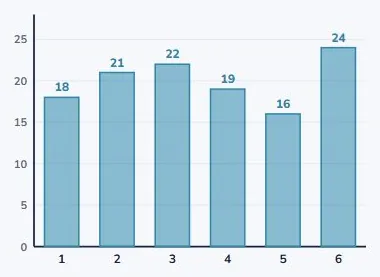
- Roll a die 120 times and count all six outcomes.
- Twenty-four sixes gives 24 over 120, which is 0.2.
- Eighteen ones gives 0.15. Theory says about 0.167 for each.
| Outcome | Working | Relative frequency |
|---|---|---|
| Roll a die 120 times | count each outcome | |
| 24 sixes | 24/120 | 0.2 |
| 18 ones | 18/120 | 0.15 |
| Theoretical for each | 1/6 | about 0.167 |
Chart it, and you can see the whole distribution
- Six bars. With 120 rolls you expect about 20 of each.
- The real ones came out between 18 and 24.
- Roughly level, with wobble. That is what fair looks like.
Knowing that shape is the useful part
- Perfectly level bars would actually be suspicious.
- Real randomness is lumpy. Some wobble is expected.
- One bar far above the rest is what deserves a second look.
| What you see | What it means | |
|---|---|---|
| Six bars, one per face | expected height about 20 | |
| Actual heights vary | 18 to 24 | that is normal |
| Roughly level | is what a fair die looks like | |
| One bar far above | would be worth investigating |
What to take away
- Six things, and the first one is where the marks are.
| Adding probabilities | double-counts anything in both events |
| Before adding | ask whether both can happen at once |
| Mutually exclusive | means they cannot, so adding is safe |
| Independent | is a different question: does one affect the other? |
| Exclusive events | are strongly dependent, not independent |
| Relative frequency | is the count divided by the number of trials |
Your turn
- Pause here and try all four.
- Answers are in the description.
| Question | |
|---|---|
| 1 | One die. Find P(even or a 5). |
| 2 | One die. Find P(even or greater than 3). |
| 3 | Are two coin tosses independent? Why? |
| 4 | 15 heads in 60 tosses. What is the relative frequency? |
Show answer
1. 2/3. Even is 2, 4, 6 and the 5 is not among them, so there is no overlap and you can add: 3/6 plus 1/6 is 4/6. 2. Also 2/3, but for a different reason. Here 4 and 6 are in both lists, so adding gives 1, which is wrong. List them instead: 2, 4, 5, 6 out of 6. 3. Yes. The coin has no memory, so the first toss changes nothing about the second. 4. 0.25, from 15 divided by 60. That is below the theoretical 0.5, and 60 tosses is few enough that this would be worth repeating.
The answers
- Question 1 has no overlap, so you can add.
- Question 2 does, so list them instead.
- Two coin tosses do not affect each other.
| Answer | |
|---|---|
| 1 | 2/3 |
| 2 | 2/3 |
| 3 | Yes |
| 4 | 0.25 |
Is your child on track?
Take the free placement test