The periodic table: groups, periods, metals and non-metals
What this lesson covers
- What elements and atoms are, and how chemical symbols work
- How Mendeleev arranged the elements and used the gaps to predict new ones
- How many elements exist and how many are found in nature
- Groups, periods and atomic number
- Where metals and non-metals sit, and how their properties differ
- The four named families: alkali metals, alkaline earth metals, halogens and noble gases
Elements and atoms
- An element is a pure substance in which every atom is the same kind, such as gold, oxygen or carbon.
- An atom is the smallest piece of an element that still behaves chemically like that element.
- Cut a gold bar in half again and again and you eventually reach a single gold atom; split that atom and what is left is no longer gold.
- Each element has a name and a symbol of one or two letters. The first letter is always a capital and the second is always lower case, so Co is cobalt but CO is carbon monoxide, a compound.
| Element | Symbol | Why that symbol |
|---|---|---|
| Argon | Ar | First two letters of the name |
| Carbon | C | First letter |
| Chlorine | Cl | C is taken, so a second letter is added |
| Sodium | Na | From the Latin natrium |
| Iron | Fe | From the Latin ferrum |
| Gold | Au | From the Latin aurum |
Mendeleev left gaps on purpose
- By the 1860s chemists knew about 60 elements and were looking for a pattern among them.
- In 1869 the Russian chemist Dmitri Mendeleev lined them up in order of atomic mass and put elements with similar behaviour into the same column.
- Where no known element fitted, he left an empty space instead of forcing the pattern.
- He claimed those spaces belonged to elements nobody had found yet, and he described what they would be like.
- When gallium (1875) and germanium (1886) were discovered, their properties closely matched his descriptions, which convinced other scientists the table was right.
- Other chemists, such as Lothar Meyer in Germany, built similar tables at the same time, and the modern table was refined by many people after them.
Checking Mendeleev's gallium prediction
- Mendeleev called the missing element below aluminium "eka-aluminium" and predicted its properties from its neighbours.
- Compare what he wrote in 1871 with what was measured once gallium was found.
| Property | Predicted for eka-aluminium | Measured for gallium |
|---|---|---|
| Atomic mass | about 68 | 69.7 |
| Density | about 5.9 g/cm³ | 5.9 g/cm³ |
| Melting point | low | 30 °C, melts in your hand |
| Oxide formula | Ea₂O₃ | Ga₂O₃ |
- Aluminium is above the gap, indium is below itneighbours in the same column behave alike
- Predicted mass sits between its neighboursmasses rise steadily down a column
- Predicted 68, measured 69.7within about 3 percent
- The prediction matched, so the table's pattern is reala model earns trust when it predicts something new
118 elements, 94 from nature
- Today 118 elements are known, and every one has its own square on the table.
- Up to plutonium, number 94, they all occur in nature, though some only in tiny traces inside uranium ores.
- The elements after that have only ever been made in laboratories, often a few atoms at a time, and most fall apart within seconds.
- Nobody can find a new element between the existing ones, because every whole-number slot up to 118 is now filled.
Atomic number, groups and periods
- The modern table is ordered by atomic number, which is the number of protons in each atom, starting with hydrogen at 1.
- Ordering by atomic number fixed a few spots where Mendeleev's mass order had been awkward, such as tellurium and iodine.
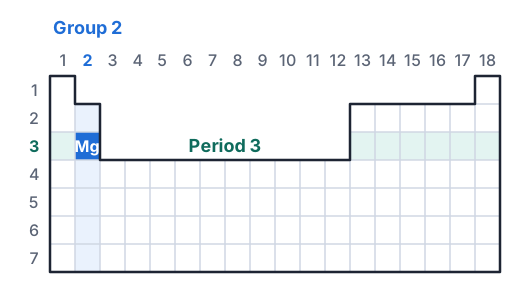
- A column is called a group, numbered 1 to 18 from left to right.
- A row is called a period, numbered 1 to 7 from top to bottom.
- So an element's position is like a map reference: magnesium is period 3, group 2.
| Term | Direction | What it tells you |
|---|---|---|
| Atomic number | rises by 1 each step left to right | how many protons the atom has |
| Group | column, top to bottom | elements with similar chemical behaviour |
| Period | row, left to right | properties change gradually from metal to non-metal |
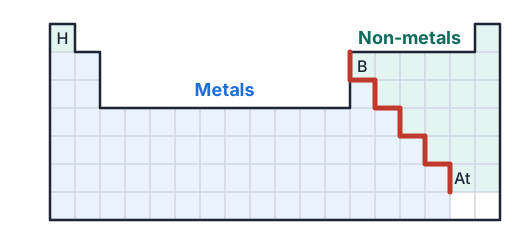
Metals on the left, non-metals on the right
- A staircase line runs from boron down to astatine. About three quarters of the elements, everything to the left and in the middle, are metals.
- Non-metals sit to the right of the staircase, plus hydrogen, which is placed at the top left but is a non-metal gas.
- Metals let heat and electric current pass through them easily, which is why pots and wires are made of them.
- Most non-metals are poor conductors, so they are used where heat or current must be blocked.
- There are exceptions: graphite, a form of carbon, conducts electricity, and mercury is a metal that is liquid at room temperature.
| Property | Metals | Non-metals |
|---|---|---|
| Conducts heat | Yes, well | Poorly (usually) |
| Conducts electricity | Yes, well | Poorly (graphite is an exception) |
| Look | Shiny when freshly cut | Dull, or a gas |
| Solid shape | Can be bent and hammered flat | Brittle if solid |
| State at room temperature | Solid, except mercury | Many are gases; bromine is liquid |
| NZ example | Iron from Taranaki and Waikato ironsand | Sulfur at Rotorua's geothermal vents |
Four families worth knowing
- Elements in one group react in similar ways, so a whole group can be learned as a family.
- Group 1 metals react with water to make alkaline solutions, and they get more violent going down the group.
- Group 17 non-metals react strongly with metals to form salts; going down the group they get darker and less reactive.
- Group 18 gases almost never react at all, which makes them useful wherever a reaction would be a problem.
| Group | Family name | Members | Typical behaviour | Everyday use |
|---|---|---|---|---|
| 1 | Alkali metals | Li, Na, K, Rb, Cs | Soft, very reactive, fizz in water | Lithium in phone batteries |
| 2 | Alkaline earth metals | Be, Mg, Ca, Sr, Ba | Reactive, but less than group 1 | Calcium in bones and limestone |
| 17 | Halogens | F, Cl, Br, I | Reactive non-metals, coloured | Chlorine to treat drinking water |
| 18 | Noble gases | He, Ne, Ar, Kr, Xe | Colourless, almost unreactive | Argon shielding gas for welding |
Predicting rubidium's melting point
- Melting points in group 1 fall steadily going down the group.
- Use the data for the elements around rubidium to predict its value, then compare with the measured one.
| Element | Period | Melting point (°C) |
|---|---|---|
| Lithium | 2 | 181 |
| Sodium | 3 | 98 |
| Potassium | 4 | 63 |
| Rubidium | 5 | ? |
| Caesium | 6 | 28 |
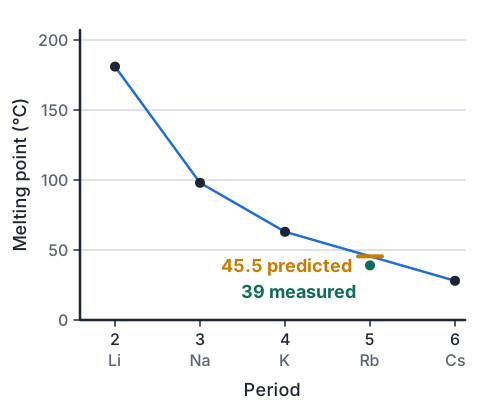
- Rubidium sits between potassium (63 °C) and caesium (28 °C)it is the next element down
- (63 + 28) ÷ 2 = 45.5halfway between the two neighbours
- Prediction: about 45 °C, a solid that melts on a warm daythe trend is falling, so it must be under 63
- Measured value: 39 °Cclose to the prediction and fits the trend
Testing a prediction yourself
- Choose an element you have not studied, for example bromine in group 17.
- From its position, predict whether it is a metal, whether it conducts, its state at room temperature, and how reactive it is compared with chlorine.
- Look up the real values in a data book or a reliable online table and record predicted and actual side by side.
- Bromine turns out to be a non-metal that does not conduct, a red-brown liquid, and less reactive than chlorine, as the group trend suggests.
- Where your prediction was wrong, ask whether you used the trend badly or whether the element is a genuine exception.
Models of atoms: what each one is good for
- Atoms are far too small to see, so scientists explain them with models, and every model leaves something out.
- A model is useful when it explains the evidence and predicts something, even if it is not a perfect picture.
- Comparing models helps you choose the right one for the job and spot where each one could mislead you.
| Model | Strength | Limitation |
|---|---|---|
| Digital simulation (for example PhET Build an Atom) | Lets you add particles and see the element and charge change instantly | Particles look like coloured balls and sizes are not to scale |
| Human-scale model (students act as particles) | Shows movement and numbers in a memorable way | The nucleus would really be tiny compared with where electrons are |
| Drawn shell diagram | Quick, and shows how electrons are arranged | Electrons do not really travel in neat circles |
| Periodic table itself | Predicts properties from position | Shows patterns, not what atoms look like |
Common mistakes
- Groups are the rows and periods are the columns.Groups are the columns (1 to 18) and periods are the rows (1 to 7); elements in one group behave alike, which is why the columns matter most.
- The modern periodic table is in order of atomic mass.It is in order of atomic number, the number of protons, which is why tellurium comes before iodine even though it is heavier.
- Hydrogen sits at the top of group 1, so it is a metal.Hydrogen is a non-metal gas; it is placed at the top left, but it does not conduct or behave like the alkali metals.
- CO is the symbol for cobalt.Cobalt is Co, with a lower case second letter; CO has two capitals, so it is two elements, carbon and oxygen, joined as a compound.
Metal or non-metal? Test three elements
You need: a strip of aluminium foil, a steel teaspoon, a lead from a mechanical pencil (mostly graphite, a form of carbon), a wooden pencil or chopstick, a mug of hot tap water, a paper towel
- Fold the foil strip back and forth a few times, and gently bend the end of the teaspoon handle; note whether each one bends or breaks.
- Wrap the pencil lead in the paper towel and press it with your thumb until it snaps; note whether it bent first.
- Stand the teaspoon, a tightly rolled foil strip and the wooden pencil upright in the mug of hot tap water so their tops stick out.
- After one minute, touch the top of each one and rank them from warmest to coolest.
- Look for: the aluminium and the steel spoon (mostly iron) bend without breaking and carry heat up to your fingers, while the carbon lead snaps and the wood, made of the non-metals carbon, hydrogen and oxygen, stays cool at the top.
Safety: Hot tap water can scald, so test it with a fingertip before filling the mug, and snap the pencil lead inside the paper towel because the broken ends are sharp.
Your turn
- 1. Element 17 is in period 3. Name it, give its group, and say whether it is a metal or non-metal.
- 2. Calcium is in group 2. Would a calcium wire conduct electricity? Give a reason.
- 3. Why is argon, not air, pumped around the metal while welding?
- 4. Melting points in group 17 rise down the group: chlorine −101 °C, bromine −7 °C, iodine 114 °C. Predict the state of astatine, the next halogen, at room temperature.
- 5. A grey element is shiny, conducts, and fizzes violently in water. Which group is it most likely in?
Show answer
1. Chlorine, group 17 (a halogen), a non-metal, because it is right of the staircase. 2. Yes. Group 2 is on the left of the table, so calcium is a metal, and metals conduct. 3. Argon is a noble gas in group 18, so it does not react with the hot metal, while oxygen in air would. 4. A solid. The melting points keep rising down the group and iodine is already solid, so astatine's melting point will be higher still. 5. Group 1, the alkali metals: reactive metals that react strongly with water.
Recap
- An element contains one kind of atom and has a name and a one or two letter symbol.
- Mendeleev grouped similar elements and left gaps, then his predictions for gallium and germanium came true.
- There are 118 known elements; 94 occur naturally and the rest are made in laboratories.
- The table is ordered by atomic number, with groups as columns and periods as rows.
- Metals are on the left and centre and conduct heat and electricity; non-metals are on the right and mostly do not.
- Groups 1, 2, 17 and 18 are families: alkali metals, alkaline earth metals, halogens and noble gases.
How is Year 9 maths going?
See the Year 9 maths guide