Atomic theory: Rutherford, Bohr and the parts of an atom
What this lesson covers
- How the model of the atom changed as new evidence arrived
- What Rutherford's gold foil experiment showed about the nucleus
- The Bohr model: a nucleus of protons and neutrons with electrons in shells
- The charge on protons, neutrons and electrons
- Atomic number, and why it decides which element an atom is
- Why a neutral atom has equal numbers of protons and electrons
A model that keeps getting better
- Nobody has ever looked inside an atom the way you look inside a box, so our picture of it is a model built from evidence.
- Each time an experiment produced a result the old model could not explain, scientists argued about it, tested it again, and changed the model.
- A new model is accepted only when most scientists agree it fits all the evidence better than the old one.
- This is still happening: today's model is more detailed than the one in this lesson, but the simple version explains most of Year 9 chemistry.
From solid balls to shells
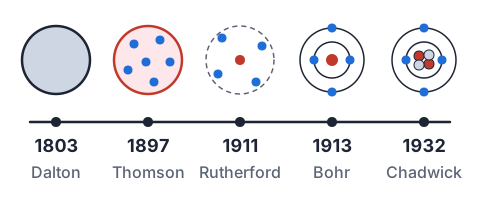
- The idea of atoms is ancient, but John Dalton made it scientific around 1803 by explaining how elements combine in fixed ratios.
- J. J. Thomson found the electron in 1897, which proved atoms have smaller parts inside them.
- Each later scientist kept what still worked from the earlier model and replaced what the new evidence ruled out.
| Year | Scientist | Evidence | Model |
|---|---|---|---|
| 1803 | John Dalton | Elements combine in fixed mass ratios | Tiny solid balls that cannot be split |
| 1897 | J. J. Thomson | Cathode rays are made of tiny negative particles | Plum pudding: electrons dotted through a spread of positive charge |
| 1911 | Ernest Rutherford | A few alpha particles bounce back off gold foil | Tiny dense positive nucleus with electrons around it |
| 1913 | Niels Bohr | Elements give off light only at certain colours | Electrons in fixed energy levels (shells) |
| 1932 | James Chadwick | Radiation that carried no charge but had mass | Nucleus holds neutrons as well as protons |
Rutherford's gold foil experiment
- Ernest Rutherford grew up near Nelson and studied at Canterbury College in Christchurch before moving to England; he is on the New Zealand $100 note.
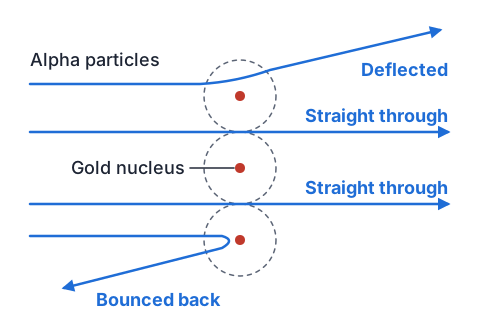
- His team, Hans Geiger and Ernest Marsden, fired fast, positively charged alpha particles at gold foil only about a thousand atoms thick.
- If Thomson's plum pudding model were right, every particle should have passed straight through with only tiny wobbles.
- Most did go straight through, but a few were bent sharply and about 1 in 8000 bounced almost straight back.
- Rutherford concluded that nearly all of an atom's mass and all of its positive charge sit in a tiny core, the nucleus, with mostly empty space around it.
| Observation | What it means |
|---|---|
| Most alpha particles pass straight through | An atom is mostly empty space |
| Some are deflected at an angle | There is something positive in the atom that repels them |
| A very few bounce back | That positive part is very small, very dense and holds most of the mass |
How small the nucleus is
- The nucleus is roughly 100 000 times narrower than the whole atom.
- If an atom were blown up to the size of Eden Park, the nucleus would be about the size of a sesame seed on the centre of the pitch.
- Yet that seed would carry more than 99.9 percent of the atom's mass.
The Bohr model and the three particles
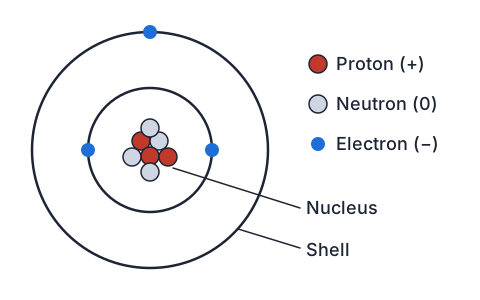
- In the Bohr model the nucleus sits in the centre and contains protons and neutrons.
- Electrons move around the nucleus in shells, which are fixed energy levels at set distances from the centre.
- Electrons fill the shell closest to the nucleus first, then the next one out. Part 2 covers how many fit in each shell.
- Opposite charges attract, so the negative electrons are held to the positive nucleus.
| Particle | Charge | Where it is |
|---|---|---|
| Proton | Positive (+1) | In the nucleus |
| Neutron | None (0) | In the nucleus |
| Electron | Negative (−1) | In shells around the nucleus |
Atomic number decides the element
- The atomic number is how many protons are in the nucleus.
- Every atom with 6 protons is carbon and every atom with 8 protons is oxygen; change the proton count and you have a different element.
- The periodic table is laid out in order of atomic number, so each step to the right adds one proton.
- On most tables the atomic number is the whole number printed above or beside the symbol.
Why a neutral atom has no overall charge
- A proton and an electron carry charges of the same size but opposite sign.
- If an atom has the same number of electrons as protons, the charges cancel and the atom is neutral.
- So for any neutral atom, the number of electrons equals the atomic number.
- If an atom gains or loses electrons it becomes charged, and is then called an ion.
Counting particles in a neutral oxygen atom
- Oxygen has atomic number 8. Work out its protons and electrons.
- Atomic number = 8read from the periodic table
- Protons = 8atomic number counts the protons
- Electrons = protons = 8the atom is neutral, so the charges must balance
- Oxygen: 8 protons and 8 electrons
Identifying a particle from its counts
- A particle has 11 protons and 10 electrons. Which element is it, and what is its overall charge?
- 11 protons, so atomic number 11protons fix the element
- Element 11 is sodium, Nafind 11 on the periodic table
- Charge = (+11) + (−10) = +1add the proton and electron charges
- A sodium ion with a charge of +1it has lost one electron
Finding the pattern across a period
- Take period 2, from lithium to neon, and fill a table with each element's atomic number, protons and electrons.
- The pattern is that each element has exactly one more proton and one more electron than the one to its left.
- Now compare elements in the same column, such as lithium (3) and sodium (11): sodium has eight more of each, one full period later.
- That jump of eight is a clue that electrons are arranged in layers, which Part 2 explains.
| Element | Symbol | Atomic number | Protons | Electrons (neutral) |
|---|---|---|---|---|
| Lithium | Li | 3 | 3 | 3 |
| Beryllium | Be | 4 | 4 | 4 |
| Boron | B | 5 | 5 | 5 |
| Carbon | C | 6 | 6 | 6 |
| Nitrogen | N | 7 | 7 | 7 |
| Oxygen | O | 8 | 8 | 8 |
| Fluorine | F | 9 | 9 | 9 |
| Neon | Ne | 10 | 10 | 10 |
Common mistakes
- Some alpha particles bounced back, so the gold foil experiment showed atoms are solid.Most particles went straight through, so atoms are mostly empty space; the rare bounce-backs showed a tiny, dense, positive nucleus.
- Electrons sit in the nucleus with the protons.Only protons and neutrons are in the nucleus; electrons are in shells around it, held by the attraction of opposite charges.
- Neutrons are the negative particles.Neutrons have no charge; electrons are negative and protons are positive.
- Atomic number means protons plus neutrons added together.The atomic number counts only the protons; protons plus neutrons is the mass number, which Part 2 covers.
Find a hidden nucleus with marbles
You need: a large flattened cardboard box, 4 mugs, a full food can, a dice, 10 marbles, a pen and paper
- On a smooth floor, ask someone to put the can somewhere in the middle while you look away, then rest the cardboard on the four mugs over it so you cannot see underneath.
- Kneel about a metre away and roll marbles one at a time straight under the cardboard, aiming at a different spot along the edge each time, until you have made 20 rolls.
- For each roll, tally whether the marble came out the far side, came out at an angle, or rolled back towards you.
- Ask your helper to swap the can for the dice and hide it somewhere new, then make another 20 rolls and tally them the same way.
- Look for the pattern: most marbles pass straight through and only a few bounce back, and with the smaller dice even fewer do, just as Rutherford's rare bounce-backs showed the nucleus is tiny.
Safety: Marbles are a choking risk for small children and a slipping risk underfoot, so keep little ones away and count every marble back in when you finish.
Your turn
- 1. How many protons and electrons are in a neutral atom of magnesium, atomic number 12?
- 2. An atom has 7 protons. Name the element.
- 3. In the gold foil experiment, why did most alpha particles pass straight through the foil?
- 4. Which particle did Thomson's plum pudding model include, and which part did Rutherford add?
- 5. A particle has 17 protons and 18 electrons. What is its overall charge?
Show answer
1. 12 protons and 12 electrons, because the atomic number gives the protons and a neutral atom has equal numbers. 2. Nitrogen, element 7. 3. Atoms are mostly empty space, so most particles never came near a nucleus. 4. Thomson's model included the electron; Rutherford added a small, dense, positive nucleus. 5. −1, because 17 positive charges and 18 negative charges leave one extra negative (it is a chloride ion).
Rutherford Scattering
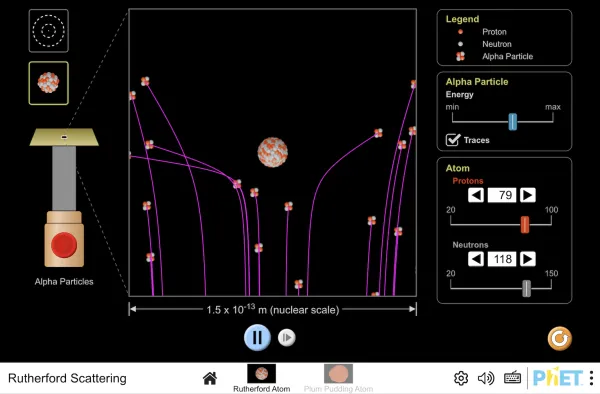
Full screen · PhET Interactive Simulations, University of Colorado Boulder, CC BY 4.0
Recap
- The model of the atom changed from Dalton's solid balls to Thomson's plum pudding, Rutherford's nucleus and Bohr's shells as evidence built up.
- Rutherford's gold foil results showed that almost all of an atom's mass is in a tiny positive nucleus.
- In the Bohr model, protons and neutrons are in the nucleus and electrons sit in shells around it.
- Protons are positive, electrons are negative and neutrons have no charge.
- The atomic number counts the protons, and that count decides which element the atom is.
- A neutral atom has as many electrons as protons.
How is Year 9 maths going?
See the Year 9 maths guide