Asteroids, comets, meteors and scale models of the Solar System
What this lesson covers
- What belongs to the Solar System: everything held in orbit by the Sun's gravity
- The astronomical unit, and when to use km, AU or light-years
- Asteroids and the asteroid belt
- Comets, and why they grow a glowing head and tail near the Sun
- Meteors and meteorites, and what meteorites tell us about how the Solar System formed
- Rocky planets, gas giants and ice giants, grouped by what they are made of inside
- How to scale sizes, distances and orbit times for a model
Who belongs to the Solar System
- Part 1 sorted stars, planets and moons. This part fills in the smaller members and measures the whole system.
- The Sun holds more than 99.8 percent of the Solar System's mass, so its gravity controls the motion of everything around it.
- Anything kept in orbit by that pull is a member: the eight planets and their moons, dwarf planets, asteroids, comets and countless specks of dust.
- Gravity is what holds the system together; without it, every object would carry on in a straight line out into space.
The astronomical unit
- Distances in the Solar System are so large that kilometres give awkward numbers, such as 4,500,000,000 km to Neptune.
- Astronomers use the astronomical unit (AU) instead: the average distance between Earth and the Sun, about 150 million km.
- Earth is 1 AU from the Sun by definition, Jupiter is about 5.2 AU and Neptune about 30 AU.
- Pick the unit that keeps numbers sensible: km for the size of a planet, AU for distances inside the Solar System, and light-years for distances to other stars.
- One light-year is about 63,000 AU, so the nearest star is roughly 270,000 AU away.
| Planet | Average distance from Sun (AU) | Diameter (km) | Time for one orbit |
|---|---|---|---|
| Mercury | 0.39 | 4,880 | 88 days |
| Venus | 0.72 | 12,100 | 225 days |
| Earth | 1.00 | 12,760 | 365 days |
| Mars | 1.52 | 6,790 | 687 days (1.9 years) |
| Jupiter | 5.2 | 143,000 | 11.9 years |
| Saturn | 9.5 | 120,500 | 29.5 years |
| Uranus | 19.2 | 51,100 | 84 years |
| Neptune | 30.1 | 49,500 | 165 years |
Converting AU to kilometres
- Jupiter is 5.2 AU from the Sun. How far is that in kilometres, and how long does sunlight take to get there?
- Use 1 AU = 150 million km, and the result from part 1 that sunlight takes 8.3 minutes to cover 1 AU.
- 5.2 × 150,000,000 kmeach AU is 150 million km
- = 780,000,000 km780 million km
- 5.2 × 8.3 min = 43 minlight takes 8.3 min per AU
- Jupiter is about 780 million km away, and sunlight takes about 43 minutes to reach it
Asteroids: leftover rock
- Asteroids are rocky or metallic bodies, mostly far too small for gravity to pull them into a ball, so many are lumpy.
- Most of them orbit in the asteroid belt, a wide ring between Mars and Jupiter, roughly 2.2 to 3.3 AU from the Sun.
- They range from pebbles to Vesta at about 525 km across, and the biggest object in the belt, Ceres, is round enough to count as a dwarf planet.
- The belt is mostly empty space: spacecraft fly straight through it without needing to dodge anything, unlike the crowded belts in films.
- Jupiter's strong gravity kept stirring this material up, which is why it never gathered together into a planet.
Comets: dirty snowballs
- A comet has a solid core called a nucleus, usually a few kilometres across, made of ice mixed with dust and rock.
- Most comets spend their time far beyond Neptune, on long, stretched orbits that bring them close to the Sun only now and then.
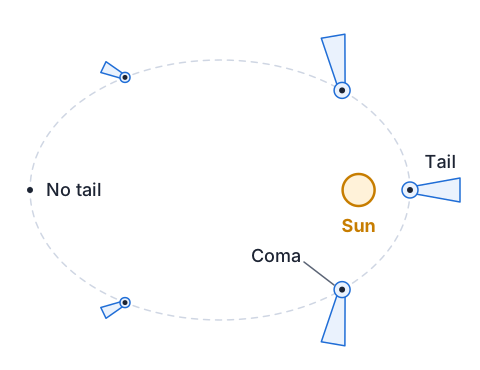
- As a comet nears the Sun, its ice turns straight to gas and releases dust, forming a huge glowing cloud around the nucleus called the coma.
- The Sun's light and the solar wind push this gas and dust out into a tail that always points away from the Sun, and it can stretch for millions of kilometres.
- Halley's Comet returns about every 76 years; it was last seen in 1986 and is due back in 2061.
Meteors and meteorites
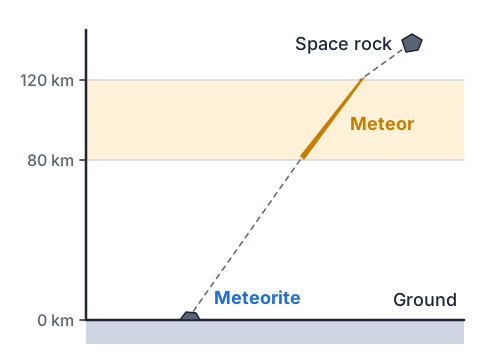
- A meteor, or shooting star, is the bright streak made when a piece of space rock or dust rushes into Earth's atmosphere and is heated until it glows.
- Most are no bigger than a grain of sand and burn up completely about 80 to 120 km above the ground.
- Meteor showers happen when Earth passes through a trail of dust left by a comet, such as the Eta Aquariids each May, which come from Halley's Comet.
- If a piece survives the fall and lands, the rock on the ground is called a meteorite. In 2004 one crashed through the roof of a house in Ellerslie, Auckland.
- Many meteorites are about 4.56 billion years old and have barely changed since the Solar System formed, so they are a record of the material planets were built from.
| Name | Where it is | Made of |
|---|---|---|
| Asteroid | in orbit, mainly between Mars and Jupiter | rock and metal |
| Comet | in orbit, mostly far beyond Neptune | ice, dust and rock |
| Meteor | a glowing streak in Earth's atmosphere | a small piece of rock or dust heating up |
| Meteorite | lying on Earth's surface | the part that survived the fall |
Three kinds of planet, sorted by their insides
- The eight planets fall into three groups depending on what they are made of inside.
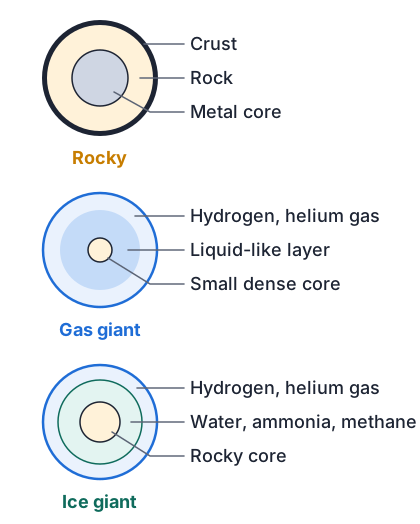
- The rocky planets have a metal core, a thick rocky layer and a thin solid crust you could stand on.
- The gas giants are made mostly of hydrogen and helium; going down, the gas gets denser until it behaves like a liquid, with no solid surface anywhere.
- The ice giants have a thick inner layer of water, ammonia and methane, which planetary scientists call ices even though they are hot and fluid, wrapped in hydrogen and helium.
- The pattern links to distance: near the hot young Sun only rock and metal could stay solid, while further out ice could also collect, which helped planets grow much bigger.
| Group | Planets | Inside | Solid surface? |
|---|---|---|---|
| Rocky (terrestrial) | Mercury, Venus, Earth, Mars | metal core, rock, thin crust | Yes |
| Gas giants | Jupiter, Saturn | mostly hydrogen and helium, small dense core | No |
| Ice giants | Uranus, Neptune | water, ammonia and methane around a rocky core | No |
A scale model on the school field
- Shrink the Sun, 1,392,000 km across, to a 30 cm beach ball, and keep every size and distance on that same scale.
- Work out how big Earth should be and how far away it goes, then place Neptune.
- 1,392,000 km ÷ 30 cm = 46,400 km per cmthe scale: each cm in the model stands for 46,400 km
- Earth: 12,760 km ÷ 46,400 = 0.28 cmdivide the real size by the scale
- Earth is about 3 mm acrossa peppercorn
- Distance: 150,000,000 km ÷ 46,400 = 3,230 cmsame scale for distance
- Earth sits about 32 m from the ball
- Neptune: 30 × 32 m ≈ 970 mNeptune is 30 AU and 1 AU is 32 m on this scale
- Neptune is a 1 cm marble almost 1 km away
Scaling time as well
- A model can also show timing: make one Earth orbit last one minute, and every other planet takes its orbit time in years as minutes.
- In that model Mercury goes round in about 15 seconds, while Neptune takes 165 minutes, nearly three hours.
- Outer planets are slower for two reasons: their path around the Sun is much longer, and the Sun's weaker pull out there means they also move more slowly.
- Try putting sizes and distances on one sheet of A4 paper and you will find you cannot: if Neptune is at the far edge, Earth is a dot far too small to draw. That is why most diagrams are not to scale.
Common mistakes
- A meteor and a meteorite are the same thing.A meteor is the glowing streak in the air, and a meteorite is the piece of rock that survives and lands on the ground.
- A comet's tail trails behind it, showing where it has come from.The tail always points away from the Sun, pushed by sunlight and the solar wind, so a comet heading away from the Sun travels tail first.
- Jupiter is 5.2 AU away, so it is 5.2 × 150 = 780 km from the Sun.1 AU is 150 million km, so the answer is 780 million km; dropping the million makes the distance a million times too small.
- The asteroid belt is so packed with rocks that spacecraft have to steer around them.The belt is mostly empty space, with asteroids typically hundreds of thousands of kilometres apart, so probes fly straight through.
A toilet paper Solar System
You need: a roll of toilet paper, a pencil, a ruler, a long hallway or a path outside
- Unroll 31 sheets in a straight line along the floor without tearing them, and draw a dot at the start of the first sheet for the Sun.
- Using a scale of one sheet for 1 AU, measure out and mark each planet: Mercury 0.4 sheets, Venus 0.7, Earth 1, Mars 1.5, Jupiter 5.2, Saturn 9.5, Uranus 19.2 and Neptune 30.
- Shade the asteroid belt from 2.2 to 3.3 sheets.
- Measure one sheet in millimetres and work out how many kilometres each millimetre stands for, using 1 AU = 150 million km.
- Look for: the four rocky planets all crowd into the first sheet and a half, while the giants are spread out over about 3 m; on this scale the Sun would be a dot about 1 mm wide and Earth far too small to draw.
Safety: Toilet paper on a smooth floor is easy to slip on, so lay the strip where nobody needs to walk and roll it back up afterwards so it can still be used.
Your turn
- 1. Saturn is 9.5 AU from the Sun. How far is that in kilometres?
- 2. Which unit would you use for each: the width of Mars, the distance from the Sun to Uranus, the distance to the Southern Cross stars? Give a reason for one of them.
- 3. A rock lands in a paddock in Canterbury after streaking across the sky. Name the streak and name the rock.
- 4. In the beach-ball model, where 1 AU is 32 m, how far from the ball does Mars (1.52 AU) go?
- 5. A comet's tail points to the left of the comet in a photo. Which way is the Sun, and why?
Show answer
1. 9.5 × 150 million km = 1,425 million km, about 1.4 billion km. 2. Kilometres for the width of Mars, AU for the Sun to Uranus, light-years for the Southern Cross. Each keeps the numbers small: 19.2 AU is easier to use than 2.9 billion km. 3. The streak is a meteor; the rock on the ground is a meteorite. 4. 1.52 × 32 m = about 49 m. 5. To the right. The tail is pushed away from the Sun by sunlight and the solar wind, so it always points away from it.
Kepler's Laws
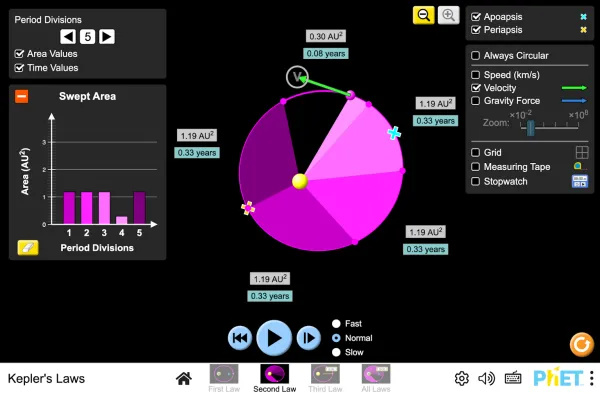
Full screen · PhET Interactive Simulations, University of Colorado Boulder, CC BY 4.0
What to take away
- The Solar System is the Sun plus everything its gravity holds in orbit: planets, moons, dwarf planets, asteroids and comets.
- 1 AU is the average Earth to Sun distance, about 150 million km; use km for sizes, AU inside the Solar System and light-years between stars.
- Asteroids are rocky and mostly sit between Mars and Jupiter; comets are icy and grow a coma and a tail pointing away from the Sun.
- A meteor is the glowing streak in the air, and a meteorite is the rock that reaches the ground, often unchanged for 4.56 billion years.
- The planets are rocky, gas giants or ice giants depending on what they are made of inside.
- Scale models show how tiny the planets are compared with the gaps between them, and why diagrams cannot show both to scale.
How is Year 9 maths going?
See the Year 9 maths guide