Stars, planets and moons: our place in the universe
What this lesson covers
- Where the Solar System sits: inside the Milky Way, one galaxy among billions
- What makes something a star, a planet or a moon
- Why the Sun counts as a star and Earth as a planet
- Why we see the Moon, and why it is often up in daylight
- How to sort objects into groups using patterns in size, orbit and motion
- How new tools, from the naked eye to the telescope, changed what we knew
Your address in space
- Earth goes around the Sun, and the Sun with everything that orbits it makes up the Solar System.
- The Solar System is a tiny part of the Milky Way, a galaxy holding somewhere between 100 and 400 billion stars.
- On a clear, dark night away from city lights, the pale band across the sky is the Milky Way seen edge on, from the inside.
- The Milky Way is only one galaxy, and astronomers estimate the universe we can observe holds hundreds of billions of them, possibly trillions.
| Level | What it is | Rough size |
|---|---|---|
| Earth | a planet | about 12,700 km across |
| Solar System | the Sun and everything orbiting it | Neptune's orbit is about 9 billion km across |
| Milky Way | our galaxy, a spiral of stars, gas and dust | about 100,000 light-years across |
| Universe | all the galaxies and the space between them | billions of light-years in every direction we can see |
A star makes its own light
- A star is a huge ball of hot gas, mostly hydrogen and helium, so massive that its own gravity squeezes its core hard enough for nuclear fusion.
- Fusion in the core releases enormous amounts of energy, and the star gives that energy out as light and heat.
- The Sun is a star. It looks far bigger and brighter than the others only because it is so much closer to us.
- The next nearest star, Proxima Centauri, is about 4.2 light-years away, so its light set off more than four years before you saw it.
- Matariki is a cluster of stars, and the Southern Cross is a pattern of stars, which is why both rise and set together night after night without changing shape.
A planet reflects light from its star
- A planet is a large, round body that travels in an orbit around a star.
- Planets make no visible light of their own; we see them because sunlight bounces off them towards us.
- Earth takes one year to go once around the Sun, and seven other planets travel around it as well.
- In the sky, planets look like bright points that shine steadily, while stars tend to twinkle more because their light comes from a single tiny point.
- Over several weeks a planet drifts slowly against the background of stars, which is where the word planet comes from: the Greek for wanderer.
A moon orbits a planet
- A moon is a natural satellite: a body, usually roughly round, that orbits a planet rather than orbiting the Sun directly.
- Earth has one moon, written with a capital letter as the Moon. Jupiter and Saturn each have dozens, and Mercury and Venus have none.
- The Moon is about 3,470 km across, roughly a quarter of Earth's width, and it sits about 384,000 km away.
- Artificial satellites such as weather and GPS satellites also orbit Earth, but they are built by people, so they are not moons.
| Object | Makes its own light? | What it orbits | Example |
|---|---|---|---|
| Star | Yes | the centre of its galaxy | the Sun, Proxima Centauri |
| Planet | No, it reflects starlight | a star | Earth, Jupiter |
| Moon | No, it reflects sunlight | a planet | the Moon, Titan (Saturn) |
Why we see the Moon, day and night
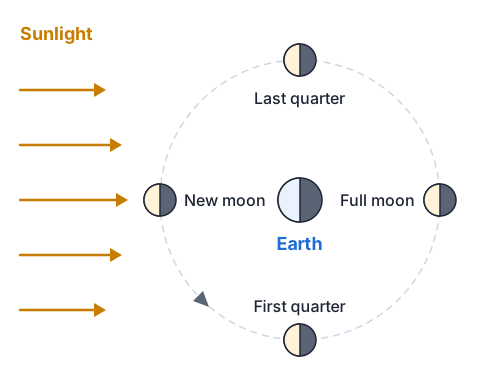
- The Moon is a ball of grey rock, and the side facing the Sun is always lit while the far side is dark.
- As the Moon orbits Earth over about 29.5 days, we see different amounts of its sunlit half, which gives the phases from new moon to full moon and back.
- The Moon is bright enough to show up against a blue sky, so it is often visible in the daytime.
- A first-quarter moon is high in the afternoon sky, and a last-quarter moon can be seen in the morning after sunrise.
- The only time it cannot be seen is near new moon, when it sits close to the Sun in the sky and its lit side faces away from us.
How old is sunlight when it reaches you?
- Light travels at about 300,000 km every second.
- The Sun is about 150 million km from Earth. How long does its light take to arrive?
- time = distance ÷ speedspeed is distance per unit of time
- time = 150,000,000 km ÷ 300,000 km/sput the values in with units
- time = 500 sthe km units cancel, leaving seconds
- 500 s ÷ 60 = 8.3 min60 seconds in a minute
- Sunlight is about 8.3 minutes old when it reaches you
And moonlight?
- Moonlight is sunlight that has bounced off the Moon, so it makes a second short trip from the Moon to Earth.
- Use the Moon's distance of 384,000 km for that second trip.
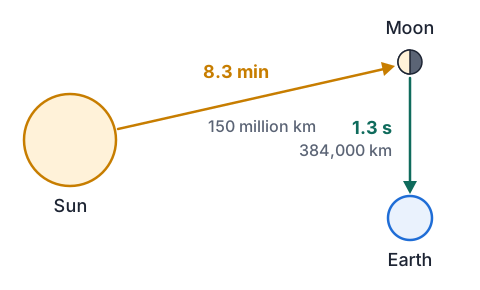
- time = 384,000 km ÷ 300,000 km/ssame rule, new distance
- time = 1.28 sdivide
- Light leaving the Moon reaches you in about 1.3 seconds
- 8.3 min + 1.3 s ≈ 8.3 min in total from the Sunthe Moon leg adds very little
Sorting objects by the pattern they fit
- Scientists group objects in the Solar System by asking the same questions each time: does it make light, what does it orbit, how big is it, and is it round?
- Objects big enough for gravity to pull them into a ball are round, while small ones stay lumpy like a potato.
- A planet is also massive enough that its gravity has swept its orbit clear of other large objects.
- Answering the questions in order puts every object into one group, and the answers explain why it belongs there.
- Asteroids and comets are covered in part 2, and dwarf planets in part 3.
| Question | If yes | If no |
|---|---|---|
| Does it give out its own light? | Star | go to the next question |
| Does it orbit a planet? | Moon | go to the next question |
| Is it big enough to be round? | go to the next question | Asteroid (rocky) or comet (icy) |
| Has it cleared its orbit of other objects? | Planet | Dwarf planet |
Sorting Ceres
- Ceres is about 940 km across, orbits the Sun between Mars and Jupiter, and shares that region with many thousands of rocky lumps.
- Run it through the questions in order.
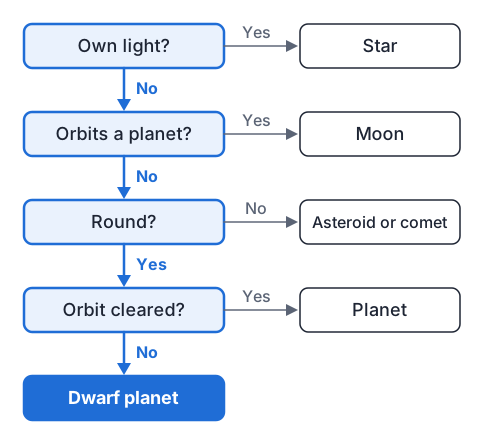
- Own light? Noit only reflects sunlight, so not a star
- Orbits a planet? Noit orbits the Sun, so not a moon
- Round? Yesat 940 km its gravity has pulled it into a ball
- Cleared its orbit? Noit shares its path with the asteroid belt
- Ceres is a dwarf planet
Better tools, more objects
- With the naked eye people could see the Sun, the Moon, thousands of stars and five planets: Mercury, Venus, Mars, Jupiter and Saturn.
- Polynesian navigators used the rising and setting points of stars to cross thousands of kilometres of open Pacific Ocean, so careful naked-eye observation was already precise science.
- In 1610 Galileo pointed a simple telescope at Jupiter and found four moons going around it, proof that not everything in the sky orbits Earth.
- Telescopes later revealed Uranus in 1781, and Neptune in 1846 after mathematicians predicted where to look from tiny wobbles in Uranus's orbit.
- Every jump in technology has added new objects and new categories, which is why the groups in the sorting table were only settled in 2006.
| Tool | What it added |
|---|---|
| Naked eye | Sun, Moon, stars, five planets, the Moon's phases |
| Telescope (1600s on) | Jupiter's moons, Saturn's rings, Uranus, Neptune |
| Larger telescopes and cameras | asteroids, distant icy worlds such as Pluto (1930) |
| Space probes | close-up photos and measurements, covered in part 3 |
Common mistakes
- The Moon glows at night because it makes its own light.The Moon is grey rock that only reflects sunlight, which is why we see just the part of it facing the Sun.
- The phases happen because Earth's shadow covers part of the Moon.Phases come from how much of the Moon's sunlit half faces us as it orbits; Earth's shadow only falls on the Moon in a lunar eclipse.
- The Sun cannot be a star because it is far bigger and brighter than the stars at night.The Sun is a star that looks bigger and brighter only because it is about 8 light-minutes away, while the next star is over 4 light-years away.
- Titan is bigger than Mercury, so Titan must be a planet.The group depends on what an object orbits, not its size, and Titan orbits Saturn, so it is a moon.
Make the Moon's phases with a torch and a ball
You need: a torch or a phone torch, a ball about the size of a tennis ball, or an orange, a pile of books, paper and a pencil
- Set the torch on a pile of books at about head height on one side of a room, pointing across the room, then switch it on and turn off the other lights.
- Stand a few metres from the torch, facing it, and hold the ball at arm's length in front of your face, a little above your head so your head does not shade it.
- Turn slowly on the spot to your left, keeping the ball in front of you, and stop after each eighth of a turn to sketch the lit part you can see.
- When your back is to the torch, raise the ball just enough that your head's shadow misses it.
- Switch the torch off for a moment and notice that the ball almost disappears.
- Look for: the half of the ball facing the torch is always lit, but you see a dark ball, then a crescent, a half, a full ball, and back again as you turn, and the ball shows nothing once the torch is off, just as the Moon only reflects sunlight.
Safety: Do not look straight into the torch beam, and clear the floor before turning off the lights, because it is easy to trip while turning in the dark.
Your turn
- 1. Venus is often the brightest point in the evening sky after sunset. Is it a star or a planet, and how do you know it does not make its own light?
- 2. Titan orbits Saturn and is bigger than the planet Mercury. Which group does Titan belong to, and why does its size not matter?
- 3. A friend says the Moon only comes out at night. Give two pieces of evidence that this is wrong.
- 4. Mars is on average about 228 million km from the Sun. How long does sunlight take to reach Mars, in minutes?
- 5. Matariki rises together and keeps the same shape every year. Explain why it cannot be a group of planets.
Show answer
1. A planet. It shines steadily, it drifts against the stars over weeks, and it only shines because sunlight reflects off its clouds. 2. A moon. The group depends on what it orbits, and Titan orbits a planet, not the Sun directly. 3. The Moon is often seen in a blue afternoon sky near first quarter and in the morning sky near last quarter, and it can be up at night or in the day depending on its phase. 4. 228,000,000 ÷ 300,000 = 760 s, and 760 ÷ 60 = about 12.7 minutes. 5. Matariki is a cluster of stars. Planets each wander across the sky at their own pace, so a group of them would not keep a fixed shape year after year.
Gravity and Orbits
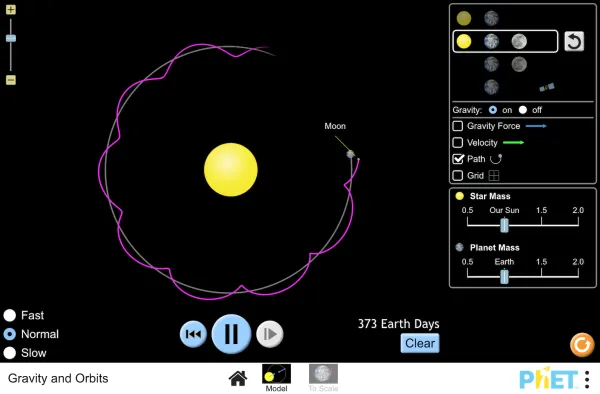
Full screen · PhET Interactive Simulations, University of Colorado Boulder, CC BY 4.0
What to take away
- Earth orbits the Sun, the Sun is one star in the Milky Way, and the Milky Way is one of a vast number of galaxies.
- A star makes its own light; a planet orbits a star and reflects its light; a moon orbits a planet.
- We see the Moon because it reflects sunlight, and it is up in daylight for part of most days.
- Objects are sorted by asking the same questions each time: own light, what it orbits, round or not, orbit cleared or not.
- Each new tool, from the naked eye to the telescope, has added objects and sharpened the groups.
How is Year 9 maths going?
See the Year 9 maths guide