Quadratics: factorise, solve, and read the graph
What this lesson covers
- The properties of operations (commutative, distributive, associative, inverse, and identity) and the order of operations apply to numbers and variables.
Factorise, solve, and read the graph
- How to factorise a quadratic, how to solve a quadratic equation, and what the answers look like on a graph.
- Have some paper ready for the two pause moments.
Expanding as a rectangle
- (x + 3)(x + 5) is a rectangle, x + 3 across and x + 5 down.
- The four pieces are x², 3x, 5x and 15.
- 3 + 5 = 8 and 3 × 5 = 15: that is where the 8 and the 15 come from.
| Step | Working | Why |
|---|---|---|
| Start | (x + 3)(x + 5) | |
| Four pieces | x² + 3x + 5x + 15 | each term times each term |
| Collect | x² + 8x + 15 | 3x + 5x = 8x |
Factorising: two numbers
- To factorise x² + 7x + 12, find two numbers that multiply to 12 and add to 7.
- Try the factor pairs of 12: 1 and 12 add to 13, 2 and 6 add to 8, 3 and 4 add to 7.
- Check by expanding.
| Pair | Multiply | Add |
|---|---|---|
| 1, 12 | 12 | 13 |
| 2, 6 | 12 | 8 |
| 3, 4 | 12 | 7 |
| Answer | (x + 3)(x + 4) |
When the last number is negative
- x² + 2x − 8: the two numbers have different signs.
- −2 and 4 multiply to −8 and add to 2.
- So x² + 2x − 8 = (x + 4)(x − 2).
| Step | Working | Why |
|---|---|---|
| Start | x² + 2x − 8 | |
| Pair | −2 and 4 | × = −8, + = 2 |
| Factorised | (x + 4)(x − 2) |
Try it: find the pair
Splitting the middle term
- Write 2x as 4x − 2x, then group in pairs.
- Take x out of the first pair and −2 out of the second.
- Both brackets are (x + 4), so take it out.
| Step | Working | Why |
|---|---|---|
| Split | x² + 4x − 2x − 8 | 2x = 4x − 2x |
| Group | x(x + 4) − 2(x + 4) | common factor of each pair |
| Factorised | (x − 2)(x + 4) | (x + 4) is common |
Both numbers negative
- x² − 7x + 10: the middle number is negative and the last is positive, so both numbers are negative.
- −2 and −5 multiply to 10 and add to −7.
| Step | Working | Why |
|---|---|---|
| Start | x² − 7x + 10 | |
| Pair | −2 and −5 | × = 10, + = −7 |
| Factorised | (x − 2)(x − 5) |
Common factor first
- 2x² + 10x + 12: take out the 2 first.
- Then factorise x² + 5x + 6 with 2 and 3.
| Step | Working | Why |
|---|---|---|
| Start | 2x² + 10x + 12 | |
| Common factor | 2(x² + 5x + 6) | every term divides by 2 |
| Factorised | 2(x + 2)(x + 3) | 2 × 3 = 6, 2 + 3 = 5 |
A square take away a square
- x² − 9 = (x − 3)(x + 3).
- Expand to check: the middle terms +3x and −3x cancel out.
| Step | Working | Why |
|---|---|---|
| Start | x² − 9 | |
| Factorised | (x − 3)(x + 3) | |
| Check | x² + 3x − 3x − 9 = x² − 9 | middle terms cancel |
Try it: factorise x² + x − 20
- Find two numbers that multiply to −20 and add to 1.
- 5 and −4.
- So x² + x − 20 = (x + 5)(x − 4).
| Step | Working | Why |
|---|---|---|
| Start | x² + x − 20 | |
| Pair | 5 and −4 | × = −20, + = 1 |
| Factorised | (x + 5)(x − 4) |
Solving: when a product is zero
- If A × B = 0, then A = 0 or B = 0.
- (x − 2)(x + 4) = 0 means x − 2 = 0 or x + 4 = 0.
| Step | Working | Why |
|---|---|---|
| Start | (x − 2)(x + 4) = 0 | |
| Each bracket | x − 2 = 0 or x + 4 = 0 | one of them is zero |
| Solutions | x = 2 or x = −4 |
Make it equal zero first
- x² + x = 12. Take 12 from both sides first.
- Then factorise and set each bracket to zero.
| Step | Working | Why |
|---|---|---|
| Start | x² + x = 12 | |
| Equal zero | x² + x − 12 = 0 | − 12 both sides |
| Factorise | (x + 4)(x − 3) = 0 | 4 × −3 = −12, 4 − 3 = 1 |
| Solutions | x = −4 or x = 3 |
The slip
- Writing x(x + 1) = 12 and then x = 12 does not work.
- Check it: 12 × 13 = 156, not 12. The zero rule only works when the product equals zero.
Try it: solve x² − 9x + 14 = 0
- Find two numbers that multiply to 14 and add to −9: −2 and −7.
- So (x − 2)(x − 7) = 0, and x = 2 or x = 7.
| Step | Working | Why |
|---|---|---|
| Start | x² − 9x + 14 = 0 | |
| Factorise | (x − 2)(x − 7) = 0 | × = 14, + = −9 |
| Solutions | x = 2 or x = 7 |
Solutions on the graph
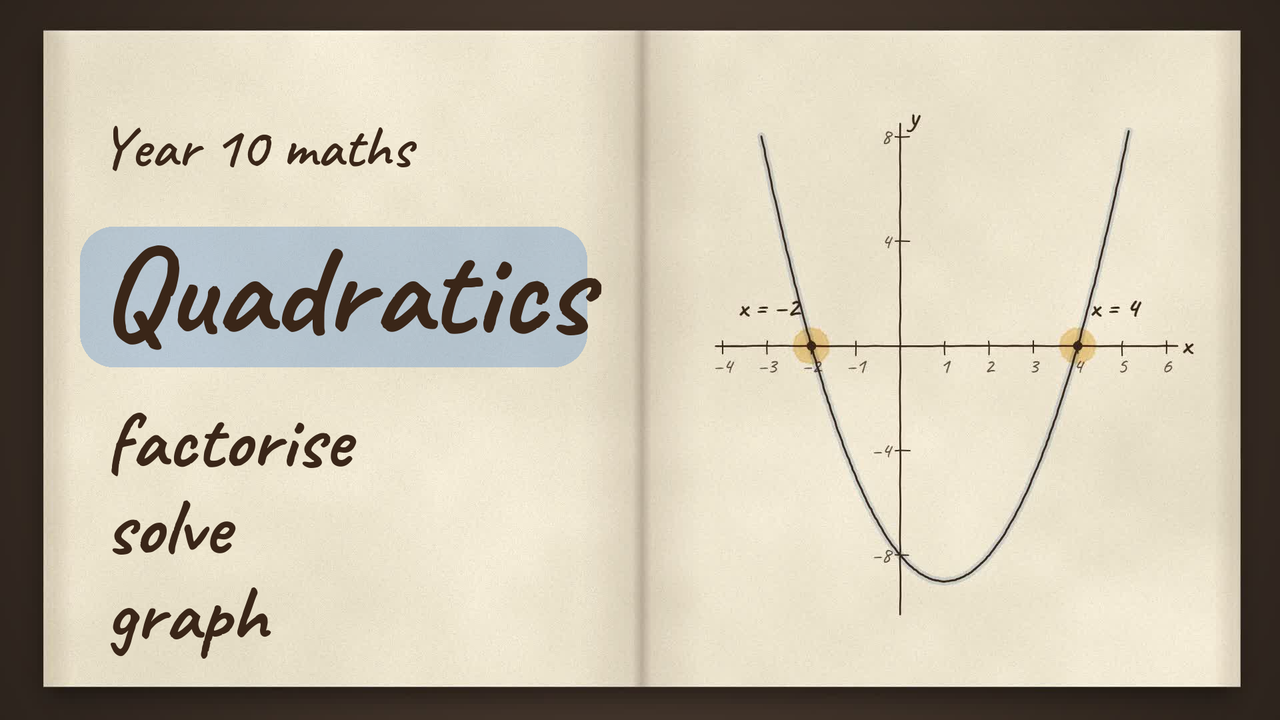
- y = x² − 2x − 8 = (x + 2)(x − 4).
- The solutions of x² − 2x − 8 = 0 are x = −2 and x = 4.
- Those are exactly where the curve crosses the x-axis, because y = 0 everywhere on the x-axis.
| Step | Working | Why |
|---|---|---|
| Graph | y = x² − 2x − 8 | |
| Factorised | y = (x + 2)(x − 4) | |
| x-intercepts | x = −2 and x = 4 | where y = 0 |
Try it: the roots on the graph
x² + c = 0
- x² − 25 = 0: x² = 25, so x = 5 or x = −5, because (−5)² is also 25.
- x² + 4 = 0: x² = −4 has no solutions. A square is never negative, so the curve never crosses the x-axis.
| Equation | Working | Solutions |
|---|---|---|
| x² − 25 = 0 | x² = 25 | x = 5 or x = −5 |
| x² + 4 = 0 | x² = −4 | none |
Changing a and c
- Changing c slides the curve up or down: y = x² + 3 is three higher than y = x², and y = x² − 3 is three lower.
- Changing a stretches it: y = 2x² is steeper and narrower, y = 3x² narrower still. The lowest point stays at the origin.
| Graph | Compared with y = x² |
|---|---|
| y = x² + 3 | 3 up |
| y = x² − 3 | 3 down |
| y = 2x² | narrower |
| y = 3x² | narrower still |
A garden
- A rectangular garden is 3 m longer than it is wide, and its area is 40 m².
- Let the width be w metres, so the length is w + 3.
- A width cannot be negative, so the garden is 5 m by 8 m. Check: 5 × 8 = 40.
| Step | Working | Note |
|---|---|---|
| Equation | w(w + 3) = 40 | width × length = area |
| Equal zero | w² + 3w − 40 = 0 | |
| Factorise | (w + 8)(w − 5) = 0 | 8 × −5 = −40, 8 − 5 = 3 |
| Solutions | w = 5 or w = −8 | reject −8 |
| Answer | 5 m by 8 m | 5 × 8 = 40 |
Quadratics on one page
- The whole method on one card.
| First | take out a common factor |
| Factorise | two numbers that multiply to the last term and add to the middle |
| Solve | make it = 0, then each bracket = 0 |
| Graph | the solutions are the x-intercepts |
| x² = k | two answers if k > 0, none if k < 0 |
| a and c | c slides the curve, a stretches it |
Common mistakes
- x² + x = 12, so x(x + 1) = 12, so x = 12.Make it equal zero first: x² + x − 12 = 0, so (x + 4)(x − 3) = 0 and x = −4 or x = 3.
- x² + 2x − 8 = (x − 4)(x + 2).−4 and 2 add to −2, not 2. The pair is 4 and −2: (x + 4)(x − 2).
- x² − 25 = 0, so x = 5.(−5)² is also 25, so x = 5 or x = −5.
Your turn
Factorise x² + 9x + 20.
Factorise x² − 3x − 18.
Solve x² + 2x − 15 = 0.
A rectangle is 4 cm longer than it is wide, and its area is 60 cm². How wide and how long is it?
Show answer
1. (x + 4)(x + 5): 4 × 5 = 20 and 4 + 5 = 9. 2. (x − 6)(x + 3): −6 × 3 = −18 and −6 + 3 = −3. 3. x = 3 or x = −5: (x + 5)(x − 3) = 0. 4. 6 cm by 10 cm: w(w + 4) = 60, so w² + 4w − 60 = 0, (w + 10)(w − 6) = 0, and w = 6.
The answers
- Find the pair that multiplies to the last term and adds to the middle.
- Make the equation equal zero before you factorise.
- Reject a negative length.
| Answer | |
|---|---|
| 1 | (x + 4)(x + 5) |
| 2 | (x − 6)(x + 3) |
| 3 | x = 3 or x = −5 |
| 4 | 6 cm by 10 cm |
Graphing Quadratics
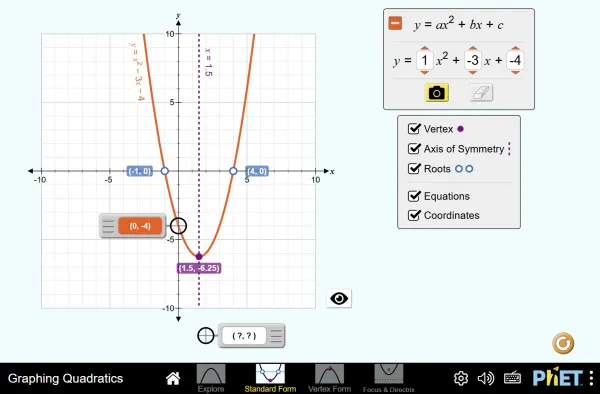
Full screen · PhET Interactive Simulations, University of Colorado Boulder, CC BY 4.0
Challenge
The curve y = x² + bx + c crosses the x-axis at x = −3 and x = 5. Find b and c, and find the two x-values where the curve meets the line y = −7.
Hint
If the roots are −3 and 5, what are the brackets? Expand them. For the second part, set the curve equal to −7 and make it equal zero.
Answer
b = −2, c = −15. The curve meets y = −7 at x = −2 and x = 4.
Step by step
- Roots at −3 and 5 mean the brackets are (x + 3) and (x − 5).
- Expanding: x² − 5x + 3x − 15 = x² − 2x − 15, so b = −2 and c = −15.
- To meet y = −7: x² − 2x − 15 = −7. Add 7 to both sides to make it zero: x² − 2x − 8 = 0.
- Two numbers that multiply to −8 and add to −2: −4 and 2. So (x − 4)(x + 2) = 0.
- x = 4 or x = −2. Check x = 4: 16 − 8 − 15 = −7.
Full working
- y = (x + 3)(x − 5)x-intercepts at −3 and 5
- = x² − 2x − 15so b = −2, c = −15
- x² − 2x − 15 = −7meets the line y = −7
- x² − 2x − 8 = 0make it equal zero first
- (x − 4)(x + 2) = 0−4 × 2 = −8, −4 + 2 = −2
- b = −2, c = −15; x = 4 or x = −2
Two consecutive odd numbers multiply to 323. Find both possible pairs.
Hint
Call the smaller one n. The next odd number is n + 2. Write an equation, make it equal zero and factorise. 323 is close to 18², so look near 18.
Answer
17 and 19, or −19 and −17
Step by step
- Let the smaller number be n, so the next odd number is n + 2.
- Their product is 323: n(n + 2) = 323, so n² + 2n − 323 = 0.
- Find two numbers that multiply to −323 and add to 2: 19 and −17.
- (n + 19)(n − 17) = 0, so n = 17 or n = −19.
- n = 17 gives 17 and 19. n = −19 gives −19 and −17. Both multiply to 323.
Full working
- n(n + 2) = 323consecutive odd numbers differ by 2
- n² + 2n − 323 = 0equal zero first
- (n + 19)(n − 17) = 019 × −17 = −323, 19 − 17 = 2
- n = 17 or n = −19each bracket zero
- 17 × 19 = 323 and (−19) × (−17) = 323check both
- 17 and 19, or −19 and −17
A rectangular lawn is 10 m by 6 m. A path of the same width goes all the way round it. The path alone has an area of 36 m². How wide is the path?
Hint
If the path is w metres wide, the outside rectangle is 10 + 2w by 6 + 2w. The outside area minus the lawn is the path. Look for a common factor before you factorise.
Answer
1 m
Step by step
- Let the path be w metres wide. It adds w on each side, so the outside is (10 + 2w) by (6 + 2w).
- Lawn plus path is 60 + 36 = 96 m², so (10 + 2w)(6 + 2w) = 96.
- Expanding: 60 + 20w + 12w + 4w² = 96, which tidies to 4w² + 32w − 36 = 0.
- Take out the common factor 4: w² + 8w − 9 = 0, which is (w + 9)(w − 1) = 0.
- w = 1 or w = −9. A width cannot be negative, so the path is 1 m wide.
- Check: the outside is 12 by 8 = 96, and 96 − 60 = 36.
Full working
- (10 + 2w)(6 + 2w) = 60 + 36 = 96outside rectangle = lawn + path
- 4w² + 32w + 60 = 96every term times every term
- 4w² + 32w − 36 = 0equal zero first
- 4(w² + 8w − 9) = 0, so (w + 9)(w − 1) = 0common factor first, then 9 × −1 = −9, 9 − 1 = 8
- w = 1 (reject w = −9)a width is positive
- 12 × 8 − 10 × 6 = 96 − 60 = 36check
- 1 m
Report a mistake
More in Algebra
Is your child on track?
Take the free placement test