Congruent, similar, and the four transformations
What this lesson covers
- In similar shapes, corresponding angles are equal and the lengths of corresponding sides are proportional.
- Congruent shapes are identical in shape and size.
- A set of points in a plane can be transformed by translation, reflection about a line, and rotation about a fixed point.
Four things you can do to a shape
- Slide it, flip it, turn it, or resize it.
- Three of those leave it exactly the same size.
- One does not, and that is where the second word comes in.
| The move | In plain words | Size |
|---|---|---|
| Translation | slide it | same size |
| Reflection | flip it | same size |
| Rotation | turn it | same size |
| Enlargement | resize it | different size |
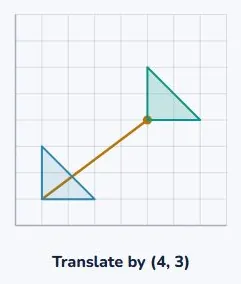
Translation: slide it
- Four squares across and three up.
- Every vertex moves by the same amount.
- Same lengths, same angles, same shape. Just elsewhere.
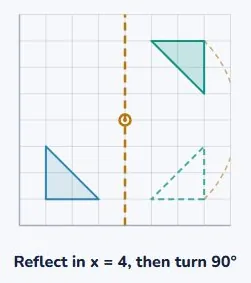
Reflection and rotation, one after the other
- First a flip in the line x equals 4.
- Then a quarter turn about the point (4, 4).
- Two moves, and the shape is still exactly the size it started.
That is what congruent means
- Identical in shape and size. Not similar. Identical.
- Slide, flip and turn can never break it.
- You could cut one out and lay it exactly on the other.
Now the fourth move
- Pick a point to work from. Call it the centre.
- Measure from the centre to a corner, and multiply.
- Do that to every corner with the same number.
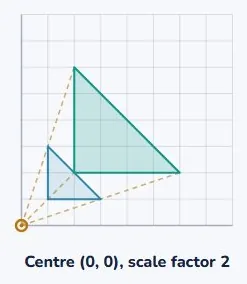
Enlargement by a scale factor of 2
- The centre is the corner of the grid, and it never moves.
- Every corner slides out along its own line, twice as far.
- Count the sides: every one has exactly doubled.
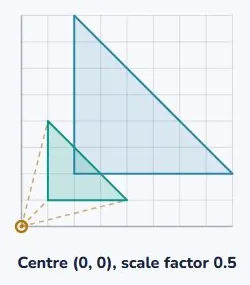
A scale factor of a half is also an enlargement
- Same move, same rays, same centre.
- The factor is 0.5, so every distance halves.
- It gets smaller, and it is still called an enlargement.
And that is what similar means
- The angles did not change. They never do.
- Every side changed by the same factor.
- Similar does not mean alike. It means an enlargement of.
| What you did | What it is called | What survived |
|---|---|---|
| Slide, flip, turn | congruent | sides and angles kept |
| Resize | similar | angles kept, sides scaled |
| Congruent means | identical in shape and size | |
| Similar means | an enlargement of |
Using it to find a side you were not given
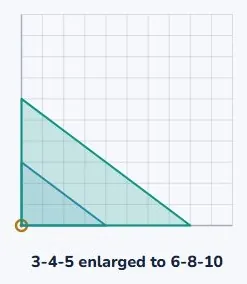
- A three, four, five triangle, enlarged.
- You are told one pair: the 4 became an 8. So the factor is 2.
- Every other side follows. Six and ten. Count them.
The reason anyone bothers
- A stick 1.5 metres tall casts a shadow 2 metres long.
- A tree beside it casts 14 metres. Same sun, same angle.
- Scale factor 7. The tree is 10.5 metres, and nobody climbed it.
| Step | Working | Result |
|---|---|---|
| A stick 1.5 m tall | casts 2 m | |
| A tree nearby | casts 14 m | |
| Same sun, same angle | so the triangles are similar | |
| Scale factor | 14 ÷ 2 | 7 |
| The tree is | 1.5 × 7 | 10.5 m |
Second half, and it is a different idea
- Nets are in the same unit as transformations and are unrelated.
- The honest link is that both flatten a shape into the plane.
- One by moving it about, one by unfolding it.
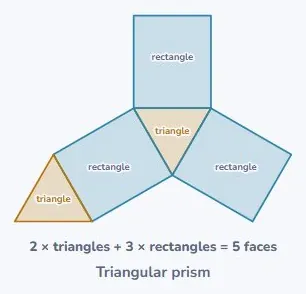
A net is the solid, opened out
- A triangular prism: two triangles and three rectangles.
- Five faces, and the net has to have all five.
- Cut it out, fold every edge, and it closes up.
A cylinder, and the one fact worth keeping
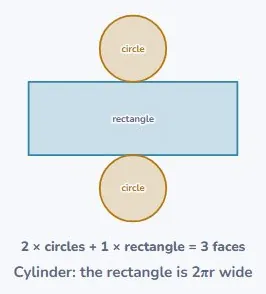
- Two circles for the ends, one rectangle for the curved side.
- Unroll that side and it really is a rectangle.
- Its width is how far round the circle goes. The circumference.
What to take away
- Six things, and the third one is the definition to keep.
| Slide, flip, turn | keep the size: congruent |
| Resize | keeps the angles: similar |
| Similar means | an enlargement of |
| Scale factor | is one known pair, divided |
| A factor under 1 | is still an enlargement |
| A cylinder net | rectangle width is the circumference |
Your turn: four questions
- Pause here and work all four.
- Question 2 wants the factor first, then the other two sides.
- Question 3 is the tree again, with different numbers.
| Question | |
|---|---|
| 1 | Scale factor 3 on a 2 cm side. How long? |
| 2 | Sides 5-12-13. The 5 becomes 15. SF? |
| 3 | A 2 m pole casts 3 m, a tree casts 12 m. |
| 4 | How many parts in a cylinder net? |
Show answer
1. 6 cm, from 2 × 3. 2. The scale factor is 3, from 15 ÷ 5, so the other two sides become 36 and 39. Note the triangle is still right-angled: enlarging never changes an angle. 3. The scale factor is 4, from 12 ÷ 3, so the tree is 2 × 4 = 8 m. The pole and the tree make similar right-angled triangles because the sun is at the same angle to both. 4. Three: two circles for the ends and one rectangle for the curved side. The rectangle is as wide as the circles are round, which is 2 × π × r.
The answers
- Two times three is six centimetres.
- Factor 3, so the other sides are 36 and 39.
- Factor 4, so the tree is 8 metres.
- Three parts: two circles and a rectangle.
| Answer | |
|---|---|
| 1 | 6 cm |
| 2 | SF 3, then 36 and 39 |
| 3 | SF 4, so 8 m |
| 4 | Three |
Is your child on track?
Take the free placement test