Pythagoras, distance, speed and time
What this lesson covers
- For right-angled triangles, Pythagoras’ theorem states that the square of the hypotenuse (longest side) is equal to the sum of the squares of the other two sides.
- If (a,b,c) is a Pythagorean triple, then so is (ka,kb,kc), where k is a positive integer.
- There is a fixed relationship between speed, distance, and time: speed = distance/time.
- In position-time graphs, the gradient represents speed.
- Decimal measures are used for very small durations (e.g. milliseconds); the rest of time measurement uses a different system, based principally on 12 and 60.
One theorem, three different jobs
- Right-angled triangles have a rule nothing else does.
- It finds a missing side, and it tests whether a corner is square.
- And it measures the distance between any two points on a grid.
Name the sides first
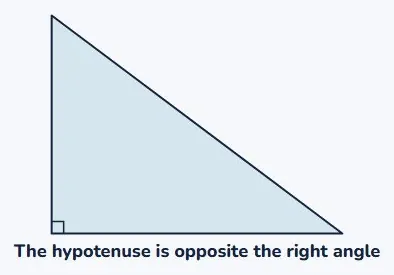
- The hypotenuse is the side opposite the right angle.
- It is always the longest side. That is a useful check.
- In a squared plus b squared equals c squared, c is that side.
Finding a missing side
- Short sides three and four: nine plus sixteen is twenty-five.
- That is c squared, so c is five.
- If the hypotenuse is known instead, subtract rather than add.
| Given | Working | Answer |
|---|---|---|
| Sides 3 and 4 | 9 + 16 | 25 |
| So c²= 25 | square root | c = 5 |
| Hypotenuse 13, side 5 | 169 − 25 | 144 |
| Missing side | square root | 12 |
Add or subtract?
- Looking for the longest side: add the two squares.
- Looking for a short side: subtract from the longest squared.
- If your answer is longer than the hypotenuse, you added by mistake.
Is that corner actually square?
- Sides six, eight and eleven. Square the two short ones and add.
- A hundred. But eleven squared is a hundred and twenty-one.
- They do not match, so there is no right angle in it.
| Step | Working | Result |
|---|---|---|
| Sides 6, 8 and 11 | test it | |
| Short sides | 36 + 64 | 100 |
| Longest squared | 11² | 121 |
| 100 is not 121 | so no right angle |
Triples, and why they multiply
- Three, four, five works. So does six, eight, ten.
- Scale all three sides and the relationship survives.
- Recognising them saves you the arithmetic entirely.
| Triple | Where from | Check |
|---|---|---|
| 3, 4, 5 | the famous one | 9 + 16 = 25 |
| 6, 8, 10 | that doubled | still works |
| 9, 12, 15 | tripled | still works |
| 5, 12, 13 | a different one | 25 + 144 = 169 |
Distance between two points
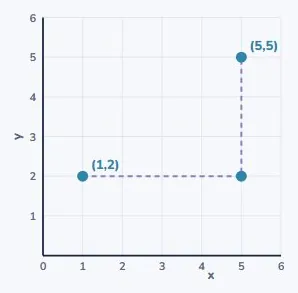
- Across four and up three. Draw those in and look.
- You have made a right-angled triangle without meaning to.
- So the distance is the hypotenuse. Sixteen plus nine, root, five.
That is the distance formula
- The x difference and the y difference are the two short sides.
- So the formula is Pythagoras with the gaps written out.
- Nothing new to memorise. Draw the triangle instead.
A four metre ladder
- Base a metre and a half from the wall. How high does it reach?
- Sixteen take two point two five is thirteen point seven five.
- Root of that, three point seven one metres. Not a tidy number.
| Step | Working | Result |
|---|---|---|
| Ladder 4 m | base 1.5 m out | |
| So | 16 − 2.25 | 13.75 |
| Height reached | √13.75 | 3.71 m |
| Most answers | are not whole numbers |
Speed, and where it hides on a graph
- Speed is distance divided by time. You know that already.
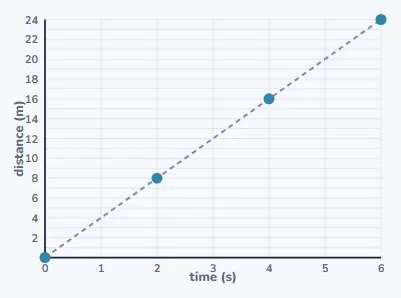
- On a position-time graph, distance is up and time is across.
- So distance over time is rise over run. The gradient is the speed.
Reading the shape before the numbers
- A steeper section means more distance in the same time. Faster.
- A flat section means time passing and distance not changing.
- That is not missing data. That is standing still.
| On the graph | Means | So |
|---|---|---|
| A flat section | time passes | distance does not change |
| Which means | stopped | |
| A steeper section | more distance per second | faster |
| Read the shape | before the numbers |
Working it out
- A hundred and twenty metres, over twenty seconds.
- Rise over run: a hundred and twenty divided by twenty.
- Six metres per second.
| Reading | Working | Answer |
|---|---|---|
| Distance up the side | time along the bottom | |
| Gradient | distance ÷ time | which is speed |
| 120 m in 20 s | 120 ÷ 20 | 6 m/s |
| Steeper line | faster |
Time is the one thing that is not decimal
- Sixty seconds, sixty minutes, twenty-four hours, twelve on the clock.
- So two point five hours is two hours thirty, not two hours fifty.
- Below a second it goes decimal again. Milliseconds behave normally.
| Written | Working | Really |
|---|---|---|
| 2.5 hours | half an hour is 30 min | 2 h 30 |
| Not 2 h 50 | that is the trap | |
| 3.75 hours | three quarters is 45 | 3 h 45 |
| 90 minutes | 90 ÷ 60 | 1.5 hours |
What to take away
- Seven lines, and the first three are one theorem.
| a² + b² = c² | c is always the hypotenuse |
| Forwards | two sides give the third |
| Backwards | three sides test for a right angle |
| On a grid | across and up are the short sides |
| A triple scaled up | is still a triple |
| Position-time gradient | is the speed |
| 2.5 hours | is 2 h 30, not 2 h 50 |
Your turn: four questions
- Pause here and work all four.
- Questions 1 and 3 are both triples in disguise.
- Question 2 wants a yes or no, with a reason.
| Question | |
|---|---|
| 1 | Legs 9 and 12. Find the hypotenuse. |
| 2 | Is 7, 24, 25 a right-angled triangle? |
| 3 | Distance from (2, 1) to (7, 13)? |
| 4 | 150 m in 12 s. Speed to 3 s.f.? |
Show answer
1. 15. Eighty-one plus a hundred and forty-four is two hundred and twenty-five, and the square root of that is fifteen. It is the three, four, five triangle tripled. 2. Yes. Forty-nine plus five hundred and seventy-six is six hundred and twenty-five, which is exactly twenty-five squared. 3. 13. Across is five and up is twelve, so it is the five, twelve, thirteen triple. Twenty-five plus a hundred and forty-four is a hundred and sixty-nine. 4. 12.5 metres per second. Distance over time, and both numbers have at least three significant figures, so the answer keeps three.
The answers
- Fifteen. It is three, four, five tripled.
- Yes: forty-nine plus five seven six is six two five, which is 25².
- Thirteen. Across five, up twelve.
- Twelve point five metres per second.
Is your child on track?
Take the free placement test