Decomposition and neutralisation reactions
What this lesson covers
- Decomposition, where one compound splits into simpler substances
- Thermal decomposition of metal carbonates into a metal oxide and carbon dioxide
- Neutralisation, where an acid and a base make a salt and water
- The products when acids react with metal hydroxides, metal oxides and metal carbonates
- Naming the salt from the metal and the acid
- Classifying a reaction from the pattern of its reactants and products
Decomposition: one reactant breaks apart
- A decomposition reaction starts with a single compound and ends with two or more simpler substances.
- The pattern is AB → A + B, the reverse of a combination reaction.
- Breaking bonds needs energy, so something has to supply it: heat, electricity or light.
- Passing electricity through water splits it: 2H₂O → 2H₂ + O₂.
- Hydrogen peroxide in a first-aid bottle slowly breaks down to water and oxygen: 2H₂O₂ → 2H₂O + O₂.
| Energy source | Example | Equation |
|---|---|---|
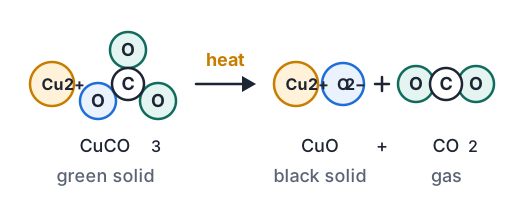
| Heat | copper carbonate | CuCO₃ → CuO + CO₂ |
| Electricity | water | 2H₂O → 2H₂ + O₂ |
| Light | silver chloride darkening in sunlight | 2AgCl → 2Ag + Cl₂ |
Thermal decomposition of carbonates
- Thermal decomposition means heat alone breaks the compound down.
- Most metal carbonates do this the same way: metal carbonate → metal oxide + carbon dioxide.
- The carbonate ion, CO₃²⁻, loses a CO₂ molecule and leaves behind O²⁻, which stays with the metal.
- Limestone (calcium carbonate) is heated in kilns this way to make lime and cement, for example at the cement works at Portland near Whangārei.
- Not every carbonate does it easily. Sodium and potassium carbonate barely change in a Bunsen flame, which is why the rule says 'most'.
| Carbonate | Equation | What you see |
|---|---|---|
| copper carbonate | CuCO₃ → CuO + CO₂ | green powder turns black |
| zinc carbonate | ZnCO₃ → ZnO + CO₂ | white, yellow while hot, white again when cool |
| calcium carbonate | CaCO₃ → CaO + CO₂ | needs very strong heat; white to white |
Worked example: heating magnesium carbonate
- Predict the products of heating magnesium carbonate and write the word and symbol equations.
- one reactant, heatedso thermal decomposition
- magnesium carbonate → magnesium oxide + carbon dioxidemetal carbonate pattern
- MgCO₃ → MgO + CO₂Mg²⁺ with CO₃²⁻, then Mg²⁺ with O²⁻
- left: 1 Mg, 1 C, 3 O; right: 1 Mg, 1 C, 1 + 2 = 3 O
- MgCO₃(s) → MgO(s) + CO₂(g)
Was the method followed well?
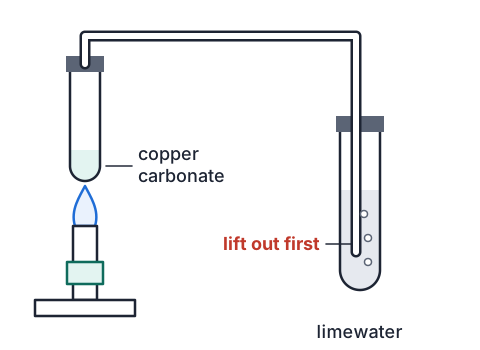
- Planned method: heat 2 g of copper carbonate in a test tube for 5 minutes, pass the gas into limewater, then reweigh the cooled solid.
- A student's write-up shows several departures. For each, ask what changed and whether it could alter the result.
- A good critique gives a reason for each change and says whether it makes the conclusion weaker.
- Note the safety step too: lift the delivery tube out of the limewater before turning off the heat, or cold limewater can be sucked back into the hot tube and crack it.
| What happened | Effect on the result | Better choice |
|---|---|---|
| Heated for 2 minutes, not 5 | some carbonate left, so less mass lost | heat until no more colour change, then to constant mass |
| Used 3 g instead of 2 g | fine if recorded, but harder to compare with other groups | keep the planned mass, or note the change |
| Weighed while still hot | rising hot air makes the balance read wrong | let it cool first |
| Yellow, sooty flame | less heat and soot on the tube adds mass | open the air hole for a blue flame |
Acids and bases
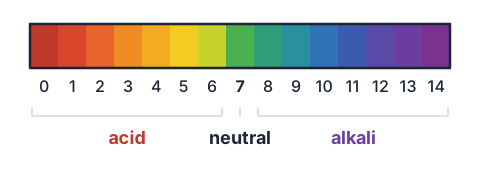
- Acids release hydrogen ions (H⁺) when dissolved in water. They have a pH below 7.
- Bases react with acids and cancel them out. Metal oxides, metal hydroxides and metal carbonates are all bases.
- A base that dissolves in water is called an alkali, and its solution has a pH above 7.
- Universal indicator shows how far you are from neutral: red for strong acid, green at pH 7, purple for strong alkali.
| Acid | Formula | Salts it makes are called |
|---|---|---|
| hydrochloric acid | HCl | chlorides |
| sulfuric acid | H₂SO₄ | sulfates |
| nitric acid | HNO₃ | nitrates |
Neutralisation makes a salt and water
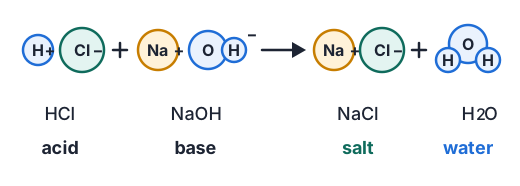
- When an acid reacts with a base, the H⁺ from the acid joins with the base to form water.
- What is left over is a salt: an ionic compound made of the metal ion from the base and the negative ion from the acid.
- With a metal hydroxide or a metal oxide, the products are just a salt and water.
- With a metal carbonate, carbon dioxide forms as well, so the mixture fizzes.
- The salt's name comes from both parents: metal first, then the acid's ion.
| Reactants | Products | Example |
|---|---|---|
| acid + metal hydroxide | salt + water | NaOH + HCl → NaCl + H₂O |
| acid + metal oxide | salt + water | CuO + H₂SO₄ → CuSO₄ + H₂O |
| acid + metal carbonate | salt + water + carbon dioxide | CaCO₃ + 2HCl → CaCl₂ + H₂O + CO₂ |
Worked example: sodium hydroxide and sulfuric acid
- Name the salt, then write a balanced symbol equation.
- acid + metal hydroxide → salt + waterneutralisation pattern
- sodium + sulfate → sodium sulfatemetal from the base, ion from the acid
- Na⁺ and SO₄²⁻, so Na₂SO₄two +1 charges cancel one −2
- NaOH + H₂SO₄ → Na₂SO₄ + H₂ONa: 1 left, 2 right
- 2NaOH + H₂SO₄ → Na₂SO₄ + 2H₂O2 NaOH gives 2 OH⁻, each pairs with an H⁺
- left: 2 Na, 6 O, 4 H, 1 S; right: 2 Na, 6 O, 4 H, 1 S
Worked example: a carbonate and an acid
- Sodium carbonate is added to hydrochloric acid. Predict the observations and write the balanced equation.
- acid + metal carbonate → salt + water + carbon dioxideso expect fizzing
- salt: sodium chloride, NaClNa⁺ and Cl⁻
- Na₂CO₃ + HCl → NaCl + H₂O + CO₂Na: 2 left, 1 right
- Na₂CO₃ + HCl → 2NaCl + H₂O + CO₂now Cl: 1 left, 2 right
- Na₂CO₃ + 2HCl → 2NaCl + H₂O + CO₂
- left: 2 Na, 1 C, 3 O, 2 H, 2 Cl; right: the same
- test: the gas turns limewater milkyconfirms CO₂
Neutralisation in everyday life
- Indigestion tablets contain bases such as magnesium hydroxide or calcium carbonate, which neutralise excess stomach acid.
- Many NZ soils are naturally acidic, so farmers and kiwifruit growers spread lime (crushed calcium carbonate) to raise the pH so plants take up nutrients well.
- Toothpaste is slightly basic and neutralises the acids that bacteria make on your teeth.
- Baking powder contains a carbonate and a dry acid. When wet, they react and the CO₂ bubbles make a cake rise.
| Use | Base | Equation |
|---|---|---|
| Antacid tablet | magnesium hydroxide | Mg(OH)₂ + 2HCl → MgCl₂ + 2H₂O |
| Liming acidic soil | calcium carbonate | acid in soil + CaCO₃ → salt + H₂O + CO₂ |
Classifying a reaction from its pattern
- Count the reactants and products and look at what kind of substances they are. The pattern names the reaction.
- Some reactions fit two types. Burning magnesium is combustion and combination at once.
| Pattern | Type | Example |
|---|---|---|
| A + B → AB | combination | 2Mg + O₂ → 2MgO |
| AB → A + B | decomposition | CuCO₃ → CuO + CO₂ |
| fuel + O₂ → CO₂ + H₂O | combustion | CH₄ + 2O₂ → CO₂ + 2H₂O |
| acid + base → salt + H₂O | neutralisation | KOH + HNO₃ → KNO₃ + H₂O |
Common mistakes
- Heating copper carbonate gives copper and carbon dioxide.It gives copper oxide and carbon dioxide, because the carbonate ion loses only one CO₂ and its third oxygen stays with the metal.
- A salt means sodium chloride.A salt is any ionic compound made of a metal ion from the base and the negative ion from the acid, such as copper sulfate or magnesium nitrate.
- Sodium hydroxide and hydrochloric acid make a salt and hydrogen gas.A hydroxide gives a salt and water, because the acid's H⁺ joins the OH⁻; hydrogen gas comes from an acid reacting with a metal.
- Sulfuric acid makes sulfides.It makes sulfates, because the salt keeps the acid's SO₄²⁻ ion; a sulfide contains only S²⁻.
Neutralise vinegar with baking soda
You need: 2 red cabbage leaves, hot tap water, a jug, a clear glass, vinegar, baking soda, a teaspoon
- Tear the cabbage leaves into the jug, cover them with hot tap water and leave for 10 minutes until the water is purple.
- Put 2 tablespoons of vinegar and 2 tablespoons of the purple liquid into the glass. It turns pink because it is acidic.
- Add baking soda a small pinch at a time, stirring and waiting for the fizzing to stop after each pinch.
- Stop as soon as the colour changes from pink to purple, then add one more pinch and stir.
- Look for the fizzing (carbon dioxide from the carbonate) getting weaker as the acid is used up, the colour reaching purple when the acid is neutralised, and turning blue or blue-green once there is spare baking soda: the acid and base have made a salt, water and carbon dioxide.
Safety: The mixture can froth up and over the glass, so add the baking soda in small pinches over a sink, keep vinegar splashes away from your eyes, and remember the cabbage dye stains clothes.
Your turn
- 1. Write the word and balanced symbol equations for heating zinc carbonate.
- 2. Name the salt formed when magnesium oxide reacts with nitric acid.
- 3. Balance: KOH + H₂SO₄ → K₂SO₄ + H₂O
- 4. Classify: 2KClO₃ → 2KCl + 3O₂
- 5. In a test, a student saw fizzing when acid was added to a white powder, but did not test the gas. Why can't they say for certain the powder was a carbonate, and what should they add to the method?
Show answer
1. zinc carbonate → zinc oxide + carbon dioxide; ZnCO₃ → ZnO + CO₂, already balanced (1 Zn, 1 C, 3 O each side). 2. Magnesium nitrate, Mg(NO₃)₂: magnesium from the base, nitrate from the acid. 3. 2KOH + H₂SO₄ → K₂SO₄ + 2H₂O: two K on the right needs 2KOH, which makes two waters. 4. Decomposition: one compound breaks into two simpler substances. 5. Other reactions also fizz, for example a metal such as zinc with acid gives hydrogen. They should bubble the gas through limewater; turning milky would confirm CO₂ and so a carbonate.
Recap
- Decomposition: one compound splits into simpler substances, AB → A + B, using heat, electricity or light.
- Most metal carbonates decompose on heating to a metal oxide and carbon dioxide.
- Neutralisation: acid + base → salt + water; with a carbonate, carbon dioxide forms too.
- Name the salt by the metal from the base and the ion from the acid: chloride, sulfate or nitrate.
- Judge a method by checking each change against the plan and asking how it could alter the result.
- Classify any reaction by its pattern of reactants and products.
How is Year 10 maths going?
See the Year 10 maths guide