Waves: oscillations, amplitude, wavelength and frequency
What this lesson covers
- What an oscillation is
- How waves move energy from place to place while the material stays put
- What happens to the energy when a material absorbs a wave
- Amplitude, wavelength, frequency and period, with their units
- Mechanical waves and why they need a medium
- Investigating waves with springs, ripple tanks, sound and light, and judging claims about waves
Oscillations: back and forth about a rest point
- An oscillation is a motion that repeats, going back and forth either side of a middle position.
- The middle position is where the object sits when nothing disturbs it, called the rest or equilibrium position.
- A swing, a plucked guitar string, a pendulum clock and a boat bobbing at its mooring all oscillate.
- One complete oscillation is a full trip: out one way, back through the middle, out the other way, and back to the start.
Waves carry energy, not stuff
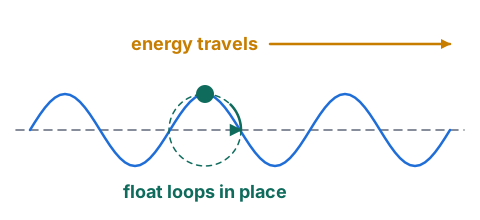
- A wave is a travelling pattern of oscillations that moves energy from one place to another.
- Think of a seagull floating beyond the surf at Piha: as a swell passes, the bird rises and falls but ends up roughly where it started.
- The water under it moves in small loops, while the energy of the swell keeps travelling to the beach.
- Swell that breaks on the west coast can come from storms far out in the Tasman Sea and Southern Ocean. The energy crossed the ocean; that water did not.
- A stadium 'Mexican wave' is the same idea: each person stands and sits in place, but the wave travels round the stands.
Mechanical waves need a medium
- A mechanical wave passes energy along by making neighbouring particles push and pull on each other.
- So it needs a material, called a medium, to travel through: a solid, a liquid or a gas.
- Sound in air, ripples on a pond, a pulse on a slinky and earthquake waves through rock are all mechanical.
- With no particles there is nothing to pass the energy on. An electric bell inside a jar goes silent as the air is pumped out, even though you can still see the hammer hitting it.
- That is also why space is silent: there is no medium between stars and planets.
Describing a wave: amplitude, wavelength, frequency
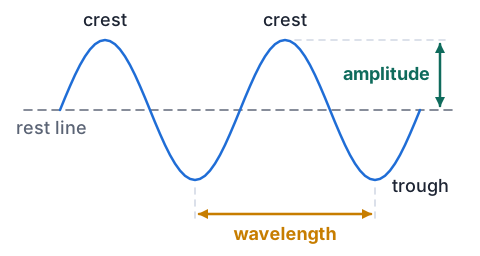
- Picture a side-on drawing of a water wave: a wavy line above and below a flat dashed rest line. High points are crests and low points are troughs.
- Amplitude is the greatest distance a particle moves from the rest line, measured from the rest line to a crest. It is not crest to trough, which is twice the amplitude.
- Wavelength is the length of one complete wave, for example from one crest to the next crest.
- Frequency is the number of complete waves passing a point (or oscillations made) each second, measured in hertz. 1 Hz means one per second.
- Period is the time for one complete oscillation, so period = 1 ÷ frequency.
| Property | Symbol | Unit | Measures |
|---|---|---|---|
| Amplitude | A | metre (m) | size of the oscillation |
| Wavelength | λ (lambda) | metre (m) | length of one full wave |
| Frequency | f | hertz (Hz) | waves per second |
| Period | T | second (s) | time for one wave |
Worked example: frequency and period from a count
- In a ripple tank, a dipper makes 30 complete ripples in 10 seconds. Find the frequency and the period.
- f = number of waves ÷ timewaves per second
- f = 30 ÷ 1030 waves in 10 s
- f = 3 Hz
- T = 1 ÷ f = 1 ÷ 3period is the time for one wave
- T ≈ 0.33 s
- 3 waves × 0.33 s ≈ 1 s
Worked example: reading a wave
- A diagram of a swell shows exactly 3 complete waves across a distance of 60 m. The height from a trough up to the next crest is 1.6 m.
- Find the wavelength and the amplitude.
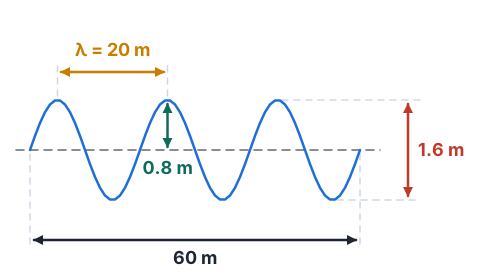
- λ = total length ÷ number of waveseach full wave is the same length
- λ = 60 ÷ 33 complete waves in 60 m
- λ = 20 m
- A = 1.6 mwrong: that is trough to crest
- A = 1.6 ÷ 2amplitude runs from the rest line to a crest
- A = 0.8 m
When a wave is absorbed
- A wave does not have to keep going. A material can absorb it, taking its energy.
- The absorbed energy makes the material's particles move or vibrate faster, which means its thermal energy rises and it warms up.
- Dark car seats in summer get hot because they absorb sunlight.
- A microwave oven works by making water molecules in food absorb microwaves, and the faster-moving water heats the rest of the food.
- Even sound is absorbed this way: curtains and carpets soak up sound energy and warm by a tiny amount.
Experiments that show waves meeting matter
- Each experiment gives you something you can see or hear as evidence of what the wave is doing.
- Record what you changed and what you observed, so another group could repeat it.
| Set-up | What you do | What you observe | What it shows |
|---|---|---|---|
| Coiled spring (slinky) on the floor | send a pulse along it | a ribbon tied on one coil moves and returns | energy travels, the coils do not |
| Ripple tank | speed up the dipper | ripples get closer together | higher frequency, shorter wavelength |
| Tuning fork | touch a struck fork to water | the water splashes | sound comes from vibration |
| Ear on the bench | tap the far end of the bench | the tap is louder through the wood | sound travels through solids |
| Ray box and mirror | shine a ray at the mirror | the ray bounces off at a matching angle | light reflects |
| Ray box and glass block | shine a ray in at an angle | the ray bends at the surface | light refracts |
| Glass, tissue paper, cardboard | shine a torch through each | clear, blurry, blocked | materials transmit different amounts |
A fair test: does amplitude change wave speed?
- Question: does a bigger pulse travel along a slinky faster than a small one?
- Changed variable: the amplitude, by moving your hand 10 cm, 20 cm or 30 cm sideways.
- Measured variable: the time for the pulse to travel to the far end and back, timed over a 4 m stretch.
- Keep the same: the same slinky, stretched to the same length, on the same smooth floor, timed by the same person.
- Repeat each amplitude three times and average. Similar times for every amplitude would show speed depends on the spring, not on the size of the pulse.
- A follow-up test: stretch the slinky further. The pulse speeds up, because a tighter medium passes the energy along faster.
Checking a claim: 'Microwave ovens are dangerous'
- Ask who is making the claim and whether they gain from it, for example by selling 'radiation shields'.
- Ask what evidence is given: measurements with units, or only stories?
- Check the science. Microwaves heat water by making molecules move faster, but they do not make food radioactive and they do not change DNA the way X-rays can.
- The metal box and the mesh in the door keep the microwaves inside, and ovens sold here are made to meet strict leakage limits.
- The real, well-supported risk is burns: steam, superheated water and unevenly heated food. A fair verdict separates that from the exaggerated claim.
| Claim | Check | Verdict |
|---|---|---|
| Microwaving makes food radioactive | microwaves only heat; they add no radioactive material | false |
| Microwaves leak out and harm you | metal walls and door mesh block them; leakage is tested | not supported for an undamaged oven |
| Microwaved liquids can burn you | water can overheat and boil suddenly | true, so stir and stand |
Common mistakes
- Waves carry the water towards the beach.The water only moves in small loops and stays roughly where it was; it is the energy that travels to the beach.
- A wave that is 1.6 m from trough to crest has an amplitude of 1.6 m.Amplitude is measured from the rest line to a crest, so it is half of that, 0.8 m.
- 30 waves in 10 s, so the frequency is 10 ÷ 30 = 0.33 Hz.Frequency is waves divided by time, 30 ÷ 10 = 3 Hz; the 0.33 s is the period, the time for one wave.
- One wavelength is the distance from a crest to the next trough.That is only half a wave; a wavelength is one complete wave, from a crest to the next crest.
Ripples that leave a bottle cap behind
You need: a large roasting dish or baking tray, a jug of water, a plastic bottle cap, a pencil, a phone timer, a tea towel
- Put the dish on a flat table, pour in water about 2 cm deep, and wait until the surface is still.
- Float the bottle cap in the middle of the dish.
- Dip the pencil tip in and out of the water at one end, about twice a second, for 10 seconds while someone times you and counts your dips.
- Wait until the water is still, then repeat, dipping about twice as fast.
- Work out each frequency as dips ÷ 10 s, in hertz.
- Look for: the cap bobs up and down as ripples pass under it but stays roughly where it started, because the ripples carry energy, not water; and the faster dipping gives ripples that are closer together, so a higher frequency gives a shorter wavelength.
Safety: Spilt water on the floor is a slipping hazard, so keep the water shallow, keep the tea towel handy and empty the dish as soon as you finish.
Your turn
- 1. A buoy rises and falls 12 times in one minute. What is the frequency of the waves, and their period?
- 2. On a diagram, 5 complete waves span 2.0 m. What is the wavelength?
- 3. A wave is 0.6 m from crest to trough. What is its amplitude?
- 4. Explain why a duck on a pond is not carried to the shore by ripples.
- 5. Why can astronauts on a spacewalk not hear an explosion nearby, even though they could see it?
Show answer
1. f = 12 ÷ 60 = 0.2 Hz; T = 1 ÷ 0.2 = 5 s. 2. λ = 2.0 ÷ 5 = 0.4 m. 3. 0.3 m, because amplitude is half the crest-to-trough height. 4. Waves carry energy, not water: the water and the duck oscillate up and down in place as the energy passes under them. 5. Sound is a mechanical wave and needs particles to travel; space has almost none. Light needs no medium, so they can see it.
Wave on a String
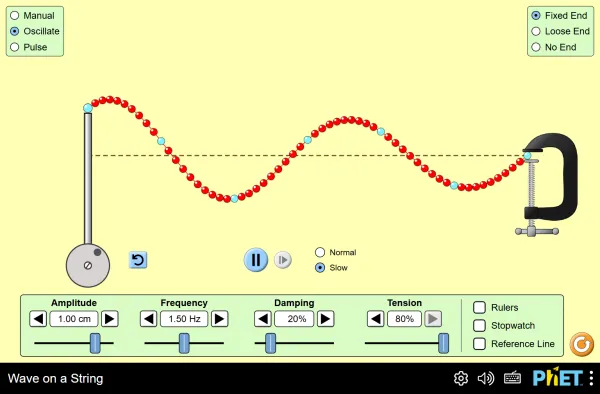
Full screen · PhET Interactive Simulations, University of Colorado Boulder, CC BY 4.0
Recap
- Oscillation: a motion that keeps repeating either side of a rest position.
- Waves transfer energy from place to place; the medium oscillates but stays where it is.
- Absorbed wave energy makes particles move faster, raising thermal energy.
- Amplitude (m) is rest line to crest; wavelength λ (m) is one full wave; frequency f (Hz) is waves per second; period T = 1 ÷ f.
- Mechanical waves such as sound and water waves need a solid, liquid or gas to travel.
- Test wave ideas with one changed variable, and test claims by checking who, what evidence and what the science says.
How is Year 10 maths going?
See the Year 10 maths guide