DNA, genes, chromosomes and proteins
What this lesson covers
- What a phenotype is, and why it depends on both genes and surroundings
- The double helix shape of DNA and the four bases that pair inside it
- How Rosalind Franklin, Maurice Wilkins, James Watson and Francis Crick each contributed to the DNA model
- How DNA is packed into chromosomes inside the nucleus
- What a gene is, using the insulin gene as an example
- The jobs proteins do in a body: building, carrying, speeding up reactions and defending
- How to sort measured traits into discrete and continuous data
Phenotype: the traits you can see or measure
- Your phenotype is every characteristic of you that can be observed or measured, such as eye colour, height, blood group or the shape of your ears.
- Your genome is the full set of genetic instructions you inherited, half from each parent.
- A phenotype comes from the genome and the environment working together, not from either one alone.
- Hydrangeas show this clearly: two plants with identical genes can have blue flowers in acidic soil and pink flowers in alkaline soil.
- Identical twins share the same genome, yet they can end up with different weights or different scars because their lives differ.
| Trait | Mostly set by | Example of the environment changing it |
|---|---|---|
| ABO blood group | Genes | None, it does not change through life |
| Height | Genes and environment | Poor nutrition in childhood can reduce adult height |
| Hydrangea flower colour | Genes and environment | Soil acidity turns flowers blue or pink |
| Skin tone | Genes and environment | Sunlight darkens skin by triggering more pigment |
DNA is a twisted ladder
- DNA (deoxyribonucleic acid) is the molecule that stores the instructions a living thing needs to grow, develop and keep working.
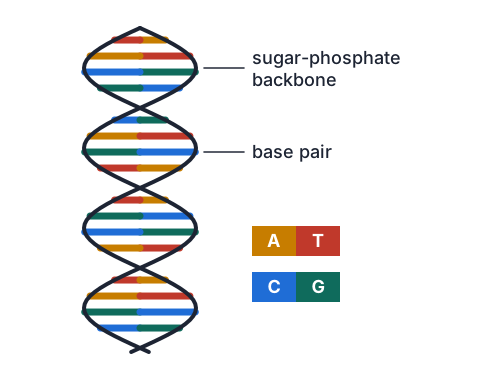
- It has two long strands wound around each other in a spiral called a double helix, like a ladder that has been twisted.
- The sides of the ladder are a backbone of sugar and phosphate groups.
- The rungs are pairs of chemical bases. There are four bases: adenine (A), thymine (T), cytosine (C) and guanine (G).
- A always pairs with T, and C always pairs with G, so if you know one strand you can work out the other.
- The order of the bases along a strand is the code, in the same way the order of letters in a sentence carries its meaning.
| Base | Letter | Always pairs with |
|---|---|---|
| Adenine | A | Thymine (T) |
| Thymine | T | Adenine (A) |
| Cytosine | C | Guanine (G) |
| Guanine | G | Cytosine (C) |
Working out the partner strand
- One strand of a short piece of DNA reads A T G C C A.
- Use the pairing rule base by base to write the strand that sits opposite it.
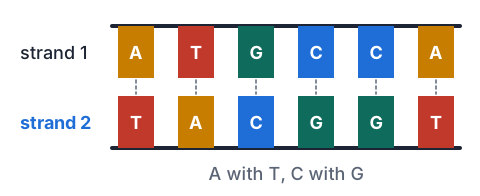
- Strand 1: A T G C C Athe bases you are given
- A pairs with T, T pairs with Afirst two bases
- G pairs with C, C pairs with G, C pairs with Gnext three bases
- A pairs with Tlast base
- Strand 2: T A C G G T
Who worked out the double helix
- In the early 1950s Rosalind Franklin used X-ray crystallography at King's College London, firing X-rays at DNA fibres and recording the pattern they made.
- Her best image, Photo 51, taken with her student Raymond Gosling in 1952, showed an X shape that pointed to a helix, and her measurements gave its width and the spacing of its turns.
- Maurice Wilkins, who also worked on DNA at King's, showed Photo 51 to James Watson without Franklin knowing.
- Watson and Francis Crick at Cambridge combined that evidence with Franklin's data and the known base pairing to build their double helix model, published in 1953.
- Watson, Crick and Wilkins received the Nobel Prize in 1962. Franklin had died in 1958, and the prize is not given after death, so her part was often overlooked for years.
| Scientist | Contribution |
|---|---|
| Rosalind Franklin | Clear X-ray images and measurements showing DNA is a helix with its backbone on the outside |
| Maurice Wilkins | Earlier X-ray work on DNA; passed Franklin's image on to Watson |
| James Watson and Francis Crick | Built the first correct model of the double helix from everyone's evidence |
Chromosomes: DNA packed for storage
- The DNA in one human cell would stretch about 2 metres if laid end to end, yet it fits inside a nucleus far too small to see without a microscope.
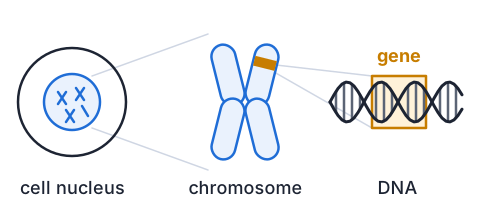
- It fits because each long DNA molecule is wrapped around proteins and coiled tightly into a structure called a chromosome.
- Chromosomes are kept in the nucleus of the cell.
- Most human body cells have 46 chromosomes arranged in 23 pairs, with one chromosome of each pair from each parent.
- Chromosomes are easiest to see just before a cell divides, when they are at their most tightly coiled.
A gene is one recipe on the chromosome
- A gene is a stretch of DNA that holds the instructions for building one protein, or one part of a protein.
- Each chromosome carries hundreds to thousands of genes, one after another along its length, and humans have roughly 20 000 protein-building genes in total.
- The insulin gene is a good example: it holds the code for insulin, a protein hormone that lowers the amount of sugar in the blood.
- People with type 1 diabetes cannot make enough insulin, so they inject insulin that is now produced by bacteria given a copy of the human insulin gene.
| Level | What it is | Comparison |
|---|---|---|
| Nucleus | Control centre of the cell | A library |
| Chromosome | One long coiled DNA molecule | One book |
| Gene | A section of DNA coding for a protein | One recipe in the book |
| Base | A, T, C or G | One letter of the recipe |
Proteins do the work
- Proteins are large molecules built by cells from chains of smaller units called amino acids.
- The order of bases in a gene sets the order of amino acids, and that order decides the shape of the protein.
- A protein's shape decides its job, so a change in the gene can change what the protein can do.
- Some proteins build structures, some carry substances around, some speed up chemical reactions and some defend the body against disease.
| Type of protein | Job | Example |
|---|---|---|
| Structural | Builds body parts | Keratin in hair and nails, collagen in skin |
| Carrier | Moves substances | Haemoglobin carries oxygen in red blood cells |
| Enzyme | Speeds up a chemical reaction | Amylase in saliva breaks starch into sugar |
| Hormone | Carries a chemical message | Insulin tells cells to take in sugar |
| Antibody | Defends against disease | Antibodies latch onto viruses and bacteria |
Comparing models of DNA
- No model of DNA is perfect, because the real molecule is far too small to see and every model leaves something out.
- A good habit is to ask what each model shows well and what it gets wrong or hides.
- Choosing a model depends on the question: a flat diagram is best for practising base pairing, while a 3D model is best for showing the twist.
| Model | Strength | Limitation |
|---|---|---|
| Flat ladder diagram | Base pairs are easy to read | Hides the twist of the helix |
| Twisted paper or pipe-cleaner ladder | Shows the double helix shape | Too few rungs; real DNA has millions of pairs |
| Ball-and-stick kit | Shows atoms and bonds | Fiddly, and only a tiny piece can be built |
| Computer space-filling model | Shows true shape and grooves | Hard to see which base pairs with which |
Two kinds of trait data
- When you collect data on a trait across a group, first decide what kind of data it is.
- Discrete data falls into separate categories with nothing in between, such as blood group A, B, AB or O.
- Continuous data can take any value within a range, such as height, mass or the length of a tuna (eel), and is measured with an instrument.
- Discrete data suits a bar graph with gaps between bars, while continuous data is grouped into ranges and drawn as a histogram with bars touching.
Sorting traits in a class survey
- A class records five traits for every student: height, blood group, hand span, whether earlobes are attached or free, and body mass.
- Sort each one by asking whether a value between two others is possible.
- Height: 162.4 cm is possible between 162 and 163any value in a range
- Hand span: measured with a ruler, any valueany value in a range
- Blood group: no group between A and Bfixed categories
- Earlobes: attached or free, nothing in between is recordedfixed categories
- Body mass: 51.35 kg is possible on a good scaleany value in a range
- Continuous: height, hand span, mass. Discrete: blood group, earlobes
Common mistakes
- The partner of A T G is A T G, or A pairs with G.A always pairs with T and C with G, so the partner of A T G is T A C.
- A chromosome is the same thing as a gene.A chromosome is one long DNA molecule carrying hundreds to thousands of genes, and each gene is just one section of it.
- My height is 162 cm, a whole number, so height is discrete data.Height is continuous because any value in between is possible; rounding a measurement does not make it discrete.
- Your phenotype is decided by your genes alone.Phenotype comes from genes and environment together, which is why identical twins can differ in weight.
Build a twisted DNA ladder
You need: 2 long strips of paper about 3 cm wide, 8 short strips of paper, 4 coloured pens or pencils, sticky tape, scissors
- Lay the two long strips side by side, about 10 cm apart: these are the two backbones.
- Give each base its own colour, then write the sequence A T G C C A down the left strip, one base every 4 cm.
- For each base, colour half of a short strip to match it, and colour the other half for its partner: T opposite A, A opposite T, C opposite G and G opposite C. Write the letters on.
- Tape each short strip across as a rung, so every base on the left meets its partner on the right.
- Hold the top of the ladder still and gently turn the bottom half a turn.
- Look for: the right-hand strip reads T A C G G T, fixed by the left one, and the turned ladder makes the double helix shape; every rung is the same length because each pair joins one bigger base to one smaller one.
Safety: Scissors are the only sharp item, so cut with the blades moving away from the hand holding the paper.
Your turn
- 1. One DNA strand reads G G A T C T. Write the partner strand.
- 2. Put these in order from largest to smallest: gene, nucleus, base, chromosome.
- 3. Name the protein type for each: antibody, amylase, keratin.
- 4. Is the number of petals on a flower discrete or continuous? What about the mass of a lamb at birth?
- 5. Give one strength and one limitation of a flat paper diagram of DNA.
Show answer
1. C C T A G A, because G pairs with C and A pairs with T. 2. Nucleus, chromosome, gene, base: a nucleus holds chromosomes, a chromosome carries many genes, and a gene is a sequence of bases. 3. An antibody defends against disease, amylase is an enzyme that speeds up digestion of starch, keratin is a structural protein. 4. Petal number is discrete, since you cannot have 5.3 petals. Birth mass is continuous, since it can be any value such as 4.27 kg. 5. Strength: base pairs and their order are easy to read. Limitation: it is flat, so it hides the double helix twist.
Gene Expression Essentials
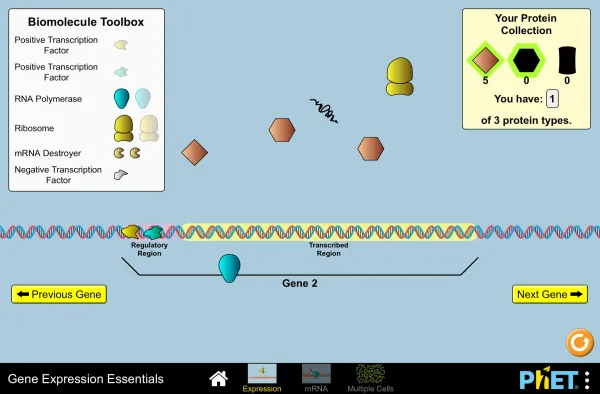
Full screen · PhET Interactive Simulations, University of Colorado Boulder, CC BY 4.0
What to take away
- Phenotype is what you can observe, and it comes from genes and environment together.
- DNA is a double helix whose base order (A with T, C with G) is the code.
- DNA is coiled into chromosomes in the nucleus, and a gene is a section of DNA coding for a protein.
- Proteins build, carry, speed up reactions, send messages and defend.
- Franklin's X-ray evidence, shared through Wilkins, let Watson and Crick build the 1953 model.
- Trait data is discrete (categories) or continuous (any value in a range).
How is Year 10 maths going?
See the Year 10 maths guide