Light, colour and uses of electromagnetic waves
What this lesson covers
- Every electromagnetic wave travels at the same speed in a vacuum, 3.0 × 10⁸ m/s
- Light as a transverse electromagnetic wave
- What happens when light is absorbed, reflected, transmitted, scattered or refracted
- How wavelength sets colour, and why objects look the colour they do
- Grouping electromagnetic waves by their uses
- How Sir Paul Callaghan used magnetic fields and radio waves to study materials
One speed for every EM wave
- Part 2 set out the EM spectrum from radio waves to gamma rays.
- In a vacuum, all of them travel at exactly the same speed, the speed of light: c = 3.0 × 10⁸ m/s, or 300,000 km every second.
- Because v is fixed, the wave equation becomes c = fλ: a high-frequency EM wave must have a short wavelength, and the reverse.
- In air, light is only very slightly slower than in a vacuum, so we use 3.0 × 10⁸ m/s for air too.
Worked example: wavelength of an FM radio station
- An FM station broadcasts at 100 MHz. Find the wavelength of its radio waves. (1 MHz = 1,000,000 Hz.)
- f = 100 MHz = 1.0 × 10⁸ Hzconvert to hertz first
- λ = c ÷ frearranged from c = fλ
- λ = (3.0 × 10⁸) ÷ (1.0 × 10⁸)c = 3.0 × 10⁸ m/s
- λ = 3.0 m
Worked example: how old is sunlight?
- The Sun is 1.5 × 10¹¹ m from Earth. How long does its light take to reach us?
- time = distance ÷ speedsteady speed through space
- t = (1.5 × 10¹¹) ÷ (3.0 × 10⁸)c = 3.0 × 10⁸ m/s
- t = 500 s
- 500 ÷ 60 ≈ 8.3 minutesthe sunlight you see left the Sun about 8 minutes ago
What light can do when it meets a material
- Light is a transverse EM wave, and when it reaches a material several things can happen, often at the same time.
- A window transmits most light, reflects a little (your faint reflection at night) and absorbs a tiny amount.
- Scattering is light bouncing off tiny particles in all directions. Air molecules scatter blue light more than red, which is why the sky is blue and sunsets are red.
| What happens | Meaning | Example |
|---|---|---|
| Absorbed | energy taken in, material warms | black tar seal getting hot in summer |
| Reflected | bounces back off the surface | a mirror, or Lake Matheson reflecting Aoraki |
| Transmitted | passes through | clear glass, water |
| Scattered | sent off in many directions | blue sky, a car's headlights in fog |
| Refracted | changes direction entering a new material | a straw looking bent in water |
Reflection
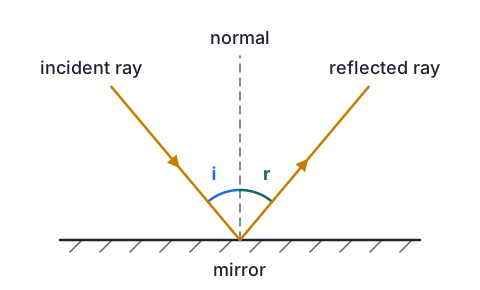
- Angles are measured from the normal: an imaginary line at right angles to the surface where the ray hits.
- For a mirror, the angle of reflection always equals the angle of incidence.
- A smooth surface reflects all rays the same way, giving a clear image. A rough surface such as paper reflects them in all directions, so you see the paper but no image.
Refraction
- Light slows down when it enters a denser material such as water or glass. In glass it travels at about 2.0 × 10⁸ m/s.
- If the ray meets the surface at an angle, the change of speed makes it change direction.
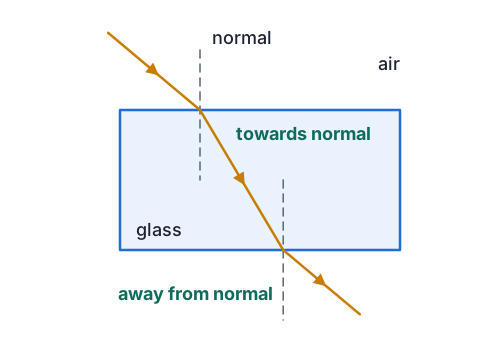
- Going into a slower material, the ray bends towards the normal; coming back out into air, it bends away from the normal.
- A ray hitting the surface straight on, along the normal, slows down but does not bend.
- Refraction is why a swimming pool looks shallower than it really is, and why a straw looks broken at the water's surface.
Wavelength sets colour
- Our eyes detect EM waves from about 400 nm to 700 nm long, and the brain sees each wavelength as a colour.
- Red has the longest wavelength and lowest frequency; violet has the shortest wavelength and highest frequency.
- White light, such as sunlight, is a mix of every visible wavelength.
- A prism splits white light because each wavelength refracts by a slightly different amount: violet bends most, red least. Raindrops do the same to make a rainbow.
| Colour | Wavelength (approx.) |
|---|---|
| Red | 620 to 700 nm |
| Orange | 590 to 620 nm |
| Yellow | 570 to 590 nm |
| Green | 495 to 570 nm |
| Blue | 450 to 495 nm |
| Violet | 400 to 450 nm |
Why objects look coloured
- An opaque object looks the colour of the light it reflects; it absorbs the rest.
- A ripe tomato in white light reflects red and absorbs the other colours, so it looks red.
- A white object reflects all colours, and a black one absorbs nearly all of them, which is why black clothes warm up fastest in the sun.
- A transparent coloured filter transmits its own colour and absorbs the others: a red filter lets only red through.
Worked example: a red shirt under green light
- At a party, a red shirt with white writing is lit only by a green stage light. What colours do the shirt and the writing appear?
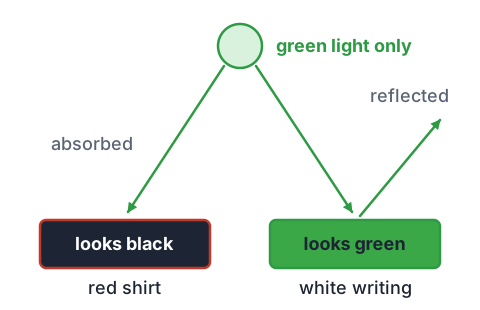
- light arriving: green onlyno other wavelengths to reflect
- red dye reflects red, absorbs greenthe green light is absorbed
- shirt reflects nothingno light reaches your eye from it
- shirt looks black
- white writing reflects every colour it receivesit receives green
- writing looks green
Organising EM waves by how we use them
- Each part of the spectrum is used for what its wavelength and energy make it good at.
- Long waves bend around hills and travel far, which suits communication.
- Short, high-energy waves pass through soft tissue or kill cells, which suits medicine but also makes them hazardous.
| Wave | Uses | Why it suits the job |
|---|---|---|
| Radio | FM and AM radio, TV, MetService weather balloons sending data | long waves travel far and pass round obstacles |
| Microwave | microwave ovens, cellphones, Wi-Fi, satellite links, rain radar | absorbed by water; pass through the atmosphere |
| Infrared | TV remotes, thermal cameras for search and rescue, toasters | warm objects give it off; it heats what absorbs it |
| Visible | seeing, photography, fibre-optic internet | our eyes and cameras detect it |
| Ultraviolet | sterilising water, checking banknotes, curing dental fillings | high energy kills microbes and makes some materials glow |
| X-ray | imaging broken bones, airport bag scanners | passes through soft tissue, stopped by bone and metal |
| Gamma | radiotherapy for cancer, sterilising surgical equipment | very high energy kills cells |
Sir Paul Callaghan and magnetic resonance
- Sir Paul Callaghan (1947 to 2012), born in Whanganui, was one of New Zealand's best-known physicists.
- He used nuclear magnetic resonance (NMR): put a material in a strong magnetic field, send in pulses of radio waves, and listen for the radio signals its hydrogen nuclei send back.
- Those signals reveal how molecules move inside soft materials such as gels, plastics, foods and even Antarctic sea ice.
- Hospital MRI scanners use the same physics on the water in your body to build detailed images of soft tissue such as the brain, without X-rays.
- He co-founded the Wellington company Magritek, which makes compact NMR instruments, and was the founding director of the MacDiarmid Institute.
Investigating refraction
- Question: how does the angle a light ray enters a glass block affect how much it bends?
- Changed variable: the angle of incidence, set to 10°, 20°, 30°, 40°, 50° and 60° from the normal.
- Measured variable: the angle of refraction inside the block, marked with crosses and measured with a protractor.
- Keep the same: the same rectangular glass block, the same ray box with the same colour filter, and a darkened room.
- Expected result: the refracted angle is always smaller than the incident angle and grows as it grows, showing light bends towards the normal entering glass.
Common mistakes
- 100 MHz, so λ = 3.0 × 10⁸ ÷ 100 = 3,000,000 m.Convert to hertz first: 100 MHz is 1.0 × 10⁸ Hz, so λ = 3.0 m.
- A red shirt looks red under any light, because red is its colour.The dye only reflects red light, so under green light there is nothing for it to reflect and it looks black.
- Light entering glass bends away from the normal.Light slows down entering glass or water, so it bends towards the normal, and away from it only when it comes back out into air.
- Radio waves are a kind of sound wave.Radio waves are EM waves that travel at the speed of light, even through space; a radio only turns them into sound with its speaker.
Make a hidden coin appear
You need: a coin, an opaque mug or bowl, a jug of water, a helper
- Put the coin flat on the bottom of the empty mug, near the side closest to you.
- Look over the rim and slowly lower your head until the coin just disappears behind the edge of the mug, then keep your head perfectly still.
- Ask your helper to pour water slowly into the mug against the far side, so the coin does not move.
- Keep looking at the same spot as the mug fills.
- Look for: the coin comes back into view even though neither the coin nor your eye moved, because light from the coin speeds up and bends away from the normal as it leaves the water, so it now clears the rim and reaches your eye, and the coin looks higher than it really is, which is why a pool looks shallower than it is.
Safety: Coins are a choking hazard for small children, so keep the coin out of their reach and put it away as soon as you finish.
Your turn
- 1. A microwave oven uses microwaves of frequency 2.45 × 10⁹ Hz. Find their wavelength.
- 2. Red light has a wavelength of 7.0 × 10⁻⁷ m. Find its frequency.
- 3. A green apple is seen under red light. What colour does it look, and why?
- 4. Which EM wave would you choose to (a) find a lost tramper at night, (b) check a broken arm, (c) send a text?
- 5. Why is light from a torch visible at the bottom of a clear pool, but bent where it enters the water?
Show answer
1. λ = 3.0 × 10⁸ ÷ 2.45 × 10⁹ ≈ 0.12 m (12 cm). 2. f = 3.0 × 10⁸ ÷ 7.0 × 10⁻⁷ ≈ 4.3 × 10¹⁴ Hz. 3. Black (or very dark): a green apple absorbs red light, and there is no green light for it to reflect. 4. (a) infrared, with a thermal camera detecting body heat; (b) X-rays, which bone stops; (c) microwaves, used by cellphones. 5. Clear water transmits light, so it reaches the bottom; light slows down entering water, so a ray at an angle refracts towards the normal.
Bending Light
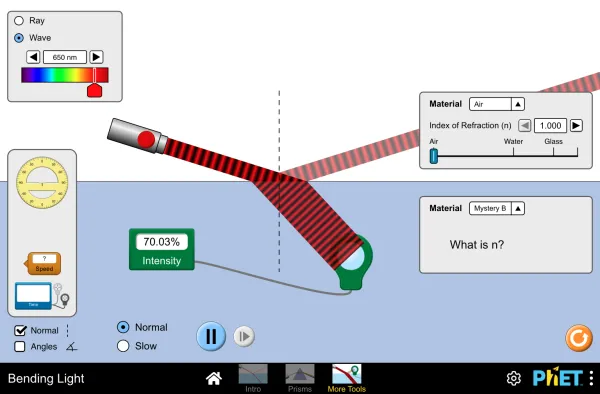
Full screen · PhET Interactive Simulations, University of Colorado Boulder, CC BY 4.0
Recap
- All EM waves travel at 3.0 × 10⁸ m/s in a vacuum, so c = fλ links their frequency and wavelength.
- Light is a transverse EM wave that can be absorbed, reflected, transmitted, scattered or refracted.
- Reflection: angles equal, measured from the normal. Refraction: light slows in glass or water and bends towards the normal.
- Wavelength sets colour; white light is all colours, and objects look the colour they reflect or transmit.
- Radio and microwaves serve communication, infrared heating and sensing, and UV, X-rays and gamma medicine and sterilising.
- Paul Callaghan used magnetic fields and radio waves (NMR) to study materials, the same physics behind MRI.
How is Year 10 maths going?
See the Year 10 maths guide