Transverse and longitudinal waves, sound and the EM spectrum
What this lesson covers
- Transverse waves, where the oscillation is at right angles to the direction of travel
- Longitudinal waves, where the oscillation is along the direction of travel
- Sound as a longitudinal mechanical wave, and how frequency sets pitch and amplitude sets loudness in decibels
- Why sound is fastest in solids and slowest in gases
- Using the wave equation v = fλ
- Electromagnetic waves, which need no medium, and the order of the electromagnetic spectrum
- Judging which models show each kind of wave best
Transverse waves
- Part 1 described waves by amplitude, wavelength and frequency. Waves also differ in which way the medium moves.
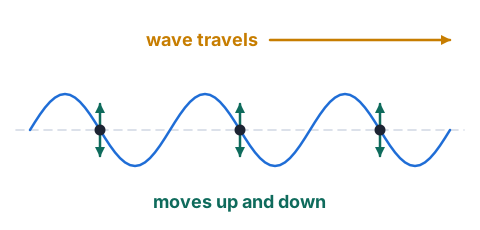
- In a transverse wave, each bit of the medium moves at right angles (perpendicular) to the direction the wave travels.
- Tie a rope to a post and flick your hand up and down: the wave runs along the rope, but each part of the rope only moves up and down.
- Transverse waves have crests and troughs. Waves on a rope, all light waves and (very nearly) ripples on water are transverse.
Longitudinal waves
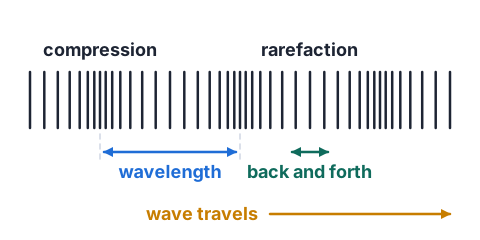
- In a longitudinal wave, the medium moves back and forth in the same direction (parallel to) the way the wave travels.
- Stretch a slinky along the floor and push one end in and out: bunched-up coils travel along it.
- Regions where coils are squashed together are compressions; regions where they are spread apart are rarefactions.
- One wavelength is the distance from one compression to the next.
- Sound and the primary (P) waves that arrive first after an earthquake are longitudinal.
| Transverse | Longitudinal | |
|---|---|---|
| Medium moves | at right angles to travel | along the line of travel |
| Features | crests and troughs | compressions and rarefactions |
| Wavelength | crest to crest | compression to compression |
| Examples | rope, water ripples, light | sound, slinky pushed, P waves |
Which model shows a wave best?
- Every model shows some features of a wave well and gets others wrong, so choose the model for the feature you want to explain.
- A slinky is the most versatile: it can show both types, and a ribbon on one coil proves the coils only oscillate.
- Falling dominoes show energy passing along a line, but each domino falls once and never returns, so they miss the repeated oscillation completely.
- A wavy line diagram looks like a transverse wave. For sound, the same curve is only a graph of air pressure, not a picture of the air.
| Model | Shows well | Misleading |
|---|---|---|
| Slinky | both wave types, energy moves while coils stay | real sound is far faster and invisible |
| Rope flicked up and down | transverse wave, crests and troughs | cannot show longitudinal waves |
| Row of dominoes | energy passed from particle to particle | no oscillation, no return, a single pulse only |
| People in a line pushing shoulders | compressions moving along | people do not spring back on their own |
| Wavy line diagram | amplitude and wavelength clearly | for sound it is a graph, not the wave's shape |
Sound is a longitudinal mechanical wave
- Every sound starts with something vibrating: your vocal cords, a guitar string or a speaker cone.
- As a speaker cone moves out it squashes the air in front into a compression; as it moves back it leaves a rarefaction.
- These compressions and rarefactions travel outward through the air to your ear, where they make your eardrum vibrate.
- Because the air must be pushed along, sound needs a medium, which makes it a mechanical wave.
Pitch and loudness
- The frequency of a sound decides its pitch: higher frequency, higher note. A tūī can sing notes too high for us to hear.
- Young people hear from about 20 Hz to 20,000 Hz, and the top limit drops with age.
- The amplitude decides the loudness: bigger vibrations carry more energy and sound louder.
- Sound level is measured in decibels (dB). Every 10 dB step means ten times the sound energy, and sounds about twice as loud.
- Long exposure above about 85 dB can damage hearing permanently, which is why workers in loud jobs wear earmuffs.
| Sound | Approximate level |
|---|---|
| quietest sound you can hear | 0 dB |
| whisper | 30 dB |
| normal conversation | 60 dB |
| busy road | 80 dB |
| lawnmower | 90 dB |
| rock concert near the speakers | 110 dB |
Sound is fastest in solids
- Sound moves by each particle pushing on its neighbour.
- In a stiff solid, particles are tightly bonded, so a push is passed on almost instantly.
- In a gas, particles are far apart and only pass the push on when they collide, so sound is slowest.
- Put your ear to a long steel fence while someone taps the far end: you hear the tap through the metal before the sound through the air arrives.
| Medium | State | Speed of sound (approx.) |
|---|---|---|
| air at 20 °C | gas | 343 m/s |
| seawater | liquid | 1,500 m/s |
| steel | solid | 5,900 m/s |
The wave equation: v = fλ
- If a source makes f waves every second, and each is λ metres long, the wave travels f × λ metres every second.
- So wave speed v = frequency f × wavelength λ, with v in m/s, f in Hz and λ in m.
- Rearranged: f = v ÷ λ and λ = v ÷ f.
- In one medium the speed is fixed, so raising the frequency makes the wavelength shorter.
Worked example: the wavelength of a note
- A violin plays the A note at 440 Hz. Sound travels at 343 m/s in the room. Find the wavelength.
- v = fλ, so λ = v ÷ fwe want the wavelength
- λ = 343 ÷ 440v = 343 m/s, f = 440 Hz
- λ ≈ 0.78 m
- 440 × 0.78 ≈ 343
Worked example: depth from an echo
- A ship in Cook Strait sends a sound pulse straight down. The echo from the seabed returns 0.80 s later. Sound travels at 1,500 m/s in seawater. How deep is the water?
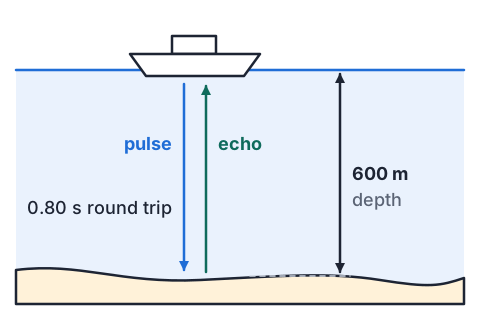
- distance = speed × timethe pulse moves at a steady speed
- 1,500 × 0.80 = 1,200 mthe total path
- 1,200 mwrong: that is down and back up
- depth = 1,200 ÷ 2the sound went to the seabed and back
- depth = 600 m
Electromagnetic waves need no medium
- Electromagnetic (EM) waves are made of electric and magnetic fields that oscillate together, at right angles to the direction of travel, so they are transverse.
- Fields can exist in empty space, so EM waves can cross a vacuum. That is how sunlight reaches us across 150 million km of space.
- Sound from the Sun cannot reach us, because sound is mechanical and needs particles.
- Light, radio, microwaves and X-rays are all EM waves; they differ only in wavelength and frequency.
The electromagnetic spectrum
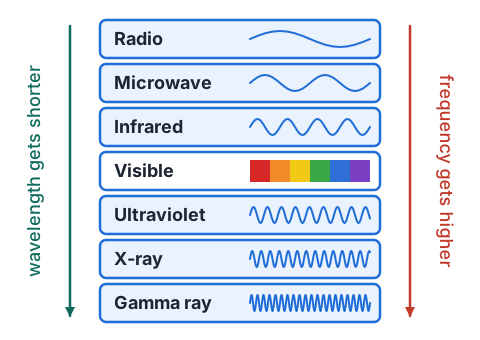
- The EM spectrum is the whole family of EM waves, arranged in order of wavelength.
- Going from radio to gamma, wavelength gets shorter and frequency gets higher.
- Higher frequency EM waves carry more energy, which is why ultraviolet, X-rays and gamma rays can damage living cells.
- Visible light is only a narrow slice in the middle.
- One way to remember the order: Raging Martians Invaded Venus Using X-ray Guns.
| Type | Typical wavelength | About the size of |
|---|---|---|
| Radio | 30 cm to kilometres | a person to a mountain |
| Microwave | 1 mm to 30 cm | a grain of sand to a ruler |
| Infrared | 0.0007 mm to 1 mm | a hair's width |
| Visible light | 400 to 700 nm | a bacterium |
| Ultraviolet | 10 to 400 nm | a virus |
| X-ray | 0.01 to 10 nm | an atom |
| Gamma ray | below 0.01 nm | an atom's nucleus |
Common mistakes
- Sound travels fastest in air, because there is less stuff in the way.Sound is fastest in solids, because tightly bonded particles pass each push on to their neighbours much faster than far-apart gas particles.
- The echo returns after 0.80 s at 1,500 m/s, so the sea is 1,200 m deep.The sound went down and back up, so halve the distance: the sea is 600 m deep.
- A higher note travels faster than a low one.In one medium every sound has the same speed; a higher frequency just means a shorter wavelength, since v = fλ.
- A high-pitched sound is a loud sound.Frequency sets the pitch and amplitude sets the loudness, so a high note can be quiet and a low note can be loud.
A spoon that rings like a bell
You need: a metal spoon, ideally a big serving spoon, about 1 m of string or kitchen twine
- Tie the middle of the string around the handle of the spoon so it hangs evenly with two long ends.
- Wind one end of the string around the first finger of each hand.
- Let the spoon swing gently against the edge of a table and listen to the sound it makes through the air.
- Now press your string-wrapped fingertips gently against the outside of your ear openings, lean forward so the string hangs tight and swing the spoon against the table again.
- Look for: through the air the spoon makes a thin clink, but through the string it sounds like a loud, deep church bell, because the vibrations travel along the string as a longitudinal wave, and a solid passes sound on far better than air does.
Safety: Only rest your fingertips against the outside of your ears, never push anything into the ear canal, and tap the spoon gently so the sound is not painfully loud.
Your turn
- 1. Say whether each is transverse or longitudinal: a ripple on a pond, a sound wave, a light wave, a slinky pushed in and out.
- 2. A dog whistle makes sound at 34,300 Hz in air at 343 m/s. Find the wavelength, and explain why people cannot hear it.
- 3. A whale call in seawater (1,500 m/s) has a wavelength of 3.0 m. What is its frequency?
- 4. Explain why you can hear a train coming through the rail before you hear it through the air.
- 5. Put these in order from longest to shortest wavelength: X-rays, radio, visible light, microwaves.
Show answer
1. Transverse, longitudinal, transverse, longitudinal. 2. λ = 343 ÷ 34,300 = 0.01 m (1 cm); 34,300 Hz is above the 20,000 Hz limit of human hearing. 3. f = 1,500 ÷ 3.0 = 500 Hz. 4. Steel is stiff, so sound travels in it about 17 times faster than in air. 5. Radio, microwaves, visible light, X-rays.
Waves Intro
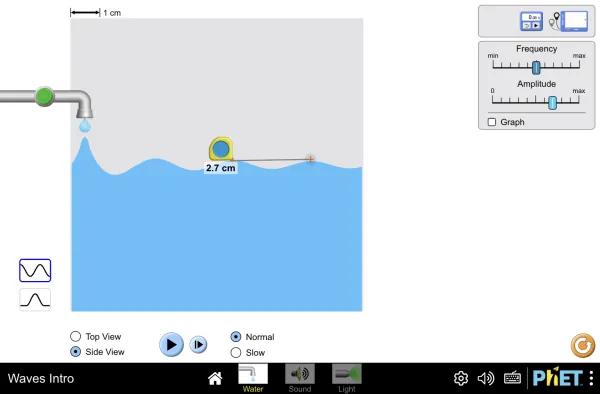
Full screen · PhET Interactive Simulations, University of Colorado Boulder, CC BY 4.0
Recap
- Transverse: the medium moves at right angles to the travel. Longitudinal: it moves along the travel, making compressions and rarefactions.
- Sound is a longitudinal mechanical wave started by vibrations; frequency sets pitch and amplitude sets loudness, measured in dB.
- Sound speed ranks solids first, then liquids, with gases last, because stiffness passes each push on faster.
- Wave speed v = fλ, so λ = v ÷ f and f = v ÷ λ.
- EM waves are oscillating electric and magnetic fields and can travel through a vacuum.
- The EM spectrum runs radio, microwave, infrared, visible, ultraviolet, X-ray, gamma: wavelength falls and frequency rises.
How is Year 10 maths going?
See the Year 10 maths guide