Choosing mathematical methods for a real problem

What this lesson covers
- A real problem has to be turned into mathematical questions before any method can be chosen.
- Methods from different strands of mathematics can work on the same problem.
What this standard asks for
- A real problem from Aotearoa or the Pacific.
- At least four processes, from two or more strands.
- Accurate answers, with units.
| Rule | Means |
|---|---|
| Four processes | at least four |
| Two strands | from number, algebra, measurement, geometry |
| Accurate | correct answers with units |
| Not counted | statistics and probability |
The problem: māra kai beds
- A school is building three raised garden beds.
- They need soil, timber, and a brace for each.
- What should they order, and what will it cost?
| Details | |
|---|---|
| Beds | 3, each 2.4 m × 1.2 m |
| Depth | 0.4 m of soil |
| Planks | 0.2 m high, 4.8 m long |
| Also | a diagonal brace across the top |
Break it into maths questions
- One big problem becomes four smaller questions.
- Each question points to a method.
- Four methods, four different strands.
| Question | Method | Strand |
|---|---|---|
| How much soil? | volume | measurement |
| What will it cost? | rounding, money | number |
| How long is the brace? | Pythagoras | geometry |
| How much timber? | a formula | algebra |
Process 1: volume of soil
- Each bed is a rectangular prism.
- Length × width × depth: 1.152 m³.
- Three beds: 3.456 m³.
| Working | Volume | |
|---|---|---|
| One bed | 2.4 × 1.2 × 0.4 | 1.152 m³ |
| Three beds | 3 × 1.152 | 3.456 m³ |
Process 2: rounding and cost
- Soil is sold by the whole cubic metre.
- 3.456 m³ must round UP, to 4 m³.
- 4 × $95 = $380.
| Step | Working | |
|---|---|---|
| Needed | 3.456 m³ | |
| Sold by | the whole cubic metre | round up |
| Order | 4 m³ | |
| Cost | 4 × $95 | $380 |
Round the way the context needs
- Rounding down to 3 m³ leaves beds unfilled.
- You cannot buy 0.456 of a delivery.
- Say why you rounded the way you did.
Process 3: Pythagoras for the brace
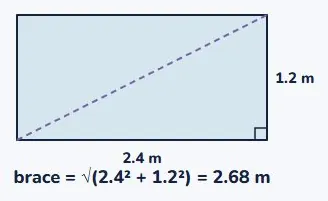
- The brace is the hypotenuse of a right-angled triangle.
- 2.4² + 1.2² = 7.2.
- √7.2 = 2.68 m, to 2 decimal places.
| Step | Working | |
|---|---|---|
| Diagonal² | 2.4² + 1.2² | 5.76 + 1.44 |
| Diagonal² | 7.2 | |
| Diagonal | √7.2 | 2.68 m |
The top of one bed
- Sides 2.4 m and 1.2 m, meeting at a right angle.
- The brace joins opposite corners.
- It must be at least 2.68 m long.
Process 4: a formula for the timber
- One row of planks goes round the perimeter: 7.2 m.
- Two rows reach 0.4 m: 14.4 m a bed, so L = 14.4n.
- Three beds: 43.2 m, exactly nine 4.8 m planks.
| Step | Working | Result |
|---|---|---|
| One row | perimeter 2(2.4 + 1.2) | 7.2 m |
| Two rows | 0.4 m ÷ 0.2 m | 14.4 m a bed |
| n beds | L = 14.4n | |
| 3 beds | 14.4 × 3 = 43.2 m | 9 planks |
Every answer is a sentence
- A number alone does not answer the problem.
- Say what it means for the school.
- Units every time.
| The answer, communicated | |
|---|---|
| Soil | Order 4 m³ of soil, costing $380. |
| Brace | Each brace must be at least 2.68 m. |
| Timber | Buy nine 4.8 m planks for three beds. |
Check it is sensible
- Is the brace longer than the long side? 2.68 > 2.4. Yes.
- Is 4 m³ just more than 3.456 m³? Yes.
- A quick estimate catches a slipped decimal.
Where this sits in the grades
- Achieved: four accurate processes, two strands.
- Merit: the processes linked, one feeding the next.
- Excellence: extended, with assumptions or a rule.
What to take away
- A real problem, broken into questions, answered with units.
| Break it down | into mathematical questions |
| Four processes | from at least two strands |
| Units | on every single answer |
| Round in context | soil and planks round up |
| A formula | turns one bed into n beds |
| Communicate | each answer as a sentence |
Your turn: four questions
- A smaller bed this time.
- Pause here and answer each with units.
- Think carefully about rounding in question 2.
| Question | |
|---|---|
| Bed | 4 beds, each 1.8 m long, 0.9 m wide, 0.3 m of soil |
| 1 | How much soil is needed for all four beds? |
| 2 | Soil is $95 per whole cubic metre. What is the cost? |
| 3 | How long is a diagonal brace across the top of one bed? |
| 4 | Which strands did questions 1 to 3 use? |
Show answer
1. 1.8 × 0.9 × 0.3 = 0.486 m³ a bed, so 4 × 0.486 = 1.944 m³. 2. Round up to 2 m³: 2 × $95 = $190. 3. √(1.8² + 0.9²) = √4.05 = 2.01 m (2 dp). 4. Measurement (volume), number (rounding and cost), geometry (Pythagoras): three strands.
The answers
- 0.486 m³ a bed, 1.944 m³ in total.
- Round up to 2 m³: $190.
- √4.05 = 2.01 m.
- Measurement, number and geometry.
Is your child on track?
Take the free placement test