Straight-line graphs, gradient and rate of change
What this lesson covers
- A pattern, a table, an equation and a graph can all describe the same relationship.
- The gradient of a straight-line graph is its rate of change: how much y changes for each one unit of x.
One relationship, four views
- A pattern, a table, an equation and a graph.
- All four can describe exactly the same relationship.
- Year 10 drew the lines. Now we explain them.
| View | Shows | Matchsticks |
|---|---|---|
| Pattern | the shapes | squares in a row |
| Table | the numbers | 4, 7, 10, 13 |
| Equation | the rule | y = 3n + 1 |
| Graph | the shape | a straight line |
A matchstick pattern
- Picture a row of squares made from matchsticks.
- Count the sticks: 4, 7, 10, 13.
- Up by 3 every time. A constant difference means linear.
| Squares, n | Matchsticks | Change |
|---|---|---|
| 1 | 4 | |
| 2 | 7 | +3 |
| 3 | 10 | +3 |
| 4 | 13 | +3 |
Explaining the rule, not just finding it
- Each new square shares a side, so needs only 3 new sticks.
- Step back to zero squares: 4 − 3 = 1 stick.
- So y = 3n + 1. Check: 3 × 4 + 1 = 13.
| Question | Reasoning | Gives |
|---|---|---|
| Why the 3? | each square adds 3 sticks | the 3n |
| Why the + 1? | step back once: 4 − 3 | term zero is 1 |
| Imagine the row | the first left-hand stick | starts the row |
| Rule | y = 3n + 1 | check n = 4: 13 |
Running the rule backwards
- Which pattern uses 64 sticks? Solve 3n + 1 = 64.
- n = 21, and substituting back gives 64.
- Fifty sticks would need a third of a square. Impossible.
| Question | Working | Answer |
|---|---|---|
| Uses 64 sticks? | 3n + 1 = 64, so 3n = 63 | n = 21 |
| Check | 3 × 21 + 1 | 64, correct |
| Uses 50 sticks? | 3n + 1 = 50, so 3n = 49 | n = 16⅓ |
| Reason | n must be whole | so no pattern uses 50 |
From the table to the graph
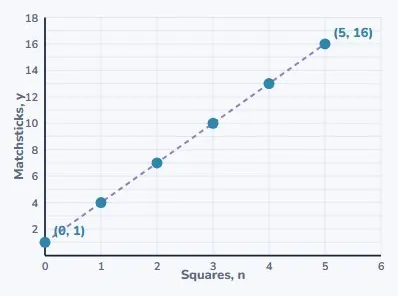
- Each row of the table becomes one point.
- Same climb each step, so the points line up.
- The line crosses the y-axis at 1. That is c.
Why the difference is the gradient
- Rise over run between any two points.
- 12 up for 4 across is 3, the same as the table.
- The difference is the rise for a run of exactly 1.
| Between | Rise over run | Gradient |
|---|---|---|
| (1, 4) and (5, 16) | (16 − 4) ÷ (5 − 1) | 12 ÷ 4 = 3 |
| (2, 7) and (3, 10) | 3 ÷ 1 | 3 |
| A run of 1 | the rise is the difference | same number |
| So | difference = gradient | m = 3 |
When x jumps by more than 1
- Here x goes up in twos, and y goes up by 6.
- That is 6 for every 2 across, so m = 3, not 6.
- At x = 0, y = 5. So y = 3x + 5.
| x | y | Change |
|---|---|---|
| 0 | 5 | |
| 2 | 11 | +6 for +2 across |
| 4 | 17 | +6 for +2 across |
| 6 | 23 | m = 6 ÷ 2 = 3 |
A gradient with units
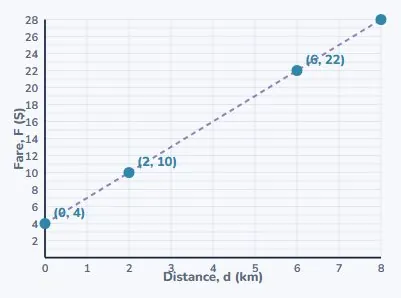
- 2 km costs $10. 6 km costs $22.
- Rise $12, run 4 km: $3 per km.
- Units of a gradient: y units per one x unit.
What the intercept means
- Back 2 km from $10, taking $3 each: $4.
- The gradient: each extra km adds $3.
- The intercept: $4 is charged before the taxi moves.
| Part | Value | Meaning |
|---|---|---|
| Gradient | $12 ÷ 4 km | $3 per km |
| Its units | y units per x unit | dollars per km |
| Intercept | 10 − 2 × 3 = 4 | $4 before moving |
| Equation | F = 3d + 4 | check d = 6: $22 |
When does the line reach $25?
- Set the rule equal to the value: 3d + 4 = 25.
- Take off the fixed charge, then divide by the rate.
- Seven kilometres.
| Step | Working | Result |
|---|---|---|
| Budget $25 | 3d + 4 = 25 | |
| Take off the $4 | 3d = 21 | |
| Divide by $3 per km | d = 7 | 7 km |
| On the taxi graph | across from 25 | down to 7 |
A negative rate of change
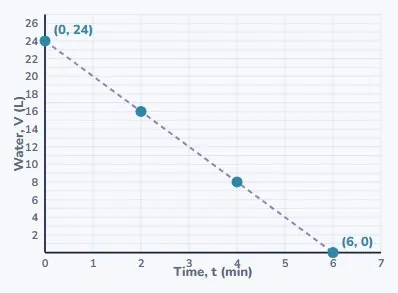
- A tank starts with 24 litres and drains steadily.
- 16 L at 2 minutes, 8 L at 4 minutes.
- Minus 8 litres over 2 minutes: −4 L per minute.
Two intercepts, two meanings
- Vertical intercept: 24 litres at the start.
- So V = 24 − 4t.
- Time intercept: V = 0 when t = 6. Empty at 6 minutes.
| Feature | Value | Meaning |
|---|---|---|
| Vertical intercept | 24 L | full at the start |
| Gradient | −8 L ÷ 2 min | −4 L per minute |
| Equation | V = 24 − 4t | |
| Time intercept | 24 − 4t = 0 | empty at 6 minutes |
When are there 10 litres left?
- Solve 24 − 4t = 10. So 4t = 14.
- t = 3.5 minutes. Substitute back to check.
- Sense check: 10 L sits between 16 L and 8 L.
| Step | Working | Result |
|---|---|---|
| 10 L left? | 24 − 4t = 10 | |
| Rearrange | 4t = 14 | t = 3.5 minutes |
| Check | 24 − 4 × 3.5 | 10, correct |
| Sense check | 16 L at 2, 8 L at 4 | 10 is between |
What to take away
- Seven lines. The first two find the rule, the rest read it.
| Constant difference | linear; with x up in 1s, it is m |
| Term zero | step back once to find c |
| Gradient | rise over run, any two points |
| x steps by more than 1 | divide the change by the step |
| Units of a gradient | y units per one x unit |
| The intercept c | the value when x is zero |
| Reaching a value | set the rule equal to it, solve |
Your turn: four questions
- Pause here and give a reason for each step.
- Question 2: watch how far x moves each time.
- Question 3 needs a sign and units.
| Question | |
|---|---|
| 1 | Tiles: 6, 11, 16, 21 for n = 1 to 4. Find the rule. |
| 2 | x = 0, 3, 6 gives y = 2, 8, 14. Write y = mx + c. |
| 3 | Steady drain, 90 L to 30 L in 12 min. Find m, with units. |
| 4 | Hall hire: C = 40h + 75. What does 75 mean? Hours for $275? |
Show answer
1. y = 5n + 1. The tiles go up by 5 each step, so m = 5, and stepping back once gives term zero 6 − 5 = 1. Check n = 4: 21. 2. y = 2x + 2. y rises 6 while x rises 3, so m = 6 ÷ 3 = 2, not 6. At x = 0, y = 2, so c = 2. 3. m = −5 litres per minute. The change is −60 L over 12 min, and the minus sign says the water is going down. 4. $75 is the fixed charge, paid before any hours. 40h + 75 = 275 gives 40h = 200, so 5 hours. Watch for students who use 60 as the rise in Q3 without the sign, or 6 as the gradient in Q2.
The answers
- y = 5n + 1.
- y = 2x + 2.
- m = −5 litres per minute.
- $75 is the fixed charge. 5 hours.
Is your child on track?
Take the free placement test