Simultaneous equations: elimination and substitution
What this lesson covers
- Two equations in two unknowns are solved by the pair of values that makes both true at once.
- Graphically, that pair is the point where the two lines cross.
One pair that fits both
- X plus y is 10, and x minus y is 4.
- Lots of pairs fit one equation. Only one fits both.
- That pair, x is 7 and y is 3, is the solution.
| Pair | x + y = 10? | x − y = 4? |
|---|---|---|
| x = 6, y = 4 | yes, 10 | no, 2 |
| x = 8, y = 2 | yes, 10 | no, 6 |
| x = 9, y = 5 | no, 14 | yes, 4 |
| x = 7, y = 3 | yes, 10 | yes, 4 |
Why you can add two equations
- Each equation says two amounts are equal.
- Add equal to equal and the totals are still equal.
- Plus y and minus y cancel, so y is eliminated.
| Line | Reason | Result |
|---|---|---|
| x + y = 10 | two equal amounts | |
| x − y = 4 | two more equal amounts | |
| Add left, add right | equal + equal is equal | 2x = 14 |
| The y terms | +y and −y cancel | x = 7 |
| Back in the first | 7 + y = 10 | y = 3 |
Elimination by adding
- Plus two y and minus two y: opposite signs.
- Add, and eight x is thirty-two, so x is four.
- Y is three. Check it in both equations.
| Step | Working | Result |
|---|---|---|
| 3x + 2y = 18 | 5x − 2y = 14 | +2y and −2y |
| Add them | 8x = 32 | x = 4 |
| x = 4 in the first | 12 + 2y = 18 | y = 3 |
| Check the first | 12 + 6 = 18 | true |
| Check the second | 20 − 6 = 14 | true |
Elimination by subtracting
- Both have plus two x: the same sign.
- Take the second from the first. Two y is six.
- Y is three, x is two, and both checks hold.
| Step | Working | Result |
|---|---|---|
| 2x + 3y = 13 | 2x + y = 7 | both +2x |
| First take second | 2y = 6 | y = 3 |
| y = 3 in the second | 2x + 3 = 7 | x = 2 |
| Check the first | 4 + 9 = 13 | true |
| Check the second | 4 + 3 = 7 | true |
Add or subtract?
- Look at one letter in both equations.
- Opposite signs, add. Same signs, subtract.
- If the sizes differ, multiply first.
| Coefficients | Do this | Because |
|---|---|---|
| Same size, opposite sign | add | they cancel |
| Same size, same sign | subtract | they cancel |
| Different sizes | multiply first | to make a match |
| Whichever it is | one letter goes | one unknown left |
Multiply one equation first
- Three y and minus y do not match yet.
- Times the whole second equation by three.
- Now add. x is three, y is two, and both check.
| Step | Working | Result |
|---|---|---|
| 4x + 3y = 18 | 2x − y = 4 | no match yet |
| Second × 3 | 6x − 3y = 12 | every term |
| Add to the first | 10x = 30 | x = 3 |
| x = 3 in the second | 6 − y = 4 | y = 2 |
| Check both | 12 + 6 = 18, 6 − 2 = 4 | both true |
With an unknown constant
- X plus y is k, where k is some fixed number.
- Add for x, subtract for y. Nothing new.
- The answers are in terms of k, and they check.
| Step | Working | Result |
|---|---|---|
| x + y = k | x − y = 6 | k is fixed |
| Add them | 2x = k + 6 | x = (k + 6)/2 |
| Subtract them | 2y = k − 6 | y = (k − 6)/2 |
| Check the sum | 2k/2 | k, true |
| Check the difference | 12/2 | 6, true |
Substitution
- One equation already says what y is.
- So put two x minus one in place of y.
- X is three, y is five. Check in both.
| Step | Working | Result |
|---|---|---|
| y = 2x − 1 | 3x + 2y = 19 | y is alone |
| Replace y | 3x + 2(2x − 1) = 19 | same number |
| Expand, collect | 7x − 2 = 19 | x = 3 |
| Find y | 2 × 3 − 1 | y = 5 |
| Check both | 5 = 5, 9 + 10 = 19 | both true |
The solution on a graph
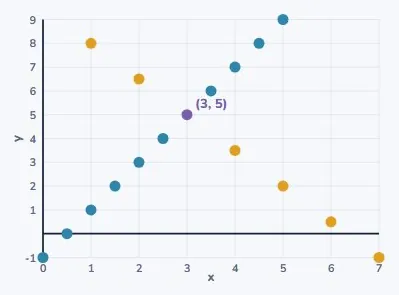
- Blue: y equals two x minus one.
- Gold: three x plus two y equals nineteen.
- Both sets of points pass through (3, 5).
Graphing calculator
Why the crossing is the answer
- Every point on a line fits its own equation.
- Only the crossing point is on both lines.
- Parallel lines never cross, so there is no solution.
| Point | Lies on | So |
|---|---|---|
| A point on one line | fits that equation | only |
| The crossing | is on both lines | fits both |
| (3, 5) | same as the algebra | x = 3, y = 5 |
| Parallel lines | never cross | no pair works |
| y = 2x + 1, y = 2x + 4 | subtract: 0 = 3 | false |
Try it: where the lines cross
Forming the equations
- Tickets to a school production: adults and students.
- Say what each letter stands for first.
- One equation counts people, one counts dollars.
| Fact | Equation | Note |
|---|---|---|
| Letters | a adult, s student | tickets sold |
| 150 people came | a + s = 150 | counts people |
| Adults $12 | students $5 | |
| $1,240 taken | 12a + 5s = 1240 | counts dollars |
Solving the ticket problem
- Times the first by five so the s terms match.
- Subtract: seven a is 490, so a is seventy.
- S is eighty. Check people, then check money.
| Step | Working | Result |
|---|---|---|
| First × 5 | 5a + 5s = 750 | s terms match |
| Second take that | 7a = 490 | a = 70 |
| a = 70 in the first | 70 + s = 150 | s = 80 |
| Check people | 70 + 80 = 150 | true |
| Check money | 840 + 400 = 1240 | true |
Answer the question that was asked
- A is seventy is not yet an answer.
- 70 adult tickets and 80 student tickets were sold.
- Whole, positive numbers: that makes sense for tickets.
What to take away
- Three ways in, one answer, and always two checks.
| A solution | one pair that makes both equations true |
| Opposite signs | add the equations |
| Same signs | subtract them |
| Nothing matches | multiply first, and every term |
| y = ... already | substitute it in |
| On a graph | the point where the two lines cross |
| Every time | check in both original equations |
Common mistakes
- 2x + 3y = 13 and 2x + y = 7: add them to get 4x + 4y = 20Both have +2x, the same sign, so subtract: 2y = 6, giving y = 3 and x = 2.
- Second equation × 3: 6x − 3y = 4Multiply every term, the right side too: 6x − 3y = 12, then add to the first to get 10x = 30.
- 3x + 2(2x − 1) = 19 becomes 3x + 4x − 1 = 19The 2 multiplies both terms in the bracket: 3x + 4x − 2 = 19, so 7x = 21 and x = 3.
- a = 70, s = 80Answer the question in context: 70 adult tickets and 80 student tickets were sold, after checking both the people and the money.
Your turn: four questions
- Write all four out.
- Question 3: define your letters first.
- Check every answer in both equations.
Solve 3x + y = 11 and 2x − y = 4 by elimination.
Solve y = x + 4 and 2x + 3y = 27 by substitution.
Pies $5, sausage rolls $3: 50 sold for $196. How many of each?
Where do the lines y = x + 1 and y = 7 − x cross?
Show answer
1. x = 3, y = 2. The y terms have opposite signs, so add: 5x = 15. Then 9 + y = 11. Check: 9 + 2 = 11 and 6 − 2 = 4. 2. x = 3, y = 7. Replace y: 2x + 3(x + 4) = 27, so 5x + 12 = 27 and 5x = 15. Check: 7 = 3 + 4 and 6 + 21 = 27. 3. 23 pies and 27 sausage rolls. p + r = 50 and 5p + 3r = 196; three times the first is 3p + 3r = 150, and subtracting gives 2p = 46. Check: 23 + 27 = 50 and 115 + 81 = 196. 4. At (3, 4). Both equal y, so x + 1 = 7 − x, 2x = 6, x = 3. Check: 3 + 1 = 4 and 7 − 3 = 4.
The answers
- X is three, y is two.
- X is three, y is seven.
- 23 pies and 27 sausage rolls.
- They cross at (3, 4).
Sample question: Achieved
Solve the simultaneous equations 3x + 2y = 17 and 5x − 2y = 7.
Hint
The y terms are +2y and −2y, opposite signs, so add the equations to eliminate y.
Answer
x = 3, y = 4
Step by step
- We want the one pair of values that makes both equations true at the same time.
- Look at the y terms: +2y and −2y. They are the same size with opposite signs, so adding will make them cancel.
- Add left sides and right sides: 3x + 5x + 2y − 2y = 17 + 7, so 8x = 24.
- Divide by 8: x = 3.
- Put x = 3 into the first equation: 9 + 2y = 17. Subtract 9: 2y = 8, so y = 4.
- Check in the second equation, the one you did not use: 5 × 3 − 2 × 4 = 15 − 8 = 7. Correct.
- So x = 3 and y = 4. On a graph, the two lines cross at (3, 4).
Full working
- 8x = 24add: +2y and −2y cancel
- x = 3
- 9 + 2y = 17, so y = 4substitute into the first
- 15 − 8 = 7check in the second
- x = 3, y = 4
Sample questions: Merit
Solve the simultaneous equations 4x + 3y = 5 and 3x − 2y = 8.
Hint
No letter matches yet. Multiply the first equation by 2 and the second by 3, so the y terms become +6y and −6y.
Answer
x = 2, y = −1
Step by step
- Neither letter has matching sizes, so multiply first. Choose the y terms, because their signs are already opposite.
- 3y and 2y both go into 6y. Multiply every term of the first equation by 2: 8x + 6y = 10.
- Multiply every term of the second equation by 3: 9x − 6y = 24. Multiplying only the left side is the classic mistake.
- Now +6y and −6y have opposite signs, so add: 17x = 34.
- Divide by 17: x = 2.
- Substitute into the first equation: 4 × 2 + 3y = 5, so 8 + 3y = 5, 3y = −3 and y = −1.
- Check in the second equation: 3 × 2 − 2 × (−1) = 6 + 2 = 8. Correct.
- Check in the first: 8 + 3 × (−1) = 5. Correct. So x = 2, y = −1.
Full working
- 8x + 6y = 10first equation × 2
- 9x − 6y = 24second equation × 3
- 17x = 34, so x = 2add
- 8 + 3y = 5, so y = −1substitute
- 6 + 2 = 8check in the second
- x = 2, y = −1
At a café, 3 coffees and 2 muffins cost $21. 2 coffees and 5 muffins cost $25. Find the price of a coffee and of a muffin.
Hint
Say what each letter stands for, write one equation for each order, then make the coffee terms match.
Answer
A coffee costs $5 and a muffin costs $3
Step by step
- Define the letters first: c is the price of one coffee and m is the price of one muffin, in dollars.
- First order: 3c + 2m = 21. Second order: 2c + 5m = 25.
- Make the c terms match. 3 and 2 both go into 6. Multiply the first equation by 2: 6c + 4m = 42.
- Multiply the second equation by 3: 6c + 15m = 75.
- Both have +6c, the same sign, so subtract. Take the first from the second: 11m = 33, so m = 3.
- Substitute into 3c + 2m = 21: 3c + 6 = 21, so 3c = 15 and c = 5.
- Check the second order: 2 × 5 + 5 × 3 = 10 + 15 = $25. Correct.
- Answer in words: a coffee costs $5 and a muffin costs $3. Both are positive, which makes sense for prices.
Full working
- 3c + 2m = 21, 2c + 5m = 25c coffee, m muffin, in dollars
- 6c + 4m = 42 and 6c + 15m = 75× 2 and × 3
- 11m = 33, so m = 3subtract
- 3c + 6 = 21, so c = 5substitute
- 10 + 15 = 25check
- Coffee $5, muffin $3
Sample questions: Excellence
Consider the simultaneous equations 2x + ky = 6 and 3x + 6y = 10, where k is a number. (a) Show that y = 212 − 3k. (b) Explain why there is no solution when k = 4, using the graphs. (c) Find the value of k that makes y = 1, and the matching value of x.
Hint
Eliminate x: multiply the first equation by 3 and the second by 2, then subtract. Treat k as a number you have not been told.
Answer
(b) both lines have the same gradient, so they are parallel and never cross (c) k = 103 and x = 43
Step by step
- (a) Eliminate x. 2x and 3x both go into 6x. Multiply the first equation by 3: 6x + 3ky = 18.
- Multiply the second by 2: 6x + 12y = 20.
- Subtract the second from the first: 3ky − 12y = −2.
- Take out y as a common factor: y(3k − 12) = −2, so y = −23k − 12.
- Multiply top and bottom by −1 to tidy it: y = 212 − 3k. That is what we had to show.
- (b) k = 4 makes the bottom 12 − 12 = 0, and you cannot divide by zero. The step before says 0 × y = −2, which is impossible.
- Using the graphs: with k = 4 the first line is 2x + 4y = 6, so y = −x2 + 32. The second is 3x + 6y = 10, so y = −x2 + 53.
- Both have gradient −12 but different intercepts, so they are parallel. Parallel lines never cross, so there is no solution.
- (c) y = 1 means 212 − 3k = 1, so 12 − 3k = 2. Then 3k = 10 and k = 103.
- Find x from the second equation, which has no k in it: 3x + 6 × 1 = 10, so 3x = 4 and x = 43.
- Check in the first equation: 2 × 43 + 103 × 1 = 83 + 103 = 183 = 6. Correct.
Full working
- 6x + 3ky = 18 and 6x + 12y = 20× 3 and × 2
- y(3k − 12) = −2subtract, take out y
- y = 212 − 3k
- k = 4: both gradients −12, different interceptsparallel, no solution
- 12 − 3k = 2, so k = 103y = 1
- 3x + 6 = 10, so x = 43second equation
- k = 103, x = 43
A harbour ferry charges $12 for an adult and $7 for a child. One sailing carried 85 passengers and took $815. (a) How many adults and how many children were on board? (b) The next day, the log says 85 passengers paid $818. Show that this record must be wrong.
Hint
Write one equation that counts people and one that counts dollars. For (b), solve the same way and look at whether the answer makes sense for people.
Answer
(a) 44 adults and 41 children (b) it gives 44.6 adults, which is not a whole number, so the record is wrong
Step by step
- Define the letters: a is the number of adults and c is the number of children.
- People: a + c = 85. Dollars: 12a + 7c = 815.
- The first equation gives c = 85 − a, so substitute it into the second: 12a + 7(85 − a) = 815.
- Expand: 12a + 595 − 7a = 815, so 5a + 595 = 815.
- Subtract 595: 5a = 220, so a = 44. Then c = 85 − 44 = 41.
- Check the money: 12 × 44 + 7 × 41 = 528 + 287 = $815. Correct.
- (b) Same people, new total: 12a + 7(85 − a) = 818, so 5a + 595 = 818 and 5a = 223.
- a = 223 ÷ 5 = 44.6. You cannot have 0.6 of an adult, so no whole numbers of adults and children fit.
- Another way to see it: each adult swapped for a child changes the total by $5, so every possible total is 595 plus a multiple of 5. 818 − 595 = 223 is not a multiple of 5.
- So the log must have a mistake: either the number of passengers or the takings is wrong.
Full working
- a + c = 85, 12a + 7c = 815people and dollars
- 12a + 7(85 − a) = 815c = 85 − a
- 5a = 220, so a = 44, c = 41
- 528 + 287 = 815check
- 5a = 818 − 595 = 223, so a = 44.6not a whole number
- (a) 44 adults, 41 children (b) 44.6 adults is impossible
Equality Explorer: Two Variables
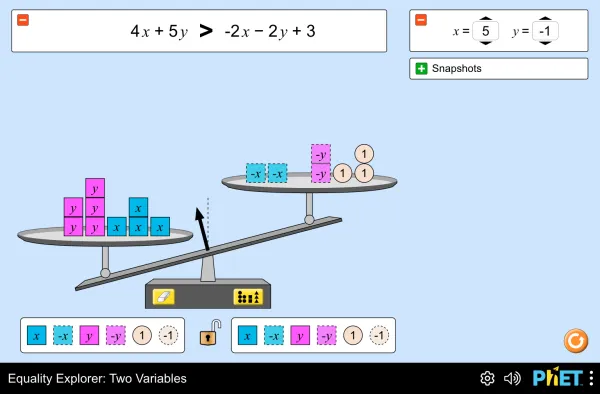
Full screen · PhET Interactive Simulations, University of Colorado Boulder, CC BY 4.0
Practise this
Report a mistake
More in AS 91947
 Expanding, index laws and algebraic fractions8 min
 Factorising quadratics, HCF and difference of squares8 min
 Algebraic proof: even, odd and consecutive numbers8 min
 Solving linear equations and inequations8 min
 Solving quadratic equations by factorising8 minSimultaneous equations: elimination and substitution8 min
 Straight-line graphs, gradient and rate of change8 min
 Optimal solutions: break-even and maximum area7 min
 Pythagoras' theorem in 2D and 3D explained7 min
 Trigonometry: SOH CAH TOA, elevation and 3D7 min
 Similar shapes: scale factors, area and volume7 min
 Surface area of pyramids, cones and spheres7 min
 Volume of cones, pyramids, spheres and composite solids7 min
 Expressions: 7 exam questions solved step by step11 min
 Factorising: 7 exam questions solved step by step10 min
 Generalising: 7 exam questions solved step by step10 min
 Equations and inequations: 7 exam questions solved11 min
 Quadratic equations: 7 exam questions solved step by step11 min
 Simultaneous equations: 7 exam questions solved step by step12 min
 Straight-line graphs: 7 exam questions solved step by step11 min
 Optimal solutions: 7 exam questions solved step by step11 min
 Pythagoras: 7 exam questions solved step by step11 min
 Trigonometry: 7 exam questions solved step by step10 min
 Similar shapes: 7 exam questions solved step by step10 min
 Surface area: 7 exam questions solved step by step11 min
 Volume: 7 exam questions solved step by step10 min
Is your child on track?
Take the free placement test