Optimal solutions: break-even and maximum area
What this lesson covers
- The best option depends on the quantity being compared, so the comparison has to be set up before the choice is made.
- Where two cost rules cross is the point at which the better option changes.
Optimal means best at something
- Cheapest, largest and quickest are different questions.
- So name the measure before you compare anything.
- Then the optimal choice is the best by that measure.
| Situation | Measure | Best is |
|---|---|---|
| Hiring a kayak | total cost | the lowest |
| Fencing a garden | area enclosed | the largest |
| Getting to school | time taken | the shortest |
| So first | name the measure | then compare |
Two hire plans, as equations
- Each plan is a fixed fee plus a rate for every hour.
- The rate multiplies h. The fixed fee stands alone.
- P = 10 + 2h and Q = 4 + 3h.
| Plan | In words | Equation |
|---|---|---|
| Plan P | $10, then $2 an hour | P = 10 + 2h |
| Plan Q | $4, then $3 an hour | Q = 4 + 3h |
| h | hours of hire | whole hours |
| Fixed fee | the number on its own | rate goes with h |
Try a few hires first
- Short hires: Q wins, because its fee is small.
- Long hires: P wins, because its rate is small.
- So somewhere in between, the winner changes.
| Hire | Plan P | Plan Q |
|---|---|---|
| 2 hours | $14 | $10, Q wins |
| 4 hours | $18 | $16, Q wins |
| 8 hours | $26 | $28, P wins |
| Somewhere between | the two | are equal |
The break-even point
- Break-even means the two costs are equal.
- Set P equal to Q and solve like any equation.
- h = 6, and both plans cost $22. Checked.
| Step | Working | Check |
|---|---|---|
| P = Q | 10 + 2h = 4 + 3h | |
| Take 2h off both | 10 = 4 + h | |
| Take 4 off both | h = 6 | |
| Check | P: 10 + 12 = 22 | Q: 4 + 18 = 22 |
Where the two plans cross
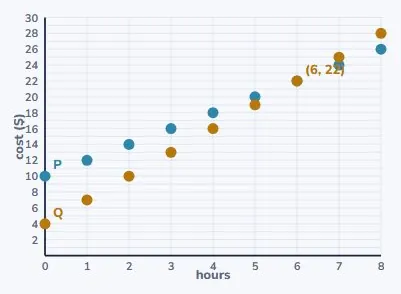
- Q starts lower but climbs faster.
- They meet at 6 hours and $22.
- After the crossing, P is the lower one.
When is Plan P cheaper?
- Cheaper means less than, so write P < Q.
- Solve it exactly as you solved the equation.
- h > 6. No negative multiplier, so no reversal.
| Step | Working | Result |
|---|---|---|
| P cheaper | 10 + 2h < 4 + 3h | |
| Take 2h off both | 10 < 4 + h | |
| Take 4 off both | 6 < h | so h > 6 |
| Check h = 7 | P $24, Q $25 | P cheaper |
Answer in hours, not in h
- Hire is charged in whole hours.
- So h > 6 means seven hours or more.
- Give all three cases, including the tie.
| Hire | Better plan | Because |
|---|---|---|
| 1 to 5 hours | Q is cheaper | h < 6 |
| Exactly 6 hours | same cost, $22 | h = 6 |
| 7 hours or more | P is cheaper | h > 6 |
| Whole hours | so h > 6 means | 7, 8, 9, ... |
Justifying the choice
- State the choice and the measure.
- Give the numbers that prove it.
- Say why, using the break-even point.
| Part | For a 3-hour hire |
|---|---|
| The choice | Plan Q, for 3 hours |
| The measure | it is the cheaper plan |
| The numbers | Q costs $13, P costs $16 |
| The reason | Q is cheaper for any hire under 6 hours |
A different measure: the most area
- 12 m of fence, with a wall along one side.
- The width x is fenced twice, so it uses 2x.
- Area is width times length: A = x(12 − 2x).
| Part | Reasoning | Expression |
|---|---|---|
| Fence | 12 m, wall on one side | |
| Width x | used twice | 2x |
| Length | what is left | 12 − 2x |
| Area | width × length | A = x(12 − 2x) |
Try some widths
- Too narrow is small. Too wide is small too.
- The areas rise, then fall in the same steps.
- That mirror pattern is the clue.
| Width | Length | Area |
|---|---|---|
| 1 m | 10 m | 10 m² |
| 2 m | 8 m | 16 m² |
| 3 m | 6 m | 18 m² |
| 4 m | 4 m | 16 m² |
| 5 m | 2 m | 10 m² |
Where the area is zero
- The model is already factorised.
- A product is zero when one factor is zero.
- So the zeros are x = 0 and x = 6.
| Case | Working | Meaning |
|---|---|---|
| A = 0 when | x = 0 | no width |
| or when | 12 − 2x = 0 | x = 6 |
| x = 6 | length is 0 | no garden |
| Zeros | 0 and 6 | the ends |
The maximum is halfway
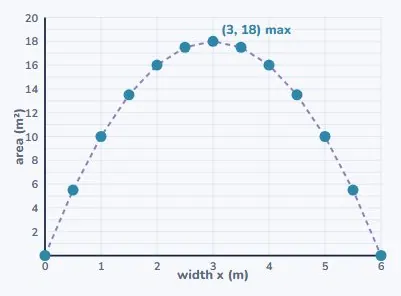
- A parabola is symmetric, and this one opens downward.
- Halfway between 0 and 6 is x = 3.
- A = 3 × 6 = 18 m². That is the maximum.
Any length of fence
- Fence L metres: x(L − 2x), which opens downward.
- The zeros are 0 and L/2, so the middle is L/4.
- Maximum area: L²/8. With L = 12 it is 18.
| Step | Working | Result |
|---|---|---|
| Fence L | A = x(L − 2x) | |
| Zeros | x = 0 and x = L/2 | |
| Midpoint | x = L/4 | length L/2 |
| Maximum | (L/4)(L/2) | L²/8 |
| Check L = 12 | 144 ÷ 8 | 18, as before |
What to take away
- Seven lines, and every one starts by naming the measure.
| Optimal | best by a measure you name first |
| Two plans | write an equation for each |
| Break-even | set them equal and solve |
| Which is cheaper | an inequation, read in context |
| Whole numbers | h > 6 means 7 hours or more |
| Maximum of x(L − 2x) | halfway between the zeros |
| Justify | choice, measure, numbers, reason |
Your turn: four questions
- Pause here and write each one out in full.
- Question 2 wants a whole number of guests.
- Question 4 has four sides fenced, not three.
| Question | |
|---|---|
| 1 | Hall P $120 + $5/guest, Q $40 + $9/guest. Equal cost when? |
| 2 | Use an inequation: for how many guests is Hall P cheaper? |
| 3 | A garden: A = x(16 − 2x) (x in metres). Find its maximum area. |
| 4 | 20 m of fence goes round all 4 sides. Width for largest area? |
Show answer
1. 20 guests. 120 + 5n = 40 + 9n gives 80 = 4n, so n = 20, and both halls cost $220. 2. 21 guests or more. 120 + 5n < 40 + 9n gives 80 < 4n, so n > 20, and guests come in whole numbers. Check 21: P is $225, Q is $229. 3. 32 m². Expanded, A = −2x² + 16x; the x² term is negative, so the graph opens downward and its turning point is a maximum. The zeros are x = 0 and x = 8, the midpoint is x = 4, the length is 16 − 8 = 8, and 4 × 8 = 32. 4. 5 m. Width x leaves length 10 − x, so A = x(10 − x) with zeros 0 and 10. Halfway is 5, a 5 m square of 25 m², and widths 4 and 6 give only 24 m².
The answers
- 20 guests, where both halls cost $220.
- 21 guests or more.
- Opens downward: 32 m², at a width of 4 m.
- A width of 5 m: a square of 25 m².
Is your child on track?
Take the free placement test