Pythagoras' theorem in 2D and 3D explained
What this lesson covers
- In a right-angled triangle, the square on the hypotenuse equals the sum of the squares on the other two sides.
- A 3D length is found by using Pythagoras' theorem twice, in two right-angled triangles that share a side.
Year 10 drew the triangle for you
- Now you find the triangle yourself.
- Some lengths need two triangles, in 3D.
- Give exact answers, then rounded ones.
| Level | What you do |
|---|---|
| Year 10 | find a side of a triangle already drawn |
| Level 1 | find the triangle inside a context |
| Level 1 | a 3D length, from two triangles |
| Level 1 | exact surd, then rounded, with reasons |
Which side is the hypotenuse
- Only in a right-angled triangle.
- The hypotenuse is opposite the right angle.
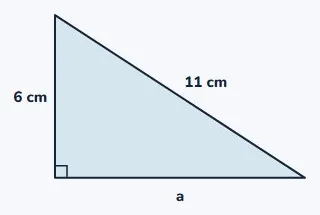
- It is always the longest side. 3² + 4² = 9 + 16 = 25 = 5²
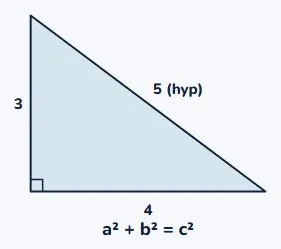
Finding the hypotenuse
- c is opposite the right angle.
- c² = 81 + 36 = 117
- c = √117 = 3√13 ≈ 10.8 cm
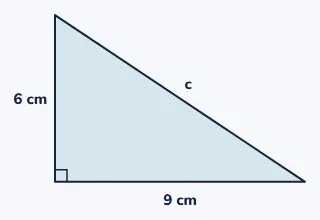
Finding a shorter side
- The 11 cm side is the hypotenuse.
- a² = 121 − 36 = 85
- a = √85 ≈ 9.2 cm, shorter than 11
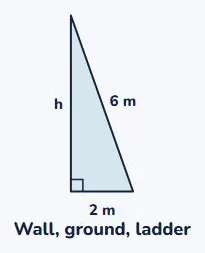
A ladder against a wall
- The wall meets the ground at a right angle.
- h² = 36 − 4 = 32
- h = √32 = 4√2 ≈ 5.66 m
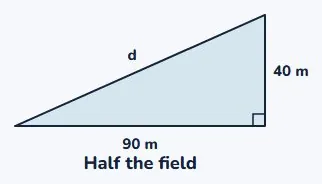
Across a rectangular field
- The diagonal cuts the field into two right-angled triangles.
- d² = 8100 + 1600 = 9700
- d = √9700 = 10√97 ≈ 98.5 m
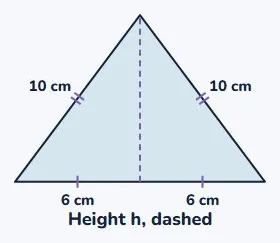
An isosceles triangle, split in two
- The height cuts the base in half, at 90°.
- Each half: legs 6 cm and h, hypotenuse 10 cm.
- h² = 100 − 36 = 64, so h = 8 cm
Is it right-angled? The converse
- Square the two shorter sides and add.
- Square the longest side.
- Equal means a right angle. Not equal means none.
| Sides | a² + b² | c² | So |
|---|---|---|---|
| 7, 24, 25 | 49 + 576 = 625 | 625 | right angle |
| 6, 7, 9 | 36 + 49 = 85 | 81 | no right angle |
| Test | two shorter sides | longest side | equal or not |
The space diagonal of a cuboid
- From one corner to the opposite corner, through the inside.
- It is not on any face, so no single triangle holds it.
- Use two triangles that share a side.
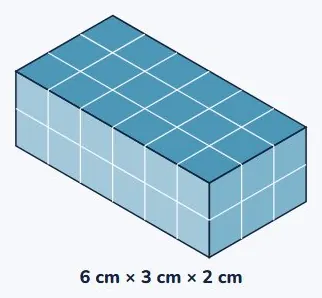
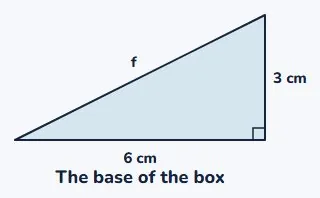
Triangle 1: across the floor
- Length and width meet at a right angle.
- f² = 36 + 9 = 45
- Keep f = √45. Do not round yet.
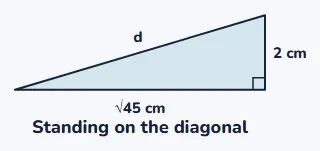
Triangle 2: up to the far corner
- The height stands at 90° to the floor diagonal.
- d² = 45 + 4 = 49
- d = 7 cm exactly
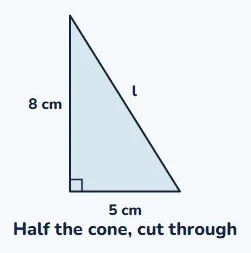
The slant height of a cone
- Cut the cone down the middle.
- Radius, height and slant make a right-angled triangle.
- l² = 25 + 64 = 89, so l = √89 ≈ 9.4 cm
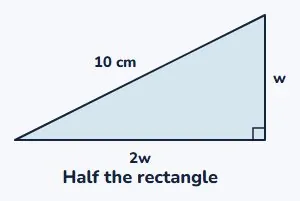
Setting it up with an unknown
- Let the width be w cm. The length is 2w.
- w² + 4w² = 100, so 5w² = 100 and w² = 20
- w = √20 = 2√5 ≈ 4.47 cm, length ≈ 8.94 cm
What to take away
- Find the right angle, name the hypotenuse, then say why.
| a² + b² = c² | c is the hypotenuse, opposite the right angle |
| Finding c | add the squares, then square root |
| A shorter side | subtract: the hypotenuse squared minus the other |
| In a context | find the right angle, draw the triangle |
| The converse | if a² + b² = c², there is a right angle |
| In 3D | two triangles that share a side |
| Answers | exact first, then rounded, with units |
Your turn: four questions
- Pause here and write all four out, with reasons.
- Give exact answers, then round sensibly.
- Question 3 needs two triangles.
| Question | |
|---|---|
| 1 | Hypotenuse 12 cm, one side 7 cm. Find the third side. |
| 2 | A gate is 3 m wide and 1.2 m high. How long is its diagonal? |
| 3 | A box is 8 cm by 4 cm by 1 cm. Find its space diagonal. |
| 4 | Sides 9 cm, 12 cm and 16 cm. Is it right-angled? Why? |
Show answer
1. √95 ≈ 9.7 cm. The 12 cm side is the hypotenuse, so subtract: 144 − 49 = 95. 2. √10.44 ≈ 3.23 m. The width, height and diagonal make a right-angled triangle with the diagonal as hypotenuse: 9 + 1.44 = 10.44. 3. 9 cm exactly. Floor diagonal squared is 64 + 16 = 80 (keep √80), then space diagonal squared is 80 + 1 = 81. 4. No. 9² + 12² = 81 + 144 = 225, but 16² = 256. The squares do not match, so by the converse there is no right angle.
The answers
- √95 ≈ 9.7 cm. Subtract: 144 − 49 = 95.
- √10.44 ≈ 3.23 m. Add: 9 + 1.44 = 10.44.
- 9 cm exactly: √80 across the floor, then 80 + 1 = 81.
- No: 81 + 144 = 225, but 16² = 256.
Is your child on track?
Take the free placement test