Trigonometry: SOH CAH TOA, elevation and 3D
What this lesson covers
- In similar right-angled triangles the ratios of sides are fixed for a given angle, which is what sine, cosine and tangent name.
- Choosing the ratio depends on which two sides are known or wanted relative to the angle.
Pythagoras needs two sides
- Pythagoras links the three sides, and no angles.
- Trigonometry links a side to an angle.
- So one side and one angle is enough.
| What you know | What you can find | Tool |
|---|---|---|
| Year 10: Pythagoras | two sides give the third | no angles used |
| Level 1: a side | from a side and an angle | sin, cos or tan |
| Level 1: an angle | from two sides | inverse functions |
| Every step | says why it is allowed |
Same angle, same shape
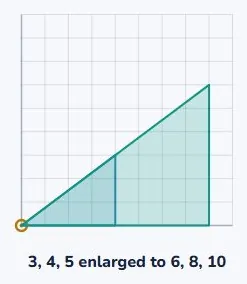
- Enlarge a right triangle from the corner with the angle.
- Every side doubles. The angle does not change.
- So the sides stay in the same proportion.
The ratios belong to the angle
- Divide one side by another in each triangle.
- The answers are identical every time.
- Sine, cosine and tangent are names for these ratios.
| Sides | opp ÷ hyp | adj ÷ hyp | opp ÷ adj |
|---|---|---|---|
| 3, 4, 5 | 3 ÷ 5 = 0.6 | 4 ÷ 5 = 0.8 | 3 ÷ 4 = 0.75 |
| 6, 8, 10 | 6 ÷ 10 = 0.6 | 8 ÷ 10 = 0.8 | 6 ÷ 8 = 0.75 |
| 9, 12, 15 | 9 ÷ 15 = 0.6 | 12 ÷ 15 = 0.8 | 9 ÷ 12 = 0.75 |
| Angle 36.9° | sin = 0.6 | cos = 0.8 | tan = 0.75 |
Label the sides from the angle
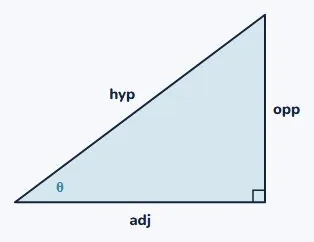
- Hypotenuse: opposite the right angle, the longest side.
- Opposite: across the triangle from θ.
- Adjacent: next to θ, and not the hypotenuse.
Move the angle, the labels move
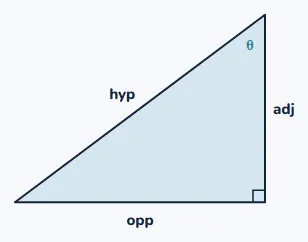
- Same triangle, now θ is at the top corner.
- The vertical side is next to θ now: adjacent.
- The hypotenuse never moves.
SOH CAH TOA picks the ratio
- Label the side you know and the side you want.
- The third side is not involved.
- The ratio that uses your two sides is the one.
| Rule | Ratio | Uses |
|---|---|---|
| SOH | sin θ = opp ÷ hyp | opp and hyp |
| CAH | cos θ = adj ÷ hyp | adj and hyp |
| TOA | tan θ = opp ÷ adj | opp and adj |
| To choose | label all three sides | drop the unused one |
Finding a side: unknown on top
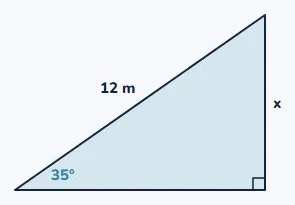
- x is opposite 35°, 12 m is the hyp: SOH.
- sin 35° = x ÷ 12, so x = 12 × sin 35°.
- x = 6.88 m (3 s.f.)
Finding a side: unknown on the bottom
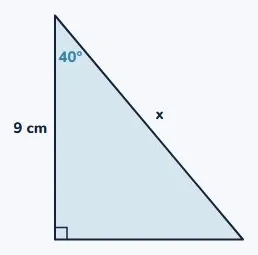
- 9 cm is adjacent to 40°, x is the hyp: CAH.
- cos 40° = 9 ÷ x, so x × cos 40° = 9.
- x = 9 ÷ cos 40° = 11.7 cm (3 s.f.)
Finding an angle: go backwards
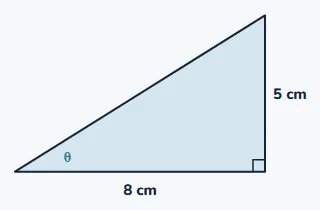
- 5 cm opposite, 8 cm adjacent: TOA.
- tan θ = 5 ÷ 8 = 0.625
- θ = tan⁻¹(0.625) = 32.0° (1 d.p.)
Degree mode, and rounding
- Check the mode: sin 30° should give 0.5.
- Keep every digit until the last line.
- Round the answer, and say how you rounded.
| Setting | Test or rule | Why |
|---|---|---|
| Degree mode | sin 30° = 0.5 | check it first |
| Radian mode | sin 30 = −0.988 | wrong mode |
| Mid-working | keep every digit | round at the end |
| Lengths | 3 significant figures | with units |
| Angles | 1 decimal place | say you rounded |
Angle of elevation: a tree
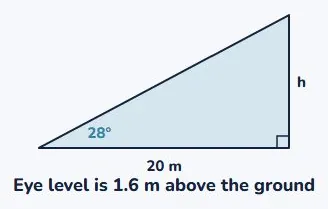
- 20 m from the tree, looking up 28° from eye level.
- tan 28° = h ÷ 20, so h = 20 × tan 28° = 10.634… m
- Add eye height 1.6 m: the tree is 12.2 m (3 s.f.)
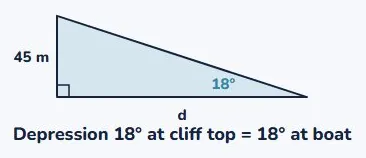
Angle of depression: a boat
- Looking down 18° from a 45 m cliff to a boat.
- Alternate angles: 18° at the boat too.
- d = 45 ÷ tan 18° = 138 m (3 s.f.)
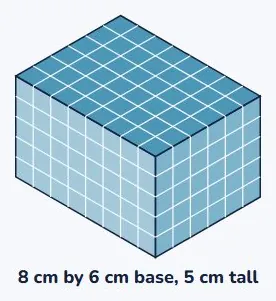
In 3D: Pythagoras on the base first
- A cuboid 8 cm by 6 cm, 5 cm tall.
- The space diagonal sits above the base diagonal.
- Base diagonal = √(8² + 6²) = √100 = 10 cm
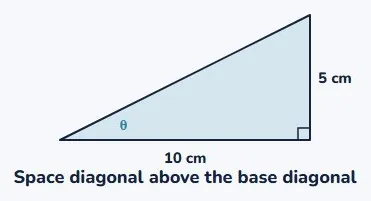
Then trigonometry in the upright triangle
- Height 5 cm opposite θ, base diagonal 10 cm adjacent.
- tan θ = 5 ÷ 10 = 0.5
- θ = tan⁻¹(0.5) = 26.6° (1 d.p.)
What to take away
- Label from the angle, choose the ratio, then give the reason.
| Why ratios work | same angle, same side ratios |
| Label from the angle | opp faces it, hyp faces the right angle |
| Choose the ratio | the two sides involved pick SOH, CAH or TOA |
| Unknown on top | multiply: x = 12 × sin 35° |
| Unknown on bottom | divide: x = 9 ÷ cos 40° |
| Finding an angle | use sin⁻¹, cos⁻¹ or tan⁻¹ |
| Depression | equals the elevation from below |
Your turn: four questions
- Pause here and label each triangle first.
- Question 2 needs the alternate-angle reason.
- Question 4 needs Pythagoras before trigonometry.
| Question | |
|---|---|
| 1 | A 6 m ladder makes 70° with the ground. How high does it reach? |
| 2 | A 30 m lighthouse sees a kayak at a 12° depression. How far out? |
| 3 | A ramp rises 1.2 m over 9 m across. Find its angle. |
| 4 | A box is 12 by 5 cm, 8 cm tall. Space diagonal angle to the base? |
Show answer
1. 5.64 m. The height is opposite the 70° angle and the ladder is the hypotenuse, so use sine: h = 6 × sin 70° = 5.638. 2. 141 m. The angle of elevation from the kayak is also 12° (alternate angles). tan 12° = 30 ÷ d, so d = 30 ÷ tan 12° = 141.1. 3. 7.6°. Opposite 1.2 and adjacent 9, so tan θ = 1.2 ÷ 9 and θ = tan⁻¹(1.2 ÷ 9) = 7.59…° ≈ 7.6°. 4. 31.6°. Base diagonal by Pythagoras: √(12² + 5²) = 13 cm. Then tan θ = 8 ÷ 13, so θ = tan⁻¹(8 ÷ 13) = 31.6°.
The answers
- 5.64 m, using sine: 6 × sin 70°.
- 141 m, using tan: 30 ÷ tan 12°.
- 7.6°, using tan⁻¹(1.2 ÷ 9).
- 31.6°: base diagonal 13 cm, then tan⁻¹(8 ÷ 13).
Is your child on track?
Take the free placement test