Similar shapes: scale factors, area and volume
What this lesson covers
- Similar shapes have equal corresponding angles and corresponding sides in the same ratio.
- If lengths scale by k, areas scale by k squared and volumes by k cubed.
Year 10 told you they were similar
- Last year the shapes came labelled as similar.
- Now you show that they are, and say why.
- Then use it for lengths, areas and volumes.
| What it asks of you | |
|---|---|
| Year 10 | enlarge by k, find one side |
| Level 1 | prove the shapes are similar first |
| Level 1 | flipped and nested triangles |
| Level 1 | areas by k², volumes by k³ |
Similar needs two things
- Every pair of corresponding angles is equal.
- Every pair of corresponding sides is in the same ratio.
- Either one alone is not enough.
| Case | What happens |
|---|---|
| Condition 1 | corresponding angles are equal |
| Condition 2 | corresponding sides in one ratio, k |
| 2 × 4 rectangle, 3 × 3 square | angles match, sides do not |
| Square, rhombus with 60° | sides match, angles do not |
Are these rectangles similar?
- Every angle in a rectangle is 90°, so only the sides can differ.
- Divide short by short, and long by long.
- One ratio means similar. Two different ratios means not.
| Rectangles | Ratios | Result |
|---|---|---|
| 4 × 6 and 6 × 9 | 6 ÷ 4 = 1.5, 9 ÷ 6 = 1.5 | similar |
| 4 × 6 and 5 × 7 | 1.25 and about 1.17 | not similar |
| The reason | short ÷ short, long ÷ long | one k |
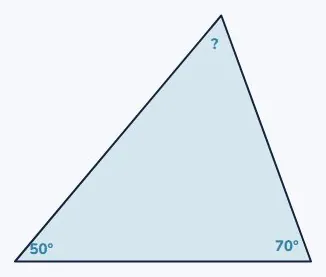
For triangles, two angles are enough
- The angles of a triangle add to 180°.
- So two angles fix the third: here it must be 60°.
- Same three angles, same shape. That is similar.
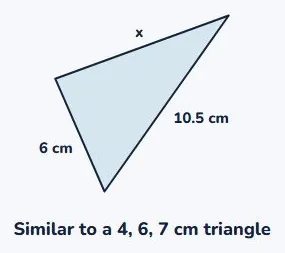
When one triangle is flipped
- Match sides by length, not position.
- Shortest with shortest: 6 ÷ 4 = 1.5. Longest: 10.5 ÷ 7 = 1.5.
- So the middle side is x = 6 × 1.5 = 9 cm.
The scale factor from a known pair
- Find one pair of sides you know on both shapes.
- Here 4 cm on the small one matches 10 cm on this one.
- k = 10 ÷ 4 = 2.5, from small to large.
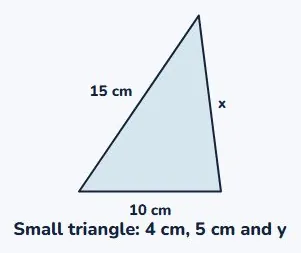
Using k in both directions
- Small to large: multiply by k.
- Large to small: divide by k, or multiply by 1/k.
- Check the answer is bigger or smaller, as it should be.
| Step | Working | Why |
|---|---|---|
| Scale factor | k = 10 ÷ 4 = 2.5 | a known pair |
| Small to large | x = 5 × 2.5 = 12.5 cm | multiply by k |
| Large to small | y = 15 ÷ 2.5 = 6 cm | divide by k |
| Sense check | 12.5 is more than 5 | large is larger |
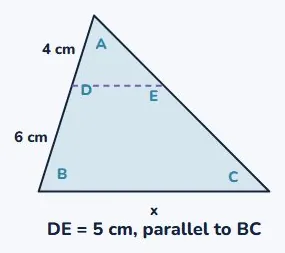
A parallel line makes two triangles
- Triangle ADE sits inside triangle ABC.
- They share angle A.
- DE is parallel to BC, so the angles at D and B are equal.
Use the whole side
- Two equal angles, so the triangles are similar.
- The large triangle's side is 4 + 6 = 10 cm, not 6.
- k = 2.5, so x = 12.5 cm.
| Step | Working | Reason |
|---|---|---|
| Angle A | in both triangles | shared |
| Angles D and B | equal | corresponding, DE ∥ BC |
| Whole side AB | 4 + 6 = 10 cm | not just 6 |
| Scale factor | k = 10 ÷ 4 = 2.5 | AB ÷ AD |
| Missing side | x = 5 × 2.5 = 12.5 cm | not 7.5 |
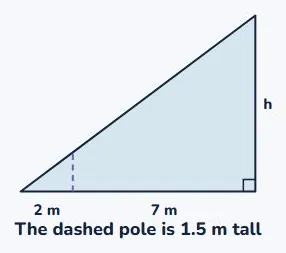
Measuring a tree with a shadow
- The sun's rays hit both at the same angle.
- Both stand upright, so each has a right angle.
- Whole ground 9 m, k = 9 ÷ 2 = 4.5, h = 1.5 × 4.5 = 6.75 m.
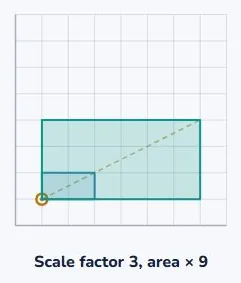
Areas scale by k squared
- Enlarge by 3: the width and the height both triple.
- 2 squares become 18. That is 9 times, and 9 is 3².
- A volume has three lengths, so it scales by k³.
Two similar cylinders
- Radius 4 cm, height 10 cm: volume 160π cm³.
- Large: radius 6 cm, height 15 cm, so k = 1.5.
- Multiply the volume by k³, then check with the formula.
| Step | Working | Note |
|---|---|---|
| Scale factor | k = 6 ÷ 4 = 1.5 | radii, or 15 ÷ 10 |
| Volume factor | k³ = 3.375 | k cubed |
| Large volume | 160π × 3.375 = 540π | exact, cm³ |
| Rounded | about 1696.5 cm³ | 1 decimal place |
| Check | π × 6² × 15 = 540π | formula agrees |
From an area ratio back to lengths
- Two similar garden beds: 20 m² and 45 m².
- The area ratio is k², so take the square root.
- A 4 m edge on the small bed is 6 m on the large one.
| Step | Working | Why |
|---|---|---|
| Area ratio | 45 ÷ 20 = 2.25 | this is k² |
| Length ratio | k = √2.25 = 1.5 | square root |
| Missing length | 4 × 1.5 = 6 m | use k |
| The trap | 4 × 2.25 = 9 m | wrong factor |
What to take away
- Prove it is similar, find k, then choose k, k² or k³.
| Similar | equal angles, sides in one ratio k |
| Triangles | two equal angles are enough |
| Match sides | by the angles, not the position |
| Scale factor | from a known pair, used both ways |
| Parallel line | use the whole side, not the piece |
| Areas | multiply by k² |
| Volumes | multiply by k³; from an area, take √ |
Your turn: four questions
- Pause here and write all four out, with reasons.
- Question 3: is DB the whole side?
- Question 4 is a volume, not a length.
| Question | |
|---|---|
| 1 | One triangle has 35° and 75°, another 75° and 70°. Similar? Why? |
| 2 | A 6, 8, 9 cm triangle is enlarged so 6 becomes 15. Longest side? |
| 3 | DE ∥ BC, AD = 3 cm, DB = 9 cm, DE = 4 cm. Find BC. |
| 4 | Similar jars, 10 cm and 15 cm tall. Small holds 320 mL. Large? |
Show answer
1. Yes. The first triangle's third angle is 180 − 35 − 75 = 70°, so both triangles have angles 35°, 70° and 75°, and two equal angles are enough. 2. 22.5 cm. Shortest matches shortest, so k = 15 ÷ 6 = 2.5, and the longest is 9 × 2.5 = 22.5 cm. 3. 16 cm. Angle A is shared and the angles at D and B are corresponding, so the triangles are similar. AB = 3 + 9 = 12, k = 12 ÷ 3 = 4, so BC = 4 × 4 = 16 cm, not 12. 4. 1080 mL. k = 15 ÷ 10 = 1.5, volumes scale by k³ = 3.375, and 320 × 3.375 = 1080 mL.
The answers
- Yes: the third angle is 70°, so all three match.
- k = 15 ÷ 6 = 2.5, longest 22.5 cm.
- AB = 12, k = 4, so BC = 16 cm.
- k³ = 3.375, so 1080 mL.
Is your child on track?
Take the free placement test