Science 1.1: kauri dieback, the science and the perspectives
What this lesson covers
- A local issue is one that matters to you or your community and that different groups see differently.
- A science idea is a cause and effect, a relationship or a model, not just an observation or a fact.
- Kauri dieback is caused by Phytophthora agathidicida, a soil-borne water mould that infects roots and spreads when soil moves.
- A perspective belongs to a group, such as an iwi, a council or a business, and has its own reasons.
- A science-informed response is an action built on the science idea, like closing tracks and keeping boots off kauri roots.
- Tiakitanga means taking care of, and responsibility for, the issue, and your report must show it.
What makes an issue local
- Science 1.1 (AS 91920) is an internal worth 5 credits: you research one issue and write it up, usually as a report.
- An issue is a topic where groups of people hold different views about what is happening and what should be done.
- Local means it matters to you or to your community, so a problem in your own region, iwi, school or town is ideal.
- Good local issues for Auckland students include kauri dieback in the Waitākere Ranges, sewage overflows at city beaches after rain, and predator control in regional parks.
- Pick an issue with real science behind it and at least one group whose view you can find in its own words, such as a press release or website.
The three parts, and tiakitanga around them
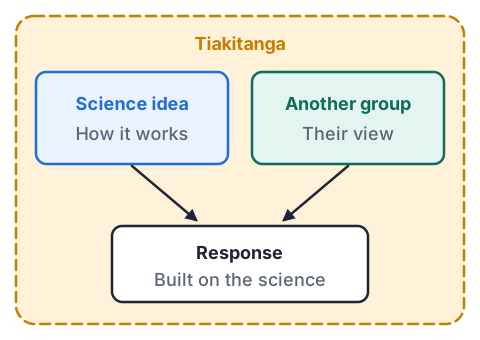
- Part 1 is the science idea behind the science perspective: how something in the issue works.
- Part 2 is another perspective: the view of a particular group, such as an iwi or hapū, a council or a company, and why they hold it.
- Part 3 is the science-informed response: what has been done, or could be done, that rests on the science idea.
- Around all three you show tiakitanga: who is taking care, taking ownership or taking responsibility, and how.
- One person's opinion is not a group perspective, and "people" or "the public" is too broad; name the group.
A fact is not a science idea
- A fact or observation says what is there: "Many kauri in the Waitākere Ranges are dying."
- A science idea links things together: a cause and its effect, a relationship between two things, or a model that explains what we see.
- Turn a fact into an idea by asking how or why, and answering with the science.
- A quick test: if your sentence contains "because", "so" or "which means" and the link is science, it is probably an idea.
| Fact or observation | Science idea |
|---|---|
| Kauri are dying. | A water mould in the soil infects kauri roots and blocks the flow of water and nutrients, so the tree starves. |
| Dead kauri are often near tracks. | The mould travels in soil, so boots carrying soil along tracks spread it from tree to tree. |
| The tracks were closed. | Fewer people on the tracks means less soil moved, so fewer new trees are infected. |
The science idea: how kauri dieback works
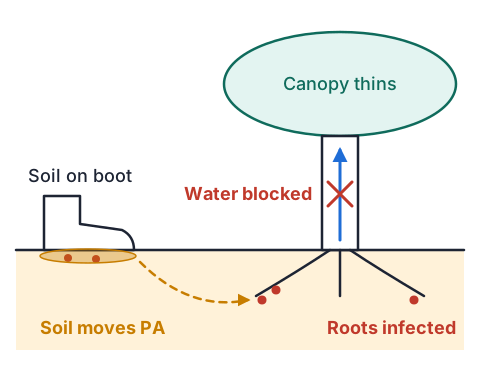
- Kauri dieback is caused by Phytophthora agathidicida, usually shortened to PA, a microscopic water mould (an oomycete, not a fungus) that lives in soil.
- PA infects a kauri through its roots and damages the tissue that carries water and nutrients between the roots and the leaves.
- Without that flow the canopy thins and yellows and the tree slowly starves; it can kill kauri of any age, and there is no known cure.
- PA cannot fly or blow in the wind; it moves when infected soil moves, on footwear, animals, equipment and vehicles.
- So the science idea is a chain of cause and effect: soil moves, PA reaches new roots, roots are infected, the tree cannot move water, the tree dies.
Example: what the Waitākere survey showed
- Auckland Council surveyed kauri in the Waitākere Ranges Regional Park in 2011 and again in 2016, and released the report in 2017.
- Use the numbers to describe the change, then use them as evidence for the science idea.
| Survey | Kauri infected | Possibly infected as well |
|---|---|---|
| 2011 | 7.9% | 2.7% |
| 2016 | 19.0% | 4.7% |
- 19.0 − 7.9 = 11.1 percentage pointsthe rise in the share infected over five years
- 19.0 ÷ 7.9 ≈ 2.4the share infected more than doubled
- about 70% of infection within 50 m of a trackthe disease clusters where people walk
- evidence that people moving soil on tracks spread PA, so cutting soil movement is the response the science points to
Another perspective: Te Kawerau ā Maki
- Te Kawerau ā Maki are mana whenua of the Waitākere Ranges, the iwi with customary authority there.
- On 2 December 2017 they placed a rāhui over the forest, Te Wao Nui a Tiriwa, roughly the Waitākere Ranges Heritage Area, beyond the edges of the regional park.
- A rāhui is a customary prohibition under tikanga: people stay out so the place can recover and regenerate, and it protects it physically and spiritually.
- The iwi said the forest's decline was an existential threat to them and the loss of a taonga, that human movement carrying soil was the main way the disease spread, and that existing measures had failed.
- They asked the public to respect the rāhui and asked Auckland Council and the government to back it with legal controls under the Biosecurity Act 1993.
- Their view draws on both mātauranga and the science: they used the survey numbers, and their reason for acting is their relationship with the forest across generations.
A third group: Auckland Council
- Auckland Council runs the regional park, so it has to weigh protecting kauri against people's access to a much-loved place for walking, tramping and events.
- In December 2017 the council voted 11 to 7 against closing the whole park and closed only high-risk and medium-risk tracks; the iwi, backed by conservation groups such as Forest & Bird, kept calling for full closure.
- On 10 April 2018 the council voted to close the forested area of the park, and the closure took effect on 1 May 2018.
- A track could stay open only if it was outside the forest, away from kauri, or had a surface you could walk in any weather without getting soil on your shoes; 31 tracks were agreed with the iwi.
- Some groups lost out: the Hillary Trail Marathon was cancelled out of respect for the rāhui, which is part of why a council has to balance views.
The science-informed response
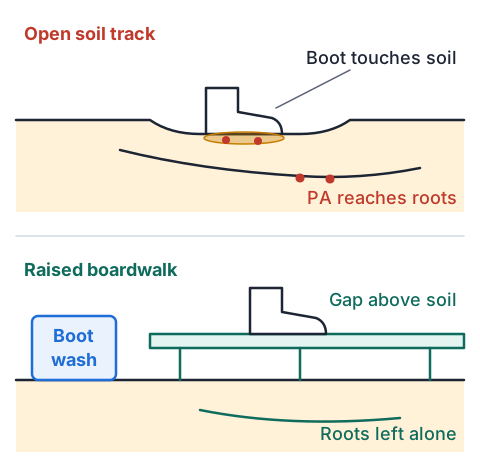
- Closing the forest tracks cut the number of boots moving soil between trees, which is the cause the science identified.
- Tracks that reopened were upgraded with raised boardwalks and hard, dry surfaces, so walkers no longer pick up or drop soil above kauri roots.
- Cleaning stations at track entrances let walkers scrub and spray their footwear, because a speck of soil can carry PA.
- Since 2022 a National Pest Management Plan for kauri dieback brings government, DOC, Māori, councils and communities under one set of rules.
- Each part is science-informed because it targets soil movement, the link in the chain that people can actually control.
Showing tiakitanga
- In this standard, tiakitanga means taking care of the issue, taking ownership of it, or taking responsibility for it, as part of doing science responsibly.
- It is related to kaitiakitanga, the guardianship that tangata whenua hold, but tiakitanga can be shown by anyone.
- Te Kawerau ā Maki showed it by placing the rāhui to protect the forest for future generations.
- The council showed it by closing the forest and paying for track upgrades, even though many visitors were unhappy.
- Scientists show it by cleaning their own boots and gear between sites so their sampling does not spread PA, and walkers show it every time they clean their shoes and stay on the track.
- In your report, name who is taking care, what they do, and why it counts as care or responsibility.
Example: one issue at three grades
- Achieved asks you to describe the science idea, outline the other perspective and identify the response, with some tiakitanga.
- Merit asks you to explain all three: the how and the why behind each one.
- Excellence asks you to discuss why both the science perspective and the other perspective matter to the response.
- Here is the kauri dieback issue written at each level.
| Grade | What a sentence sounds like |
|---|---|
| Achieved | Kauri dieback is caused by a water mould in the soil that spreads on people's shoes. Te Kawerau ā Maki put a rāhui on the forest. The council closed the tracks. |
| Merit | PA infects roots and blocks water and nutrients reaching the leaves, so the tree starves. Because PA travels in soil, every boot that crosses an infected patch can carry it to new roots, which is why most infection was near tracks. |
| Excellence | The survey showed where and how fast PA was spreading, but it was the iwi's rāhui, grounded in their responsibility to the forest, that pushed the council to close the tracks. Without the science the response would not target soil; without the iwi it may not have happened in time. |
Common mistakes
- My science idea is that 19% of kauri in the Waitākere Ranges are infected.That is a fact; the science idea is the cause and effect behind it, for example that PA moves in soil and infects roots.
- Another perspective is my uncle's, who thinks the tracks should stay open.A perspective must belong to a particular group, like Te Kawerau ā Maki, Auckland Council or a tramping club, with their reasons.
- Kauri dieback is a fungus that spreads through the air.PA is a water mould (oomycete), not a fungus, and it spreads in moved soil, which is why cleaning boots works.
- I mentioned tiakitanga in my conclusion, so that is covered.Show it in the evidence: say who takes care or responsibility, what they actually do, and how that links to the science.
How far does soil travel on a shoe?
You need: an old pair of shoes with a ridged sole, a tray or ice cream container of damp garden soil, 8 sheets of newspaper, a scrubbing brush, a bucket of water, gardening gloves
- Outside, lay the newspaper sheets in a line, one step apart, starting next to the tray of damp garden soil.
- Step into the soil with one shoe, then walk along the newspaper, one step on each sheet.
- Count how many sheets have a soil mark you can see, and note how big the mark is on the first and the last.
- Scrub the sole with the brush and water until no soil is left in the ridges, let it drip dry, and repeat with fresh newspaper.
- Look for: soil still marking sheets several steps from the tray, and far fewer or no marks after cleaning, which is why scrubbing boots and staying on hard tracks slows PA.
Safety: Garden soil can carry tetanus and other bacteria, so wear gloves, cover any cuts, use soil from the garden rather than potting mix, and wash your hands well afterwards.
Your turn
Which of these is a science idea? (a) Kauri can live for over 2000 years. (b) PA in moved soil infects kauri roots, so trees near busy tracks are more likely to be infected.
Name a group with a perspective on kauri dieback in the Waitākere Ranges and outline their view in one sentence.
Explain why a raised boardwalk slows the spread of kauri dieback.
Give one example of tiakitanga in the response to kauri dieback, and say who showed it.
The share of Waitākere kauri infected rose from 7.9% in 2011 to 19.0% in 2016. By how many percentage points did it rise?
Show answer
1. (b), because it links a cause (PA moving in soil) to an effect (more infection near tracks); (a) is a fact. 2. For example, Te Kawerau ā Maki: as mana whenua they placed a rāhui in December 2017 so the forest could recover, because the loss of kauri threatens a taonga and their people. 3. PA travels in soil, and the boardwalk keeps boots off the soil above the roots, so walkers cannot pick up or drop infected soil there. 4. For example, the iwi took responsibility by placing the rāhui to protect the forest for future generations; or walkers taking care by cleaning their shoes at every station. 5. 19.0 − 7.9 = 11.1 percentage points.
Recap
- A local issue matters to you or your community, and groups see it differently.
- The science idea is a cause and effect: PA in moved soil infects kauri roots and starves the tree.
- Te Kawerau ā Maki placed a rāhui in December 2017; Auckland Council closed the forested park on 1 May 2018.
- The response targets soil movement: closed tracks, boardwalks and cleaning stations.
- Tiakitanga is shown by who takes care or responsibility, and what they do.
| Part | Kauri dieback |
|---|---|
| Science idea | PA moves in soil, infects roots, blocks water and nutrients |
| Another perspective | Te Kawerau ā Maki: rāhui to let the forest recover |
| Response | Track closures, boardwalks, cleaning stations |
| Tiakitanga | Rāhui, track upgrades, cleaning gear between sites |
How is NCEA Level 1 maths going?
See the NCEA Level 1 maths guide