Writing up a local issue: from Achieved to Excellence
What this lesson covers
- Achieved describes, Merit explains the how and why, and Excellence discusses why both perspectives matter to the response.
- In older central Auckland suburbs, wastewater and stormwater share pipes, so heavy rain can push untreated wastewater onto beaches.
- Indicator bacteria such as enterococci show that faecal material is in the water, and with it the germs that make swimmers sick.
- Ngāti Whātua Ōrākei judge the harbour by its mauri and placed a rāhui after a major overflow in 2023.
- The Central Interceptor tunnel and Safeswim's warnings are science-informed responses.
- Tiakitanga belongs in the evidence: who takes care or responsibility, what they do, and how it links to the science.
Describe, explain, discuss
- The grade depends on the depth of your writing, not its length: the same issue can earn any grade.
- Describe (Achieved) means saying what the science idea, the other group's view and the response are, with some tiakitanga.
- Explain (Merit) means giving the how and the why: the mechanism behind the science, the reasons behind the group's view, and why the response should work.
- Discuss (Excellence) means weighing both perspectives: why each one matters to the response, where they agree, where they differ, and what would be missing without either.
- Every grade needs tiakitanga, and Excellence needs it clearly understood, not just mentioned.
| Grade | Key word | Ask yourself |
|---|---|---|
| Achieved | Describe | Have I said what the idea, the view and the response are? |
| Merit | Explain | Have I said how it happens and why? |
| Excellence | Discuss | Have I shown why both views matter to the response? |
A plan for your report
- 1. The issue: what is happening, where, and why it matters locally, in two or three sentences.
- 2. The science idea and the evidence for it, with at least one real number and its source.
- 3. The other group's perspective in their own words (a quote from their website or press release) and the reasons behind it.
- 4. The response: what is being done or proposed, and which part of the science it targets.
- 5. Tiakitanga: who is taking care or responsibility, and how.
- 6. Discussion, then a list of the sources you used, each with its link.
The issue: unsafe beaches after rain
- Safeswim is the website Aucklanders check before swimming; it shows each beach as a coloured pin.
- After heavy rain, beaches around central Auckland often turn red or black, and swimmers, surf clubs, waka ama crews and families who gather kaimoana lose the use of them.
- A black pin means a wastewater overflow has reached the beach, so untreated sewage is in the water and swimming is strongly advised against.
- People disagree about how fast to fix it, who should pay, and who decides when the water is safe again, which is what makes it an issue.
| Safeswim pin | What it means |
|---|---|
| Green | Risk of illness under 2%, about 2 in every 100 swimmers at most |
| Red | Risk may be much higher than 2%, from stormwater or overflows |
| Red, long-term | Water often fails national guidelines; risk estimated above 10% |
| Black | Wastewater overflow present; do not swim |
The science idea: one pipe, two jobs
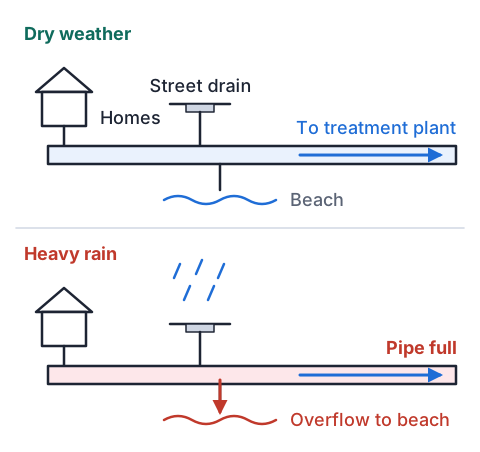
- In the older parts of central Auckland, wastewater from homes and stormwater from streets and roofs flow into the same combined pipes.
- In dry weather the pipes carry everything to the treatment plant, where it is cleaned before release.
- In heavy rain, stormwater fills the pipes beyond what they can carry, so the mixture spills out at overflow points into streams and onto beaches.
- Sewage carries disease-causing microbes such as norovirus and pathogenic bacteria, so the more overflow, the higher the risk of getting sick.
- Testing for every germ is slow and costly, so scientists count indicator bacteria (enterococci in seawater) that live in the gut: a high count means faecal material, and the germs that come with it, are present.
- In council reports based on the national guidelines, a seawater sample with more than 280 enterococci per 100 mL is graded unsafe for swimming.
| Enterococci per 100 mL of seawater | Grade used in council reports |
|---|---|
| Below 140 | Safe |
| 140 to 280 | Caution |
| Above 280 | Unsafe |
Example: the same idea, described then explained
- Here is the science idea written first at Achieved, then lifted to Merit by adding how and why.
- Achieved: "When it rains a lot, sewage overflows onto Auckland beaches, which makes swimmers sick."says what happens: a description
- add how: "Stormwater and wastewater share old pipes, and heavy rain fills them past their capacity, so the mixture spills out at overflow points."the mechanism
- add why it matters: "Sewage carries microbes such as norovirus, so swallowing the water can cause vomiting and diarrhoea."the cause of the harm
- add evidence: "Scientists count enterococci because they come from the gut; above 280 per 100 mL the water is graded unsafe."how we know
- Merit: all four sentences together explain the idea, not just describe it
Another perspective: Ngāti Whātua Ōrākei
- Ngāti Whātua Ōrākei are tangata whenua of central Tāmaki Makaurau, and the Waitematā Harbour, including Ōkahu Bay, lies at the heart of their rohe.
- In September 2023 a sinkhole blocked the Ōrākei Main Sewer, and large overflows of wastewater reached the harbour.
- On 28 September 2023 the iwi placed a rāhui, a customary restriction, over the harbour.
- They lifted it with a karakia at Ōkahu Bay on 16 November 2023, when their trust chair, Marama Royal, said the mauri, the life force, of the Waitematā had recovered enough.
- Their perspective judges the water by its mauri and its ability to provide kai, not only by a bacteria count, and sees caring for the harbour as a responsibility passed down the generations.
A third group: Watercare and the cost
- Watercare is Auckland's water and wastewater company, owned by Auckland Council and paid for by its customers through their bills.
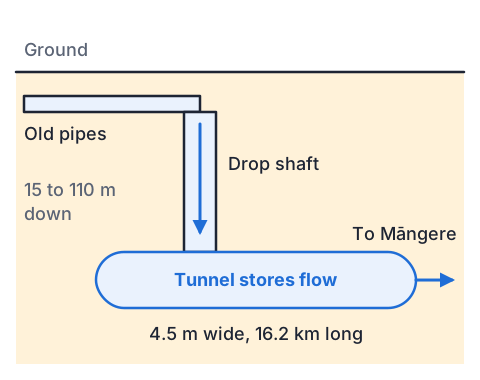
- Its view is that the fix is more capacity: in the older suburbs, separating the pipes street by street, and underneath them all, a giant new tunnel.
- The Central Interceptor is 16.2 km long and 4.5 m across, runs 15 to 110 m underground from Herne Bay to the Māngere Wastewater Treatment Plant, and was finished in mid-2026.
- It can hold about 226 000 m³ of wastewater, about 90 Olympic pools, so heavy-rain flows are stored and sent to the plant at a rate it can treat instead of spilling.
- It cost about NZ$1.67 billion, so the cost to bill payers and the years of disruption are part of the debate.
| Central Interceptor | Figure |
|---|---|
| Length | 16.2 km |
| Diameter | 4.5 m |
| Depth | 15 to 110 m |
| Storage | about 226 000 m³ |
| Cost | about NZ$1.67 billion |
| Built | 2019 to mid-2026 |
The science-informed responses
- The tunnel and pipe separation target the cause in the science idea: too much stormwater in pipes that also carry sewage.
- Safeswim targets the harm while the fix is built: it forecasts water quality from rainfall and other data, and adds black pins when an overflow is reported.
- Water samples still matter, because they test the forecasts and show which beaches stay polluted long term.
- A strong report names one main response and explains which link in the cause and effect chain it breaks.
Weighing both perspectives
- Excellence asks why each perspective matters to the response, so compare them side by side.
- Where they agree: both want water clean enough to swim in and to gather kaimoana from, and both point to overflows as the cause.
- Where they differ: the science view measures risk with a bacteria count and can change from green to red in hours, while the iwi view judges the mauri of the whole harbour and decides in its own time, through tikanga.
- Why the science matters: it shows which pipes overflow, how often and how badly, so the money goes where it cuts the most pollution.
- Why the iwi view matters: it keeps the long-term health of the harbour and its kaimoana at the centre, not just one swim day, and in 2023 the iwi and Watercare announced the end of the rāhui together, so the two views worked side by side.
- Finish by judging: would the response be as good with only one of the views, and why not?
Showing tiakitanga in the evidence
- Name the group, the action and the care or responsibility it shows, then link it to the science.
- Ngāti Whātua Ōrākei took responsibility for the harbour by placing the rāhui and planning its recovery with Watercare.
- Watercare took ownership of its overflows by building the tunnel, and pledged to plant two trees for every one it removed along the route.
- Safeswim scientists take care of swimmers by publishing their forecasts and warnings openly and checking them against real samples.
- Responsible science practice counts too: sterile sample bottles, repeated samples and honest reporting of results, even when the results look bad.
Example: an Excellence discussion paragraph
- The science perspective is essential because enterococci counts and overflow records show exactly when and where untreated wastewater reaches the beaches, which is why Watercare could size the Central Interceptor to store about 226 000 m³ rather than guess.
- However, a count only describes one moment, and Ngāti Whātua Ōrākei's perspective adds what a number misses: whether the mauri of the harbour, and the kaimoana it provides, has recovered.
- The two views agree on the cause and the goal, but they differ on timing, since a beach can return to a green pin within days while the iwi kept the rāhui for seven weeks after the 2023 sinkhole.
- This shows tiakitanga on both sides: Watercare took responsibility by building the fix, and the iwi took care of the harbour by keeping people out until it had healed.
- Without the science the response would not target the overflows; without the iwi it would measure safety by swim days alone, so the best response uses both.
- sentence 1: why the science view matters, with a real numberimportance of the science perspective
- sentence 2: why the other view mattersimportance of the second perspective
- sentence 3: where they agree and differweighing, not listing
- sentence 4: tiakitanga shown in actionsclear understanding
- sentence 5: a judgement about the response
Common mistakes
- My report is long and has lots of facts, so it should get Excellence.Grades come from depth: Excellence needs a discussion of why both perspectives matter to the response, not more facts.
- The iwi think the beach is dirty and the scientists think it is dirty too.Give each group's reasons: the science view uses bacteria counts, while Ngāti Whātua Ōrākei judge the mauri of the harbour and its kaimoana.
- E. coli and enterococci are the germs that make swimmers sick.They are indicator bacteria: they show that faecal material is present, and with it the viruses and bacteria that cause illness.
- The Central Interceptor cleans the sewage in the tunnel.The tunnel stores and carries wastewater; treatment happens at the Māngere plant, at a rate the plant can cope with.
Make a pipe overflow in a storm
You need: 2 plastic cups, scissors, a jug of water, a few drops of food colouring, a bowl, the kitchen sink
- With an adult, make a small hole in the bottom of one cup and a larger hole in its side about 2 cm below the rim, by twisting the point of the scissors into the plastic.
- Add food colouring to the jug: this is wastewater. Hold the holed cup over the sink and pour slowly, like dry weather.
- Now pour as fast as you can, like a storm sending stormwater into the same pipe, and see where the water leaves the cup.
- Repeat the fast pour holding the bowl under the side hole: the bowl stands in for the interceptor tunnel, catching what would have spilled.
- Look for: a slow pour drains only through the bottom hole (to the plant), but a fast pour fills the cup faster than the bottom hole can drain it, so coloured water spills out sideways (the overflow to the beach).
Safety: The scissor point can slip off the curved plastic and stab a hand, so an adult makes the holes, and food colouring stains clothes and benches, so work over the sink.
Your turn
Turn this fact into a science idea: "Some central Auckland beaches get black pins after heavy rain."
Explain why Safeswim scientists count enterococci instead of testing for every germ.
Explain how the Central Interceptor reduces overflows onto beaches.
Write one sentence that discusses why Ngāti Whātua Ōrākei's perspective matters to the response.
At a green pin the risk is under 2%; at a long-term red pin it is above 10%. Out of 100 swimmers, how many might get sick at each?
Show answer
1. In older suburbs wastewater and stormwater share pipes, so heavy rain fills them past capacity and untreated wastewater overflows onto the beach. 2. Enterococci live in the gut, so a high count shows faecal material is present, and with it the germs that cause illness; they are quicker and cheaper to count than every possible germ. 3. It gives the network much more room: about 226 000 m³ of storage, so stormy flows are held and sent to the Māngere plant at a rate it can treat instead of spilling out. 4. For example: The iwi's focus on the mauri of the harbour and its kaimoana means the response is judged by the long-term health of the Waitematā, not just whether a beach is green on one day. 5. Green: fewer than 2 in 100; long-term red: more than 10 in 100.
Recap
- Achieved describes, Merit explains how and why, Excellence discusses why both perspectives matter.
- Combined pipes overflow in heavy rain, and enterococci counts show when sewage has reached the water.
- Ngāti Whātua Ōrākei judge the harbour by its mauri; their 2023 rāhui lasted seven weeks.
- The Central Interceptor stores storm flows; Safeswim warns swimmers in the meantime.
- Put tiakitanga in the evidence: who took care or responsibility, what they did, and why.
| Part | Auckland beach overflows |
|---|---|
| Science idea | Shared pipes overflow in heavy rain; indicator bacteria show sewage |
| Another perspective | Ngāti Whātua Ōrākei: the mauri of the Waitematā and its kaimoana |
| Response | Central Interceptor, pipe separation, Safeswim warnings |
| Tiakitanga | Rāhui, building the fix, open warnings, careful sampling |
How is NCEA Level 1 maths going?
See the NCEA Level 1 maths guide