Bacteria, fungi and viruses: how microorganisms live
What this lesson covers
- Bacteria, fungi and viruses differ in structure and size, from a virus far too small for a light microscope to a mould you can see on bread.
- Microorganisms carry out life processes such as nutrition, respiration, excretion and reproduction.
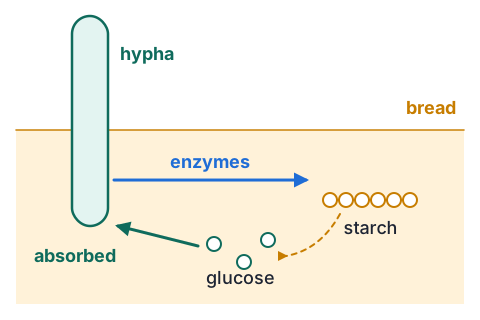
- Fungi feed saprophytically: their hyphae release enzymes onto the food and absorb the small molecules made.
- Bacteria reproduce by binary fission, moulds by spores and yeast by budding, while a virus is only copied inside a host cell.
- A virus is not fully living, because replication is its only life-like process and it needs a host cell for it.
- Temperature, pH, moisture, nutrients and oxygen control how fast a microorganism grows, through its enzymes.
Three kinds of microorganism
- Microorganisms are living things, and near-living particles, too small to see one at a time without a microscope. The three groups you need are bacteria, fungi and viruses.
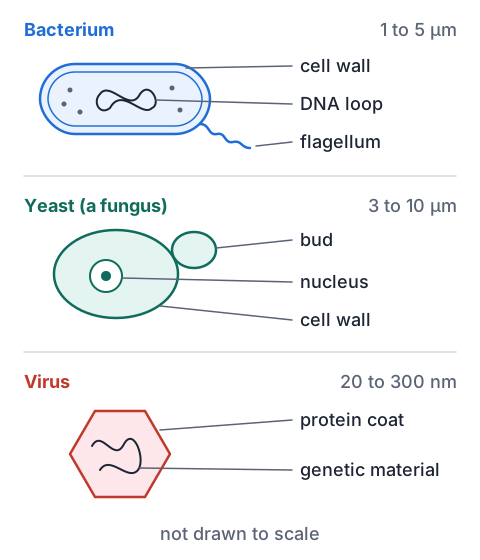
- Bacteria are single cells with a cell wall, a cell membrane, cytoplasm and ribosomes. There is no nucleus: their DNA is one loop lying free in the cytoplasm, and many also have small extra rings called plasmids and a whip-like flagellum for swimming.
- Fungi are made of cells with a nucleus and a cell wall made of chitin. Yeast lives as single oval cells; moulds such as Rhizopus on bread grow as long threads called hyphae, which tangle into a mat called a mycelium.
- Viruses are not cells at all. A virus is genetic material (DNA or RNA) inside a protein coat called a capsid, sometimes wrapped in an outer envelope.
- Sizes differ hugely: a bacterium is usually 1 to 5 micrometres (µm) long and a yeast cell 3 to 10 µm, but most viruses are 20 to 300 nanometres, so you need an electron microscope to see them.
| Bacteria | Fungi | Viruses | |
|---|---|---|---|
| Made of cells? | Yes, one cell | Yes: one (yeast) or many (moulds) | No, a particle |
| Genetic material | DNA loop, no nucleus | DNA in a nucleus | DNA or RNA in a protein coat |
| Typical size | 1 to 5 µm | Yeast cell 3 to 10 µm | 20 to 300 nm |
| Reproduction | Binary fission | Spores; yeast also buds | Copied inside a host cell |
| Example | Lactobacillus in yoghurt | Baker's yeast, bread mould | Influenza virus |
Life processes, and what AS 92020 asks for
- Living things carry out the life processes, often remembered as MRS GREN: movement, respiration, sensitivity, growth, reproduction, excretion and nutrition.
- For AS 92020 you describe one life process of one microorganism in real detail, so choose one you can connect to an environment, such as respiration in yeast or nutrition in a mould.
- A good description names the process, says what goes in and what comes out, and says where and how it happens in the microorganism.
- Writing 'bread mould feeds on bread' is too thin. Writing 'Rhizopus hyphae release enzymes onto the bread that break starch into glucose, and the hyphae absorb the glucose' describes the process.
Nutrition: digesting food outside the body
- Fungi and most bacteria cannot make their own food, so they take it from their surroundings.
- Most fungi and many bacteria are saprophytes: they feed on dead or decaying material such as fallen leaves, bread or old fruit.
- A fungus digests its food outside its body. The hyphae release enzymes into the food, the enzymes break large molecules (starch, protein, cellulose) into small soluble ones (glucose, amino acids), and the hyphae absorb them.
- This is extracellular digestion, and it needs moisture: the enzymes and the small molecules move through a film of water.
- Hyphae keep growing and branching through the food, which gives them a huge surface area for releasing enzymes and absorbing nutrients.
- Some microorganisms are parasites instead, taking food from a living host, such as the water mould that causes kauri dieback feeding in kauri roots.
Respiration: aerobic and anaerobic
- Respiration releases energy from glucose inside every living cell, bacteria and fungi included.
- Aerobic respiration uses oxygen and releases the most energy.
- When oxygen runs out, many microorganisms switch to anaerobic respiration, also called fermentation, which releases much less energy.
- Yeast fermentation makes ethanol and carbon dioxide: the gas makes bread rise and the ethanol is the alcohol in beer and wine.
- Lactic acid bacteria such as Lactobacillus ferment sugar into lactic acid, which sours milk and thickens it into yoghurt.
- glucose + oxygen → carbon dioxide + water (+ a lot of energy)aerobic, in yeast and many bacteria
- C₆H₁₂O₆ + 6O₂ → 6CO₂ + 6H₂Othe same reaction as a balanced symbol equation
- glucose → ethanol + carbon dioxide (+ a little energy)anaerobic, in yeast
- glucose → lactic acid (+ a little energy)anaerobic, in lactic acid bacteria
Excretion: getting rid of waste
- Excretion is removing the waste products of the cell's own chemical reactions.
- The wastes of respiration are carbon dioxide and water, or ethanol or lactic acid, depending on the microorganism and whether oxygen is present.
- Bacteria also excrete other substances, such as ammonia when they break down proteins, and some release toxins.
- The wastes pass out through the cell membrane and build up in the surroundings. That is how microorganisms change their environment: lactic acid lowers the pH of milk, and ethanol builds up in a brew.
- A build-up of their own waste can end up slowing the microorganisms themselves, which is part of the story of a growth curve.
Reproduction: fission, spores and budding
- Bacteria reproduce asexually by binary fission: the cell copies its DNA loop, grows, and splits into two identical daughter cells.
- In ideal conditions some bacteria divide every 20 minutes or so, so the numbers double again and again.
- Moulds such as Rhizopus grow upright hyphae topped with sporangia, round cases that each release thousands of tiny spores. The spores drift on air, water or animals and grow into new hyphae where they land on damp food.
- Yeast can also reproduce by budding: a small bud grows out of the parent cell, gets a copy of the nucleus, and pinches off.
- Spores are tough. Many survive drying out, and some bacteria make resting endospores that survive boiling, which is why canned food is heated under pressure.
Example: how fast can bacteria multiply?
- A bacterium on a chicken sandwich left in a warm car divides by binary fission every 20 minutes.
- Starting from one cell, how many bacteria are there after 3 hours, if none die and the food does not run out?
- 3 hours = 180 minuteswork in the same unit as the dividing time
- 180 ÷ 20 = 9 divisionshow many times the number doubles
- 2⁹ = 2 × 2 × 2 × 2 × 2 × 2 × 2 × 2 × 2 = 512each division doubles the number
- 512 bacteria from one cell in 3 hours
- after 1 hour (3 divisions) there are 8, and 8 × 8 × 8 = 512
- warmth, moisture and food let binary fission run fast, which is why food is kept in the fridgelinking the life process to its conditions
How a virus replicates
- A virus has no cytoplasm, no ribosomes and no enzymes for respiration, so on its own it does nothing at all.
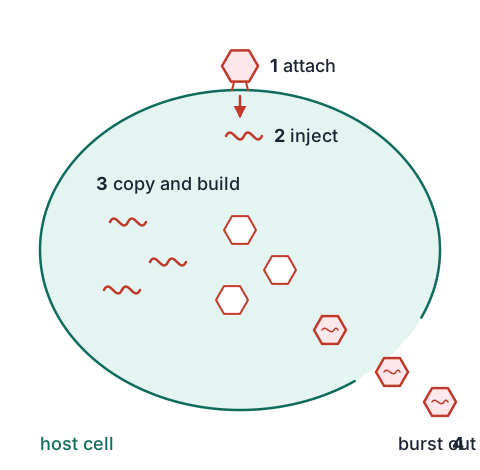
- To replicate, it attaches to a particular kind of host cell and injects its genetic material, or the whole virus is taken into the cell.
- The viral genes take over the cell, which then makes copies of the viral genetic material and the coat proteins, using its own raw materials and energy.
- The new parts assemble into new viruses, which leave by bursting the cell open or by budding out through its membrane, ready to infect more cells.
- Viruses that infect bacteria are called bacteriophages; influenza and cold viruses infect the cells lining your airways.
Why a virus is not fully living
- A virus is not a cell, and it does not feed, respire, excrete, grow or respond to its surroundings.
- Its one life-like process, replication, happens only inside a host cell, using the host's machinery and energy.
- Outside a host it is an inert particle, which is why antibiotics, which attack bacterial cells, do nothing to a virus.
- It does carry genes and it changes over time by mutation, which is why biologists place it on the border of living, and why AS 92020 lets you study a virus through its replication.
What microorganisms need to grow
- Every life process runs on enzymes, so a microorganism grows fastest when conditions suit its enzymes.
- Temperature: cold slows enzymes down, warmth speeds them up to an optimum, and too much heat denatures them (changes their shape for good), which can kill the cell.
- pH: each species has a pH it grows best at. Most bacteria prefer close to neutral, while many fungi cope with acidic food such as fruit.
- Moisture: enzymes and dissolved nutrients need water, so dried food keeps.
- Nutrients and oxygen: they need a food source for energy and raw materials, and some need oxygen, some are harmed by it, and many, such as yeast, manage either way.
| Factor | Effect on growth | Used to keep food safe |
|---|---|---|
| Temperature | Slow when cold, fastest at the optimum, enzymes denature when too hot | Fridge slows growth; cooking kills |
| pH | Best at the species' optimum; strong acid stops most bacteria | Pickling in vinegar |
| Moisture | No water, so no digestion or absorbing | Drying, salting, sugaring |
| Nutrients | Food gives energy and raw materials | Clean surfaces, covered food |
| Oxygen | Aerobes need it; anaerobes do not | Vacuum packing stops aerobes |
Example: describing a life process well
- Task: describe nutrition in the bread mould Rhizopus, and one factor that affects it, using observations.
- A class sealed slices of damp and dry bread in zip-lock bags at school, kept them closed, and checked them after 5 days. The damp bread was half covered in grey fuzz; the dry bread had none.
- Bread mould eats the bread and grows on it.too thin: no process, no enzymes, no observation
- Rhizopus is a saprophytic fungus. Its hyphae grow into the bread and release enzymes such as amylase, which digest starch into glucose outside the hyphae. The glucose dissolves in the moisture and is absorbed into the hyphae, where it is used in respiration.names the process, what goes in and out, and where
- Moisture affects this: after 5 days the damp bread was half covered in mould, but the dry bread had none.a factor, backed by an observation
Common mistakes
- Viruses are just very small bacteria.Viruses are not cells at all: they are genetic material in a protein coat, many times smaller than a bacterium.
- Fungi take in their food and digest it inside, like animals do.Fungi release enzymes onto the food and absorb the digested small molecules through their hyphae, which is extracellular digestion.
- At high temperatures the enzymes die.Enzymes are proteins, not living things; heat denatures them, changing their shape so they stop working.
- Yeast only makes carbon dioxide when it ferments.Yeast makes carbon dioxide in both aerobic and anaerobic respiration; only the anaerobic route also makes ethanol.
Feed the yeast
You need: 2 teaspoons of dried baker's yeast, sugar, 3 small empty plastic drink bottles, 3 balloons, warm tap water, a measuring jug and a teaspoon, string and a ruler
- Stretch each balloon a few times so it blows up easily, and label the bottles 0, 1 and 3.
- Pour 200 mL of warm tap water (about bath temperature) into each bottle and add a level third of a teaspoon of yeast to each.
- Add no sugar to bottle 0, one teaspoon to bottle 1 and three teaspoons to bottle 3, swirl to mix, and stretch a balloon over each neck straight away.
- Stand the bottles together somewhere warm for 30 minutes, then measure round the widest part of each balloon with the string and a ruler.
- Look for: the balloons on the sugar bottles fill with carbon dioxide from the yeast's respiration while bottle 0 barely changes, because sugar is the yeast's food; more sugar gives more gas in the same time.
Safety: The yeast mixture is not a drink, so tip it down the sink afterwards, and use zip-lock bags instead of balloons if anyone at home is allergic to latex.
Your turn
Give two differences in structure between a bacterium and a yeast cell.
A bacterium divides every 30 minutes. Starting from one cell, how many cells are there after 4 hours?
Write the word equation for anaerobic respiration in yeast, and say which product makes bread rise.
Explain why a virus is described as not fully living.
Explain why dried apricots keep for months but fresh apricots go mouldy within a week or two.
Show answer
1. A yeast cell has a nucleus, but a bacterium has its DNA as a loop free in the cytoplasm; the yeast cell wall is made of chitin; a yeast cell is also bigger (3 to 10 µm against 1 to 5 µm). 2. 4 hours = 240 minutes, 240 ÷ 30 = 8 divisions, 2⁸ = 256 cells. 3. glucose → ethanol + carbon dioxide; the carbon dioxide makes bread rise. 4. A virus is not a cell and carries out no life processes on its own: it can only replicate, and only inside a host cell using the host's machinery. 5. Mould needs water: without moisture, the enzymes released by the hyphae cannot digest the fruit and the hyphae cannot absorb nutrients, and spores cannot germinate, so the dried fruit keeps.
Recap
- Bacteria are cells with no nucleus, fungi are cells with a nucleus, and viruses are not cells at all.
- Fungi feed by extracellular digestion: hyphae release enzymes and absorb the small molecules.
- Respiration can be aerobic (carbon dioxide and water) or anaerobic (ethanol and carbon dioxide in yeast, lactic acid in bacteria).
- Wastes pass out into the surroundings, which is how microorganisms change their environment.
- Bacteria divide by binary fission, moulds release spores, yeast buds, and viruses replicate only inside host cells.
- Temperature, pH, moisture, nutrients and oxygen set how fast the enzymes, and so the microorganism, can work.
| Life process | In a microorganism |
|---|---|
| Nutrition | Enzymes out, small molecules absorbed |
| Respiration | Aerobic or anaerobic (fermentation) |
| Excretion | CO₂, ethanol, lactic acid, ammonia out |
| Reproduction | Binary fission, spores, budding |
| Replication (virus) | Only inside a host cell |
How is NCEA Level 1 maths going?
See the NCEA Level 1 maths guide