Chemical equations, ion formulae and conservation of mass
What this lesson covers
- A reaction turns reactants into products, and three kinds of equation show it: a general pattern in words, the actual names, or balanced formulae.
- Atoms gain or lose electrons to reach a full outer shell, which sets the charge on each ion.
- In an ionic formula the positive and negative charges add up to zero, with brackets around more than one polyatomic ion.
- Equations are balanced by changing the numbers in front of formulae, never the small numbers inside them.
- Atoms are only rearranged in a reaction, so total mass stays the same unless a gas escapes or joins from the air.
Reactants, products and three kinds of equation
- In a chemical reaction the starting substances (reactants) change into new substances (products), and the arrow means "react to make".
- A generic word equation gives the pattern for a whole family of reactions, such as acid + metal carbonate → salt + water + carbon dioxide.
- A chemical word equation names the actual substances: hydrochloric acid + calcium carbonate → calcium chloride + water + carbon dioxide.
- A balanced symbol equation uses formulae and shows how many of each particle react: 2HCl + CaCO₃ → CaCl₂ + H₂O + CO₂.
- State symbols say what form each substance is in: (s) solid, (l) liquid, (g) gas and (aq) dissolved in water.
- The names link up: hydrochloric acid makes chlorides, sulfuric acid makes sulfates, nitric acid makes nitrates, and the metal in the base gives the first word of the salt.
Reading a formula: subscripts, brackets and coefficients
- A small number after a symbol (a subscript) counts only the atom just before it: H₂O has 2 H and 1 O.
- A subscript after a bracket multiplies everything inside the bracket: Mg(OH)₂ has 1 Mg, 2 O and 2 H.
- A big number in front (a coefficient) multiplies the whole formula: 3H₂O means three water molecules, so 6 H and 3 O.
- Subscripts are fixed by the substance itself, so changing one makes a different substance; coefficients only change how many particles there are.
Example: counting atoms
- Count the atoms of each element in 3Ca(OH)₂ and in 2Al₂(SO₄)₃.
- 3Ca(OH)₂: Ca = 3 × 1 = 3the coefficient multiplies everything
- O = 3 × 2 = 6, H = 3 × 2 = 6the bracket doubles O and H, then × 3
- 2Al₂(SO₄)₃: Al = 2 × 2 = 4subscript 2, coefficient 2
- S = 2 × 3 = 6, O = 2 × 3 × 4 = 24inside the bracket × 3, then × 2
- 3Ca(OH)₂: Ca 3, O 6, H 6; 2Al₂(SO₄)₃: Al 4, S 6, O 24
Why ions have the charges they do
- Atoms are most stable with a full outer (valence) shell of electrons, and they form ions by losing or gaining electrons to get one.
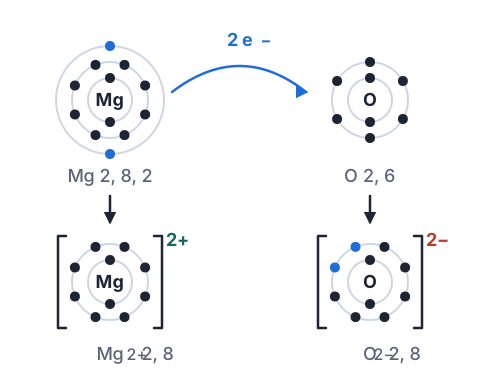
- A metal atom has only a few outer electrons, so it loses them and becomes a positive ion: magnesium (2, 8, 2) loses 2 electrons to become Mg²⁺ (2, 8).
- A non-metal atom has an almost full outer shell, so it gains electrons and becomes a negative ion: oxygen (2, 6) gains 2 to become O²⁻ (2, 8).
- The charge is the number of protons minus the number of electrons: Mg²⁺ has 12 protons and 10 electrons, so 12 − 10 = +2.
- Polyatomic ions are groups of atoms that carry a charge together, such as OH⁻, CO₃²⁻ and SO₄²⁻, and they stay together through most reactions.
| Charge | Positive ions | Negative ions |
|---|---|---|
| 1 | Na⁺, K⁺, H⁺, Ag⁺, NH₄⁺ | Cl⁻, Br⁻, I⁻, OH⁻, NO₃⁻, HCO₃⁻ |
| 2 | Mg²⁺, Ca²⁺, Ba²⁺, Zn²⁺, Cu²⁺, Fe²⁺, Pb²⁺ | O²⁻, S²⁻, CO₃²⁻, SO₄²⁻ |
| 3 | Al³⁺, Fe³⁺ | PO₄³⁻ |
Writing the formula of an ionic compound
- An ionic compound has no overall charge, so take just enough of each ion for the positive and negative charges to cancel.
- Write the positive ion first and the negative ion second, then find the smallest numbers that make the charges add to zero.
- If you need more than one of a polyatomic ion, put it in brackets with the number outside: Mg(OH)₂, not MgOH₂.
- One polyatomic ion needs no brackets: NaOH, CaCO₃.
- A quick check: total positive charge equals total negative charge.
Example: five formulae from their ions
- Write the formulae of calcium chloride, aluminium oxide, magnesium hydroxide, ammonium sulfate and calcium phosphate.
- Ca²⁺ and Cl⁻: +2 needs 2 × (−1), so CaCl₂two chloride ions
- Al³⁺ and O²⁻: 2 × (+3) = +6, 3 × (−2) = −6, so Al₂O₃lowest common multiple is 6
- Mg²⁺ and OH⁻: Mg(OH)₂two hydroxide ions, in brackets
- NH₄⁺ and SO₄²⁻: (NH₄)₂SO₄two ammonium ions, in brackets
- Ca²⁺ and PO₄³⁻: 3 × (+2) = +6, 2 × (−3) = −6, so Ca₃(PO₄)₂phosphate in brackets
- CaCl₂, Al₂O₃, Mg(OH)₂, (NH₄)₂SO₄, Ca₃(PO₄)₂
Balancing an equation
- Write the correct formula of every reactant and product first, and then leave the formulae alone.
- Count the atoms of each element on both sides.
- Put coefficients in front of formulae to even up the counts: metals first, then non-metals, leaving hydrogen and oxygen until last.
- Treat a polyatomic ion that appears unchanged on both sides, such as SO₄²⁻, as one unit.
- Recount everything at the end, and use the smallest whole numbers that work.
Example: balancing natural gas burning
- Natural gas in a gas hob is mostly methane, CH₄. It burns in oxygen to make carbon dioxide and water.
- Balance CH₄ + O₂ → CO₂ + H₂O.
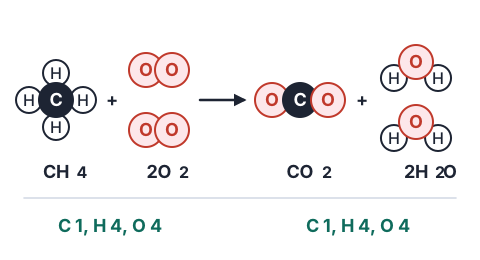
- left: C 1, H 4, O 2 right: C 1, H 2, O 3carbon already balances
- CH₄ + O₂ → CO₂ + 2H₂O2 water molecules give 4 H
- right now has O = 2 + 2 = 42 in CO₂, 1 in each water
- CH₄ + 2O₂ → CO₂ + 2H₂O2 oxygen molecules give 4 O
- both sides: C 1, H 4, O 4
Example: an antacid tablet
- Some antacid tablets contain aluminium hydroxide, which neutralises hydrochloric acid in the stomach.
- Write the chemical word equation and the balanced equation.
- hydrochloric acid + aluminium hydroxide → aluminium chloride + wateracid + base → salt + water
- HCl + Al(OH)₃ → AlCl₃ + H₂Ocorrect formulae, not yet balanced
- 3HCl + Al(OH)₃ → AlCl₃ + H₂O3 Cl on the right needs 3 HCl
- 3HCl + Al(OH)₃ → AlCl₃ + 3H₂Oleft has 3 + 3 = 6 H, so 3 waters
- both sides: Al 1, Cl 3, H 6, O 3
Conservation of mass
- In a reaction no atoms appear or vanish; the same atoms are just joined up in new ways, which is exactly what a balanced equation shows.
- Because the atoms are the same, the total mass of the products equals the total mass of the reactants.
- In a sealed container the reading on a balance therefore stays the same, even when a gas is made.
- In an open container a gas product can escape, so the mass you measure goes down by the mass of that gas.
- If a gas from the air joins in, such as oxygen when magnesium burns or iron rusts, the mass of the solid goes up by the mass of the oxygen added.
- If one reactant runs out first it limits how much product can form, and the extra of the other reactant is left over unchanged.
Example: a sealed bottle, then an open one
- A Year 11 class put vinegar and a parcel of baking soda in a fizzy drink bottle, screwed the cap on and weighed it, then tipped it so the two mixed.
- Vinegar contains ethanoic acid: NaHCO₃ + CH₃COOH → CH₃COONa + H₂O + CO₂.
- Explain each reading.
| Stage | Mass (g) |
|---|---|
| Sealed, before mixing | 182.4 |
| Sealed, after fizzing stopped | 182.4 |
| Cap taken off, after 2 minutes | 181.3 |
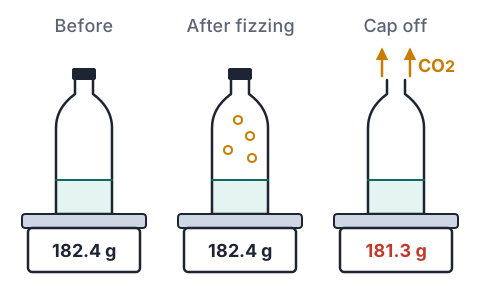
- left: Na 1, H 5, C 3, O 5 right: Na 1, H 5, C 3, O 5the equation balances as written
- sealed: 182.4 g → 182.4 gevery atom, including those in the CO₂, stays in the bottle
- opened: 182.4 − 181.3 = 1.1 gthe mass of CO₂ gas that escaped
- mass is conserved; the drop is only the gas leaving
Writing it up for Achieved, Merit and Excellence
- Achieved describes: name the reactants and products, give a word equation and a balanced equation, and say that mass is conserved.
- Merit explains: use the atom counts on each side to say why the mass stays the same, and say why a measured mass rises or falls (a gas joins or leaves).
- Excellence interprets: discuss what conservation of mass means in this situation, linking the equation, the observations and the numbers, and predict what would change if the amounts changed.
- For the bottle, an Excellence line reads: the 1.1 g drop is the CO₂ that left (a little more may still be dissolved in the liquid), and a teaspoon more baking soda (with enough vinegar) would make more CO₂, so the drop would be bigger, while the sealed reading would still not change.
| Grade | What a sentence about the bottle looks like |
|---|---|
| Achieved | Baking soda and vinegar make sodium ethanoate, water and carbon dioxide, and mass is conserved. |
| Merit | There are 1 Na, 5 H, 3 C and 5 O atoms on each side, so the mass in the sealed bottle cannot change; it drops when opened because CO₂ escapes. |
| Excellence | The 1.1 g lost is the CO₂ that left; some may still be dissolved, so at least 1.1 g formed, and more reactant would give a bigger drop. |
Common mistakes
- To balance H₂ + O₂ → H₂O, change the water to H₂O₂.H₂O₂ is hydrogen peroxide, a different substance; change coefficients only: 2H₂ + O₂ → 2H₂O.
- Magnesium hydroxide is MgOH₂.Two hydroxide ions need brackets, Mg(OH)₂, because the 2 applies to both the O and the H.
- The mass went down in the open flask, so mass was not conserved.Mass was conserved, but a gas product escaped into the air, so the balance no longer weighed all the products.
- Aluminium oxide is AlO because aluminium and oxygen combine.Al³⁺ and O²⁻ only cancel as Al₂O₃: 2 × (+3) = +6 and 3 × (−2) = −6.
Weigh a reaction in a sealed bottle
You need: an empty 1.5 L fizzy drink bottle with its cap, kitchen scales, 100 mL white vinegar, 1 teaspoon baking soda, a square of paper towel, a measuring jug
- Pour 100 mL of vinegar into the bottle, then wrap the teaspoon of baking soda in the paper towel and twist it into a parcel thin enough to fit through the neck.
- Hold the bottle upright, push the parcel just into the neck so it sits above the vinegar, screw the cap on tightly and weigh the whole bottle.
- Shake the bottle so the parcel drops into the vinegar, wait until the fizzing stops, and weigh it again with the cap still on.
- Point the bottle away from your face, unscrew the cap slowly over the sink, wait two minutes and weigh it a third time.
- Look for: the two sealed readings match, because no atoms left the bottle, and the opened reading is lower by roughly a gram or two, the mass of the carbon dioxide that escaped.
Safety: The gas makes the bottle firm and vinegar can spray when you open it, so use only a fizzy drink bottle and one teaspoon of baking soda, and open it slowly pointed away from faces.
Your turn
Write the formulae of potassium carbonate, iron(III) hydroxide and zinc nitrate.
Count the atoms of each element in 3Ca(NO₃)₂.
Balance Fe + O₂ → Fe₂O₃, the equation for iron rusting.
Hydrogen peroxide breaks down into water and oxygen. Balance H₂O₂ → H₂O + O₂.
5.0 g of baking soda is added to 50.0 g of vinegar in an open cup. When the fizzing stops the cup's contents weigh 52.4 g. What mass of carbon dioxide escaped?
Steel wool is heated in air and its mass goes up. Explain why, using conservation of mass.
Show answer
1. K⁺ and CO₃²⁻ give K₂CO₃; Fe³⁺ and OH⁻ give Fe(OH)₃; Zn²⁺ and NO₃⁻ give Zn(NO₃)₂. 2. Ca 3, N 6, O 18 (3 × 2 × 3 = 18). 3. 4Fe + 3O₂ → 2Fe₂O₃ (Fe 4 and O 6 on each side). 4. 2H₂O₂ → 2H₂O + O₂ (H 4 and O 4 on each side). 5. 5.0 + 50.0 = 55.0 g at the start, so 55.0 − 52.4 = 2.6 g of CO₂ escaped. 6. Iron atoms combine with oxygen atoms from the air to make iron oxide; no atoms are created, but the oxygen atoms were not weighed at the start, so the solid gains their mass.
Balancing Chemical Equations
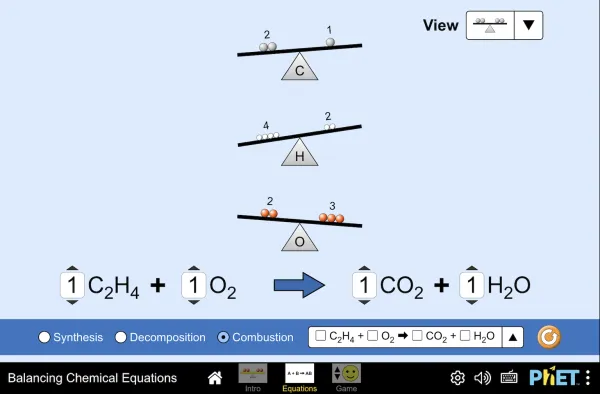
Full screen · PhET Interactive Simulations, University of Colorado Boulder, CC BY 4.0
Recap
- Reactants become products; equations can be generic word, chemical word or balanced symbol equations.
- Ion charges come from losing or gaining electrons to fill the outer shell, and an ionic formula has charges that add to zero.
- Balance with coefficients only, then recount every element.
- Atoms are rearranged, never made or destroyed, so mass is conserved; a measured mass changes only when a gas leaves or joins.
| Idea | Example |
|---|---|
| Ionic formula | Ca²⁺ + PO₄³⁻ → Ca₃(PO₄)₂ |
| Balanced equation | CH₄ + 2O₂ → CO₂ + 2H₂O |
| Gas escapes | mass measured goes down |
| Gas from the air joins | mass measured goes up |
The maths behind it
How is NCEA Level 1 maths going?
See the NCEA Level 1 maths guide