Comparing groups: 6 questions solved step by step
What this lesson covers
- Comparing two groups means comparing their whole distributions, not one number from each.
- Shift, overlap, spread and shape together decide how strong a comparison is.
6 questions, one method
- 1. Sort each group.
- 2. Median, quartiles, IQR.
- 3. Shift, overlap, spread.
- 4. Make a call only if you can.
Question 1 · Achieved
- Minutes to get to school (10 students):
- 12, 25, 8, 15, 30, 18, 10, 22, 14, 20
- Find the median and the IQR.
Q1: median and IQR
- Sort before anything.
- Quartiles: middle of halves.
- 8, 10, 12, 14, 15lower half, sorted
- 18, 20, 22, 25, 30upper half
- n = 10: median between 5th, 6th
- median = (15 + 18) ÷ 2 = 16.5
- Q1 = 12middle of lower half
- Q3 = 22middle of upper half
- IQR = 22 − 12 = 10 minutesQ3 − Q1
- median 16.5 min, IQR 10 min
Question 2 · Achieved
- Hours of part-time work (8 students):
- 6, 15, 9, 12, 4, 10, 18, 8
- Find the five-number summary and IQR.
Q2: five-number summary
- n = 8: medians of pairs.
- A quartile can fall between.
- 4, 6, 8, 9, 10, 12, 15, 18sorted
- min = 4, max = 18
- median = (9 + 10) ÷ 2 = 9.5n = 8: 4th and 5th
- lower half: 4, 6, 8, 9
- Q1 = (6 + 8) ÷ 2 = 7
- upper half: 10, 12, 15, 18
- Q3 = (12 + 15) ÷ 2 = 13.5
- IQR = 13.5 − 7 = 6.5 hoursQ3 − Q1
- 4, 7, 9.5, 13.5, 18 (hours)
Question 3 · Merit
- Screen time on a school day (hours)
- Year 9: 2, 3, 3, 4, 5, 6, 6, 9
- Year 13: 3, 5, 6, 6, 7, 7, 8, 12
- Medians, IQRs, then shift and spread.
Q3: both groups
- Lists already sorted.
- Same steps for each group.
- Year 9: 2, 3, 3, 4, 5, 6, 6, 9
- median = (4 + 5) ÷ 2 = 4.5
- Q1 = 3, Q3 = 6(3 + 3) ÷ 2, (6 + 6) ÷ 2
- IQR = 6 − 3 = 3 hours
- Year 13: 3, 5, 6, 6, 7, 7, 8, 12
- median = (6 + 7) ÷ 2 = 6.5
- Q1 = 5.5, Q3 = 7.5(5 + 6) ÷ 2, (7 + 8) ÷ 2
- IQR = 7.5 − 5.5 = 2 hours
Q3: shift and spread
- Shift, then spread.
- Too few to make a call.
- Year 9: median 4.5, IQR 3
- Year 13: median 6.5, IQR 2
- 6.5 − 4.5 = 2 hoursshift
- Year 13 sits about 2 h higher
- IQR 2 h < IQR 3 hspread
- Year 13 middle half less spread
- Year 13: typically 2 h a day more
- 8 per group: too few for a call
Question 4 · Merit
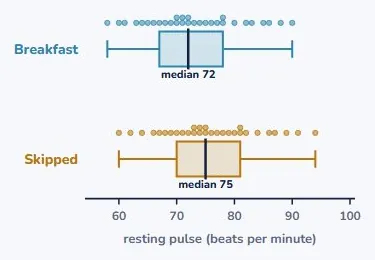
- Resting pulse, 30 Year 11s per group.
- Breakfast: median 72, box 67 to 78
- Skipped breakfast: median 75, box 70 to 81
- Can you make a call?
Q4: is there a call?
- Each median vs other box.
- Inside both: no call.
- Rule: median outside other box
- 72 vs no-breakfast box 70 to 81
- 72 is inside
- 75 vs breakfast box 67 to 78
- 75 is inside
- medians 3 bpm apart
- boxes overlap from 70 to 78
- No call can be made
Question 5 · Merit, in context
- Sleep on a school night, 30 per group.
- Phone in the bedroom at night, or not.
- Make a call if you can, then write it.
| Sleep (h) | Phone | No phone |
|---|---|---|
| Minimum | 5 | 5.5 |
| Q1 | 6.5 | 7 |
| Median | 7 | 8 |
| Q3 | 7.5 | 8.5 |
| Maximum | 9.5 | 10 |
Q5: can we make a call?
- Median outside the box?
- Then state the overlap.
- Medians: phone 7 h, no phone 8 h
- Phone box: 6.5 h to 7.5 h
- 8 > 7.5: outside the phone box
- So I can make a call
- 8 − 7 = 1 hourdifference of medians
- Boxes overlap 7 h to 7.5 h
Q5: write the comparison
- Claim, population, evidence.
- Say "tend to".
- I think Year 11s at this school
- with no phone in the bedroom
- tend to sleep longer on a school
- night than those with one.
- Medians 8 h vs 7 h: 1 h more
- Boxes overlap: so "tend to"
- Observed only: not proof of cause
Question 6 · Excellence
- Kahikatea seedlings, 10 in each group.
- Compare the two groups fully.
- Make a call if you can.
| Group | Height after 6 weeks (cm) |
|---|---|
| Sun | 22, 15, 19, 26, 17, 21, 14, 24, 18, 22 |
| Shade | 16, 11, 23, 13, 18, 10, 14, 19, 12, 15 |
Q6: sun and shade
- Sort, then split in halves.
- Quartile: middle of a half.
- Sun: 14, 15, 17, 18, 19,
- 21, 22, 22, 24, 26
- median = (19 + 21) ÷ 2 = 20
- Q1 17, Q3 22, IQR 22 − 17 = 5
- Shade: 10, 11, 12, 13, 14,
- 15, 16, 18, 19, 23
- median = (14 + 15) ÷ 2 = 14.5
- Q1 12, Q3 18, IQR 18 − 12 = 6
Q6: compare and call
- Shift, overlap, spread.
- Call, but say how sure.
- Sun: median 20, IQR 5
- Shade: median 14.5, IQR 6
- 20 − 14.5 = 5.5 cmshift
- boxes overlap 17 to 18 cmoverlap
- IQR 5 and 6: similarspread
- 20 > 18: outside shade boxso make a call
- I think kahikatea grown in sun
- tend to be taller than in shade
- Only 10 each: a tentative call
The method that solved all six
- Sort, summarise, describe, then call.
| Step | How |
|---|---|
| Sort | smallest to largest first |
| Median | middle, or mean of the two |
| Quartiles | medians of the two halves |
| IQR | Q3 minus Q1 |
| Describe | shift, overlap, spread |
| Call | median outside other box |
| Write | tend to, units, population |
Is your child on track?
Take the free placement test