Straight-line graphs: 7 exam questions solved step by step
What this lesson covers
- A pattern, a table, an equation and a graph can all describe the same relationship.
- The gradient of a straight-line graph is its rate of change: how much y changes for each one unit of x.
7 questions, two numbers
- 1. Gradient m = rise ÷ run.
- 2. Intercept c = y when x = 0.
- 3. Write y = mx + c.
- 4. In context: meaning and units.
Question 1 · Achieved
- Find the rule for the number of tiles, T.
- How many tiles in pattern 20?
| Pattern, n | Tiles, T |
|---|---|
| 1 | 5 |
| 2 | 9 |
| 3 | 13 |
| 4 | 17 |
Q1: the tile rule
- Difference = gradient.
- Step back for c.
- 9 − 5 = 4, 13 − 9 = 4constant difference
- T = 4n + cgradient 4
- 5 − 4 = 1step back to n = 0
- T = 4n + 1
- n = 4: 4 × 4 + 1 = 17
- n = 20: 4 × 20 + 1 = 81
- 81 tiles in pattern 20
Question 2 · Achieved
- The line passes through (0, 3) and (4, 11).
- Find its equation.
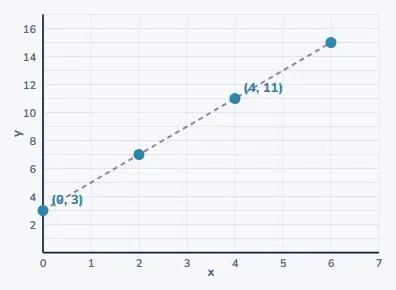
Q2: the equation of a line
- c: where it crosses.
- m: rise ÷ run.
- c = 3crosses the y-axis at 3
- rise = 11 − 3 = 8
- run = 4 − 0 = 4
- m = 8 ÷ 4 = 2rise ÷ run
- y = 2x + 3y = mx + c
- x = 4: 2 × 4 + 3 = 11
Question 3 · Merit
- Find the equation of the line.
- Careful: look at how x changes.
| x | y |
|---|---|
| 1 | 7 |
| 3 | 13 |
| 5 | 19 |
| 7 | 25 |
Q3: x goes up in twos
- The run is 2, not 1.
- Use a point for c.
- m = 6x went up 2, not 1
- y up 6 when x up 2
- m = 6 ÷ 2 = 3rise ÷ run
- y = 3x + c
- 7 = 3 × 1 + cuse (1, 7)
- c = 4−3 both sides
- y = 3x + 4
- x = 7: 3 × 7 + 4 = 25
Question 4 · Merit
- Tiles in pattern n: T = 5n + 3
- Which pattern uses 98 tiles?
- Could a pattern use exactly 120?
Q4: the rule run backwards
- Set the rule equal.
- n must be whole.
- 5n + 3 = 98T = 98
- 5n = 95−3 both sides
- n = 19÷ 5
- 5 × 19 + 3 = 98
- 5n + 3 = 120T = 120
- 5n = 117−3 both sides
- n = 23.4n must be whole
- pattern 19; no pattern uses 120
Question 5 · Merit, in context
- A candle burns down steadily.
- After 2 h: 18 cm tall. After 5 h: 12 cm.
- Find the rate of change, with units.
- Find h after t hours. What is c?
Q5: the rate of change
- Time across, height up.
- Units: cm per hour.
- (2, 18) and (5, 12)
- rise = 12 − 18 = −6height goes down
- run = 5 − 2 = 3hours
- m = −6 ÷ 3 = −2rise ÷ run
- m = −2 cm per houry units per x unit
- burns down 2 cm every hour
Q5: the equation and c
- Use a point for c.
- c is the start value.
- m = −2 cm per hour
- h = −2t + c
- 18 = −2 × 2 + cuse (2, 18)
- 18 = −4 + c
- c = 22+4 both sides
- h = 22 − 2t
- t = 5: 22 − 2 × 5 = 12
- t = 0: h = 22the intercept
- 22 cm tall when it was lit
Question 6 · Excellence, in context
- Tables in one long row for a hui.
- Each seats 3 per long side, 1 per end.
- Explain why n tables seat S = 6n + 2.
- How many tables seat 100 people?
Q6: explain the rule
- Explain each part.
- Inner ends are lost.
- 3 + 3 = 6 side seats a table
- n tables: 6n side seats
- + 2 seats, one at each end
- S = 6n + 2
- n = 1: 6 + 2 = 8
- n = 3: 18 + 2 = 20
Q6: tables for 100 people
- Round up, not off.
- Check both choices.
- S = 6n + 2
- 6n + 2 = 100S = 100
- 6n = 98−2 both sides
- n = 16.33…÷ 6
- 16 tables: 96 + 2 = 982 people short
- 17 tables: 102 + 2 = 104
- 17 tables (4 spare seats)
Question 7 · Excellence, in context
- A train: d km from Britomart, t min on.
- Find the speed in km/min and km/h.
- What does the intercept mean?
- When is it 20 km from Britomart?
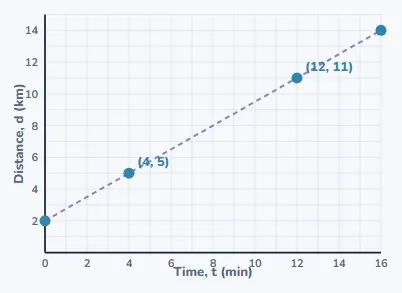
Q7: the speed and the rule
- Units: km per minute.
- × 60 for km per hour.
- rise = 11 − 5 = 6 km
- run = 12 − 4 = 8 min
- m = 6 ÷ 8 = 0.75rise ÷ run
- 0.75 km per minute
- 0.75 × 60 = 45 km/h60 minutes in an hour
- d = 0.75t + c
- 5 = 0.75 × 4 + cuse (4, 5)
- 5 = 3 + c, c = 2
- d = 0.75t + 2
Q7: the intercept and 20 km
- c: the value at t = 0.
- Set d = 20 and solve.
- d = 0.75t + 2
- t = 0: d = 2the intercept
- 2 km out when timing began
- 0.75t + 2 = 20d = 20
- 0.75t = 18−2 both sides
- t = 18 ÷ 0.75 = 24
- 0.75 × 24 + 2 = 20
- 24 minutes after timing began
What solved all seven
- Rise over run, the value at zero, and what it means.
| Step | How |
|---|---|
| Gradient | rise ÷ run, any two points |
| Pattern | difference is m; c is term 0 |
| x jumps | divide the rise by the run |
| Intercept | y when x = 0, or use a point |
| Units | y units per one x unit |
| Reverse | set the rule equal, then solve |
| Context | meaning, units and rounding |
Is your child on track?
Take the free placement test