Modelling problems on the coordinate plane
What this lesson covers
- Two lines meet where their equations agree.
- The shortest distance from a point to a line is along the perpendicular.
- Finish with an answer in context, with units.
The plan for a shortest distance
- Find the perpendicular line through the point.
- Find where it meets the original line.
- Find the distance between those two points.
Where two roads meet
- Roads follow y = 2x + 1 and y = −x + 7.
- 2x + 1 = −x + 7set the y values equal
- 3x = 6, so x = 2
- y = 2(2) + 1 = 5
- They meet at (2, 5)
The shortest pipe
- A road follows y = 2x and a house is at H(10, 0), with units in kilometres.
- perpendicular gradient = −1/2
- y = −(1/2)(x − 10) = −(1/2)x + 5
- 2x = −(1/2)x + 5, so x = 2, y = 4
- d = √(8² + 4²) = √80
- The pipe is about 8.94 km
Seeing the shortest pipe
- The orange pipe meets the road at right angles.
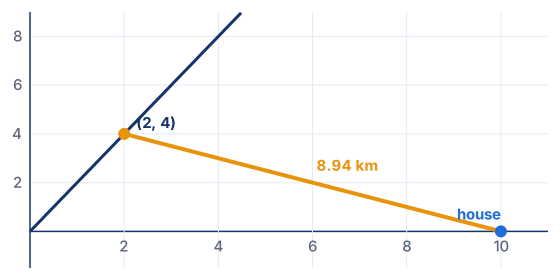
Try it: the shortest path is perpendicular
Equally far from two towns
- A mast on the road y = 1 must be equally far from A(2, 1) and B(6, 5).
- bisector of AB: y = −x + 7
- 1 = −x + 7, so x = 6
- the mast is at (6, 1)
- distance to each town = 4
Try it: equally far from two points
Common mistakes
- Measuring straight across to the x-axis or y-axis.The shortest distance runs at right angles to the line.
- Stopping at the meeting point.The question wants the distance, so finish with Pythagoras.
Your turn
Where do y = x + 1 and y = −x + 5 meet?
A road has gradient 2. What is the gradient of the shortest path to it?
Find the distance from (3, 3) to (6, 0).
Points equally far from A and B lie on which line?
Show answer
1. (2, 3) 2. −1/2 3. √18, about 4.24 4. The perpendicular bisector of AB
Sample question: Achieved
Two straight farm tracks follow y = 3x − 4 and 2x + y = 11, with units in km. Where do they cross?
Hint
Make y the subject of the second equation, then set the two expressions for y equal.
Answer
They cross at (3, 5)
Step by step
- Two lines meet where both equations are true at once.
- Make y the subject of the second track: y = 11 − 2x.
- Set the y values equal: 3x − 4 = 11 − 2x.
- Add 2x and 4 to both sides: 5x = 15, so x = 3.
- Put x = 3 into either equation: y = 3(3) − 4 = 5.
- Check in the other track: 2(3) + 5 = 11. Correct, so the crossing is (3, 5).
Full working
- y = 11 − 2xrearrange the second track
- 3x − 4 = 11 − 2xequal y values
- 5x = 15, so x = 3
- y = 3(3) − 4 = 5
- (3, 5)
Sample questions: Merit
A water tank T must sit on the road y = 0.5x + 1 so that it is the same distance from two farmhouses, A(0, 6) and B(6, 0). Units are km. Find T and its distance from each house.
Hint
Points equally far from A and B lie on the perpendicular bisector of AB. Find it, then meet it with the road.
Answer
T = (2, 2), about 4.47 km (√20 km) from each house
Step by step
- Every point that is equally far from A and B lies on the perpendicular bisector of AB. So find that line first.
- Midpoint of AB: ((0 + 6) ÷ 2, (6 + 0) ÷ 2) = (3, 3).
- Gradient AB = (0 − 6) ÷ (6 − 0) = −1. The perpendicular gradient is the negative reciprocal: 1.
- Perpendicular bisector: y − 3 = 1(x − 3), which is y = x.
- T is on the road and on the bisector, so solve x = 0.5x + 1: 0.5x = 1 and x = 2. So T = (2, 2).
- TA = √((2 − 0)² + (2 − 6)²) = √(4 + 16) = √20 ≈ 4.47 km.
- Check TB = √((6 − 2)² + (0 − 2)²) = √(16 + 4) = √20. The same, as it must be.
- Classic mistake: using the gradient of AB itself for the bisector. It has to be the perpendicular gradient.
Full working
- M = (3, 3)midpoint of AB
- m(AB) = −1, so the perpendicular gradient is 1
- y − 3 = 1(x − 3), so y = xperpendicular bisector
- x = 0.5x + 1, so x = 2meet the road
- TA = TB = √20 ≈ 4.47 kmdistance formula
- T = (2, 2), about 4.47 km from each house
A straight power line follows y = 2x + 1. A house is at H(7, 0). Units are km. Find the length of the shortest cable from the house to the power line, to 2 decimal places.
Hint
The shortest cable meets the line at right angles. Find the perpendicular through H, then where it meets the power line.
Answer
√45 = 3√5 ≈ 6.71 km
Step by step
- The shortest path from a point to a line is the perpendicular one. So the plan has three steps: perpendicular line, meeting point, distance.
- The power line has gradient 2, so the cable has gradient −12.
- Cable line through H(7, 0): y = −(12)(x − 7) = −(12)x + 3.5.
- Meet the power line: 2x + 1 = −(12)x + 3.5. Multiply by 2: 4x + 2 = −x + 7, so 5x = 5 and x = 1.
- y = 2(1) + 1 = 3. The cable joins the line at F(1, 3).
- Length HF = √((7 − 1)² + (0 − 3)²) = √(36 + 9) = √45.
- √45 = 3√5 ≈ 6.71 km.
- Classic mistake: measuring straight across or down to the line. Any other path is longer than the perpendicular one.
- Check the right angle: gradient HF = (3 − 0) ÷ (1 − 7) = −12, and 2 × (−12) = −1. Correct.
Full working
- perpendicular gradient = −12negative reciprocal of 2
- y = −(12)(x − 7)through H(7, 0)
- 2x + 1 = −(12)x + 3.5, so x = 1, y = 3foot of the perpendicular
- HF = √(6² + 3²) = √45
- √45 = 3√5 ≈ 6.71 km
Sample questions: Excellence
A ferry sails in a straight line from A(0, 0) to B(12, 8). A buoy marks a rock at P(4, 9). Units are km. Find how close the ferry comes to the buoy. The harbour rule is that ferries stay at least 4 km from the rock. Is the route safe? Justify your answer.
Hint
Find the line AB, the perpendicular from P to it, and the meeting point. Check that point is between A and B before using its distance.
Answer
Closest approach 19√13 ≈ 5.27 km, at (9013, 6013), which lies between A and B; 5.27 > 4, so the route is safe
Step by step
- The closest approach is along the perpendicular from P to the route. So find the route's line first.
- Gradient AB = 812 = 23, and it passes through the origin, so the route is y = (23)x.
- Perpendicular gradient: −32. Through P(4, 9): y − 9 = −(32)(x − 4), so y = −(32)x + 15.
- Meet the route: (23)x = −(32)x + 15. Multiply by 6: 4x = −9x + 90, so 13x = 90 and x = 9013 ≈ 6.92.
- y = (23) × (9013) = 6013 ≈ 4.62. Call this point F.
- Important check: F has x between 0 and 12, so it is on the actual trip, not on the line extended past A or B.
- Distance PF = √((4 − 9013)² + (9 − 6013)²) = √((−3813)² + (5713)²) ≈ √(8.54 + 19.22) ≈ 5.27 km.
- Exact form: (−38, 57) = 19 × (−2, 3), so PF = (1913) × √13 = 19√13.
- 5.27 km is more than 4 km, so the route is safe, with about 1.27 km to spare.
- Limitation: this treats the ferry and rock as points and assumes the ferry holds an exact straight course. Wind and tide could push it closer.
Full working
- route: y = (23)xthrough A(0, 0) and B(12, 8)
- y − 9 = −(32)(x − 4)perpendicular through P
- (23)x = −(32)x + 15, so x = 9013, y = 6013foot F
- 0 < 9013 < 12F is on the trip
- PF = √((3813)² + (5713)²) = 19√13 ≈ 5.27 km
- 5.27 km > 4 km, so the route is safe
A pump will sit on a straight river bank, the x-axis. Pipes run from house A(1, 3) to the pump and on to house B(7, 5). Units are km. Find where the pump should go to make the total length of pipe as small as possible, and find that length. Explain why your method works.
Hint
Reflect B in the x-axis to B′. Any path A to pump to B has the same length as A to pump to B′, and the shortest of those is a straight line.
Answer
The pump goes at (3.25, 0) and the shortest total length is 10 km
Step by step
- The trick is a reflection. Reflect B in the river bank: B′ = (7, −5).
- For any pump point K on the x-axis, KB = KB′, because the x-axis is the mirror line, so it is the perpendicular bisector of BB′.
- So the pipe length AK + KB equals AK + KB′. The shortest way from A to B′ is a straight line, so K must be on the line AB′.
- Gradient AB′ = (−5 − 3) ÷ (7 − 1) = −86 = −43.
- Line AB′: y − 3 = −(43)(x − 1).
- The pump is where this line crosses the bank, y = 0: −3 = −(43)(x − 1), so x − 1 = 94 and x = 3.25.
- Shortest total = AB′ = √((7 − 1)² + (−5 − 3)²) = √(36 + 64) = √100 = 10 km.
- Check: AK = √(2.25² + 3²) = √14.0625 = 3.75 and KB = √(3.75² + 5²) = √39.0625 = 6.25. Total 3.75 + 6.25 = 10. Correct.
- Classic mistake: putting the pump at the midpoint of the houses' x values, (4, 0). That gives about 4.24 + 5.83 = 10.07 km, a little longer.
- Limitation: real pipes follow land and property lines, so the true best spot may differ, but this gives the ideal.
Full working
- B′ = (7, −5)reflect B in the x-axis
- KB = KB′ for any K on the x-axismirror line
- y − 3 = −(43)(x − 1)straight line A to B′
- y = 0: x = 1 + 94 = 3.25pump position
- AB′ = √(6² + 8²) = 10shortest total
- pump at (3.25, 0), total pipe 10 km
What to take away
- Turn the words into points and lines first.
- Shortest distance means perpendicular.
Report a mistake
More in AS 91256
Is your child on track?
Take the free placement test