Geometric sequences and series
What this lesson covers
- The nth term is arⁿ⁻¹.
- The sum of n terms is a(rⁿ − 1) ÷ (r − 1).
- If r is between −1 and 1, the infinite sum is a ÷ (1 − r).
The three formulas
- A is the first term and r is the common ratio.
- Tₙ = arⁿ⁻¹.
- Sₙ = a(rⁿ − 1) ÷ (r − 1).
- S∞ = a ÷ (1 − r), only when −1 < r < 1.
3, 6, 12, ...
- Find t₈ and S₈.
- a = 3, r = 2
- t₈ = 3 × 2⁷ = 384
- S₈ = 3(2⁸ − 1) ÷ 1
- S₈ = 765
40, 20, 10, ...
- The ratio is a half, so an infinite sum exists.
- r = 1/2
- S∞ = 40 ÷ (1 − 1/2)
- S∞ = 80
Try it: multiply instead
- Switch to Geometric. A ratio below 1 shrinks, and the sum levels off.
Terms that shrink
- Each bar is half the last, so the total never passes 80.
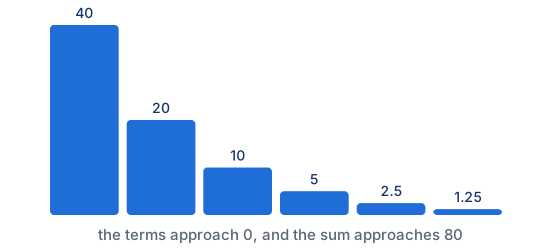
Try it: terms that shrink
Finding r
- T₂ = 6 and t₅ = 162.
- r³ = 162 ÷ 6 = 27
- r = 3
- a = 6 ÷ 3 = 2
Common mistakes
- Writing 3 × 2⁸ for the eighth term.The power is one less than the term number.
- Using S∞ when r = 2.The terms grow, so the sum has no limit.
Your turn
Find t₅ of 3, 6, 12, ...
Find the sum 1 + 2 + 4 + 8.
Find S∞ of 12, 6, 3, ...
t₁ = 5 and t₂ = 15. Find r.
Show answer
1. 48 2. 15 3. 12 ÷ 0.5 = 24 4. 3
Sample question: Achieved
For the geometric sequence 2, 6, 18, ..., find t₇ and S₇.
Hint
Find r by dividing a term by the one before it, then use tₙ = arⁿ⁻¹ and Sₙ = a(rⁿ − 1)r − 1.
Answer
t₇ = 1458 and S₇ = 2186
Step by step
- A geometric sequence multiplies by the same number each time: r = 6 ÷ 2 = 3, and a = 2.
- nth term: t₇ = ar⁶ = 2 × 3⁶ = 2 × 729 = 1458.
- Sum: S₇ = a(r⁷ − 1)r − 1 = 2(2187 − 1)2 = 2186.
- Classic mistake: using 3⁷ for t₇. The first term has no factor of r, so the 7th term has only 6.
- Check: the terms are 2, 6, 18, 54, 162, 486, 1458, and their total is 2186.
Full working
- a = 2, r = 3
- t₇ = 2 × 3⁶ = 1458tₙ = arⁿ⁻¹
- S₇ = 2(3⁷ − 1)3 − 1 = 2186
- t₇ = 1458, S₇ = 2186
Sample questions: Merit
A geometric sequence has t₃ = 12 and t₆ = −96. Find a, r and S₁₀.
Hint
Going from t₃ to t₆ multiplies by r three times, so divide them to get r³.
Answer
a = 3, r = −2 and S₁₀ = −1023
Step by step
- t₃ = ar² and t₆ = ar⁵. Dividing removes a: t₆ ÷ t₃ = r³.
- r³ = −96 ÷ 12 = −8, so r = −2. A cube root of a negative number is negative, and there is only one.
- a = t₃ ÷ r² = 12 ÷ 4 = 3.
- S₁₀ = a(r¹⁰ − 1)r − 1 = 3((−2)¹⁰ − 1)−2 − 1.
- (−2)¹⁰ = 1024, an even power, so it is positive. S₁₀ = 3 × 10²³ ÷ (−3) = −1023.
- Classic mistake: losing the bracket and working out −2¹⁰ = −1024. The base is −2, so it needs brackets.
- Check: the terms go 3, −6, 12, −24, 48, −96, so t₃ = 12 and t₆ = −96. Correct.
Full working
- r³ = −96 ÷ 12 = −8, so r = −2t₆ ÷ t₃
- a = 12 ÷ (−2)² = 3
- S₁₀ = 3((−2)¹⁰ − 1)−3 = 3 × 10²³−3Sₙ = a(rⁿ − 1)r − 1
- a = 3, r = −2, S₁₀ = −1023
How many terms of the series 3 + 6 + 12 + ... are needed for the sum to be more than 10 000?
Hint
Write Sₙ in terms of n, then solve for the power 2ⁿ, by trying powers of 2 or with logs.
Answer
12 terms (S₁₁ = 6141 and S₁₂ = 12 285)
Step by step
- a = 3 and r = 2, so Sₙ = 3(2ⁿ − 1)2 − 1 = 3(2ⁿ − 1).
- We need 3(2ⁿ − 1) > 10 000, so 2ⁿ − 1 > 3333.3 and 2ⁿ > 3334.3.
- Powers of 2: 2¹¹ = 2048, too small. 2¹² = 4096, big enough.
- With logs: n > log 3334.3 ÷ log 2 ≈ 11.7, so the next whole number is 12.
- Check both sides: S₁₁ = 3 × 2047 = 6141, not enough. S₁₂ = 3 × 4095 = 12 285, more than 10 000.
- Classic mistake: solving tₙ > 10 000 instead of Sₙ > 10 000. The question is about the total.
Full working
- Sₙ = 3(2ⁿ − 1)a = 3, r = 2
- 2ⁿ > 3334.3Sₙ > 10 000
- n > log 3334.3 ÷ log 2 ≈ 11.7
- S₁₁ = 6141, S₁₂ = 12 285check
- 12 terms
Sample questions: Excellence
A ball is dropped from 10 m. After each bounce it rises to 60% of the height it fell from. Assuming it bounces for ever, find the total vertical distance it travels. Explain why this is only a model.
Hint
After the first drop, each bounce height is travelled twice: up and back down. Use S∞ on the bounce heights.
Answer
40 m; in reality the ball stops after a finite number of bounces and the 60% ratio is not exact
Step by step
- List the movements: down 10, up 6, down 6, up 3.6, down 3.6, and so on.
- The first 10 m is travelled only once. Every bounce height after it is travelled twice.
- The bounce heights 6, 3.6, 2.16, ... are geometric with a = 6 and r = 0.6.
- r = 0.6 is between −1 and 1, so the sum to infinity exists: S∞ = a1 − r = 60.4 = 15.
- Total = 10 + 2 × 15 = 40 m.
- Classic mistake: using S∞ = 101 − 0.6 = 25 for everything. That counts each bounce only once.
- Model limitations: a real ball loses more energy as bounces get small and stops after a finite time; the 60% is only roughly constant; and air resistance is ignored.
- But because the heights shrink so fast, the model still gives a good estimate of the real total.
- Check: after 10 bounces the distance is 10 + 2 × 6(1 − 0.6¹⁰)0.4 ≈ 39.8 m, already close to 40.
Full working
- 10 + 2(6 + 3.6 + 2.16 + ...)each bounce up and down
- bounces: a = 6, r = 0.6−1 < r < 1
- S∞ = 61 − 0.6 = 15
- total = 10 + 2 × 15
- 40 m
The geometric series 1 + (2x − 1) + (2x − 1)² + ... depends on x. Find the values of x for which it has a sum to infinity. Find x when the sum to infinity is 4, and show that the sum to infinity, when it exists, is always greater than 12.
Hint
The ratio is r = 2x − 1. A sum to infinity needs −1 < r < 1.
Answer
It converges for 0 < x < 1; S∞ = 12 − 2x, which is 4 when x = 78; since 0 < 2 − 2x < 2, S∞ > 12
Step by step
- Each term is the one before times (2x − 1), so a = 1 and r = 2x − 1.
- A sum to infinity only exists when −1 < r < 1: −1 < 2x − 1 < 1.
- Add 1 to each part: 0 < 2x < 2, so 0 < x < 1.
- S∞ = a1 − r = 11 − (2x − 1) = 12 − 2x.
- Set it to 4: 2 − 2x = 14, so 2x = 74 and x = 78. This is between 0 and 1, so it is allowed.
- Check: x = 78 gives r = 34, and 11 − 34 = 4. Correct.
- Now the bound. For 0 < x < 1, the bottom 2 − 2x is between 0 and 2.
- One divided by a positive number less than 2 is more than 12. So S∞ > 12 always.
- It gets close to 12 as x gets close to 0 (r near −1), but never reaches it.
- Classic mistake: solving 12 − 2x = 4 and not checking that x is in the allowed range. Outside it, there is no sum to infinity at all.
Full working
- a = 1, r = 2x − 1
- −1 < 2x − 1 < 1, so 0 < x < 1condition for S∞
- S∞ = 11 − (2x − 1) = 12 − 2x
- 12 − 2x = 4, so x = 78in range
- 0 < 2 − 2x < 2, so S∞ > 12
- 0 < x < 1; x = 78; S∞ > 12
What to take away
- Same ratio means geometric.
- Check −1 < r < 1 before using S∞.
Report a mistake
More in AS 91258
Is your child on track?
Take the free placement test