Growth and financial problems
What this lesson covers
- A fixed added amount is arithmetic.
- A percentage change is geometric.
- Regular deposits form a geometric series.
Which kind is it
- A fixed extra amount each time gives an arithmetic sequence.
- A percentage increase multiplies by 1 + the rate, which is geometric.
Saving a bit more each month
- Save $100 in month 1 and $20 more each month after.
- a = 100, d = 20
- t₁₂ = 100 + 11 × 20 = $320
- S₁₂ = 6(200 + 220)
- S₁₂ = $2520
Try it: saving a bit more each week
Compound interest
- $5000 at 4% a year for 5 years.
- r = 1.04
- 5000 × 1.04⁵
- = $6083.26
Try it: compound interest
Money calculator
Regular deposits
- $1000 at the start of each year at 5% a year. What is it worth after 3 years?
- 1000(1.05 + 1.05² + 1.05³)
- a = 1050, r = 1.05, n = 3
- S₃ = 1050(1.05³ − 1) ÷ 0.05
- S₃ = $3310.13
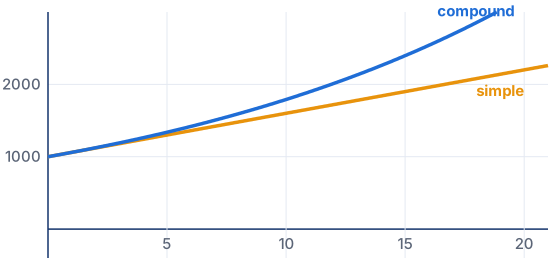
Simple against compound
- Compound growth curves upward because interest earns interest.
Common mistakes
- Using r = 0.04 for 4% growth.Growth multiplies by 1.04.
- Forgetting a bouncing ball travels up and down.After the drop, each rebound counts twice.
Your turn
What is the multiplier for a 5% rise?
$100 earns $5 simple interest a year. Find the total after 4 years.
Find $100 after 2 years at 10% compound.
What is the multiplier for a 20% fall?
Show answer
1. 1.05 2. $120 3. $121 4. 0.8
Sample question: Achieved
$8,000 is invested at 4.5% a year, compounded annually. Find its value after 6 years.
Hint
Each year multiplies the amount by 1.045, so after 6 years it is 8000 × 1.045⁶.
Answer
$10,418.08
Step by step
- A percentage increase is geometric: each year the amount is multiplied by 1 + 0.045 = 1.045.
- After 1 year: 8000 × 1.045. After 2 years: 8000 × 1.045². The power is the number of years.
- After 6 years: 8000 × 1.045⁶.
- 1.045⁶ ≈ 1.30226, so the value is about $10,418.08.
- Classic mistake: simple interest, 8000 + 6 × 360 = 10 160. Compound interest also earns interest on the interest, so it is more.
- Check: the interest earned is about 2418, which is more than the 2160 simple interest. That fits.
Full working
- multiplier = 1.0454.5% increase
- 8000 × 1.045⁶6 years
- $10,418.08
Sample questions: Merit
A car bought for $32,000 loses 18% of its value each year. After how many whole years is it first worth less than $10,000?
Hint
Losing 18% leaves 82%, so multiply by 0.82 each year. Solve 32 000 × 0.82ⁿ < 10 000.
Answer
After 6 years (about $9,728; after 5 years it is still about $11,864)
Step by step
- A percentage fall is geometric. Losing 18% leaves 82%, so the multiplier is 0.82.
- Value after n years: 32 000 × 0.82ⁿ.
- We need 32 000 × 0.82ⁿ < 10 000, so 0.82ⁿ < 0.3125.
- With logs: n > log 0.3125 ÷ log 0.82 ≈ 5.86. Dividing by log 0.82, a negative number, flips the inequality.
- The first whole number above 5.86 is 6.
- Check: after 5 years 32 000 × 0.82⁵ ≈ $11,864, still above. After 6 years ≈ $9,728, below.
- Classic mistake: multiplying by 0.18 instead of 0.82. That is the amount lost, not the value left.
Full working
- value = 32 000 × 0.82ⁿ18% fall
- 0.82ⁿ < 0.3125
- n > log 0.3125 ÷ log 0.82 ≈ 5.86
- n = 5: ≈ 11 864; n = 6: ≈ 9728check
- after 6 years
Job A pays $52,000 in year 1 and rises by $1,500 each year. Job B pays $50,000 in year 1 and rises by 4% each year. Which job pays more in total over 10 years, and by how much?
Hint
A fixed rise is arithmetic and a percentage rise is geometric. Use the matching sum formula for each.
Answer
Job B, by about $12,805 (Job A $587,500, Job B about $600,305)
Step by step
- First decide the type. Job A adds the same amount each year: arithmetic, with a = 52 000 and d = 1500.
- Job B multiplies by 1.04 each year: geometric, with a = 50 000 and r = 1.04.
- Job A total: S₁₀ = (102)(2 × 52 000 + 9 × 1500) = 5(104 000 + 13 500) = 587 500.
- Job B total: S₁₀ = 50 000 × 1.04¹⁰ − 11.04 − 1 = 50 000 × 0.48024 ÷ 0.04 ≈ 600 305.
- Job B pays about 600 305 − 587 500 = $12,805 more.
- Notice: Job A starts higher, but percentage growth compounds. By year 10 Job A pays $65,500 and Job B about $71,166.
- Classic mistake: using the arithmetic formula for both. A percentage rise is never a fixed amount.
- Check Job B roughly: its average year is about 60 000, and 10 × 60 000 = 600 000. Close.
Full working
- A: a = 52 000, d = 1500fixed rise, arithmetic
- S₁₀ = 5(104 000 + 13 500) = 587 500
- B: a = 50 000, r = 1.04percentage rise, geometric
- S₁₀ = 50 000 × 1.04¹⁰ − 10.04 ≈ 600 305
- Job B, by about $12,805
Sample questions: Excellence
Aroha puts $200 into a savings account at the start of every month. The account pays 0.5% interest a month, added at the end of each month. After how many months is the balance first more than $10,000?
Hint
Track where each deposit ends up: the first one grows for n months, the last for 1 month. That makes a geometric series.
Answer
45 months (about $10,115; after 44 months it is about $9,865)
Step by step
- Think about each deposit separately at the end of month n.
- The last deposit earns 1 month of interest: 200 × 1.005. The first earns n months: 200 × 1.005ⁿ.
- Balance = 200 × 1.005 + 200 × 1.005² + ... + 200 × 1.005ⁿ. This is geometric with a = 200 × 1.005 = 201 and r = 1.005.
- Sₙ = 201(1.005ⁿ − 1)1.005 − 1 = 201(1.005ⁿ − 1)0.005.
- We need Sₙ > 10 000: 1.005ⁿ − 1 > 10 000 × 0.005 ÷ 201 ≈ 0.24876.
- 1.005ⁿ > 1.24876, so n > log 1.24876 ÷ log 1.005 ≈ 44.5.
- The first whole month is n = 45.
- Check: S₄₄ ≈ $9,864.83 and S₄₅ ≈ $10,115.16. So month 45 is the first.
- Without interest she would need 50 months. Interest saves about 5 months of deposits.
- Classic mistake: taking a = 200. Each deposit is made at the start of the month, so even the newest one has earned a month's interest.
Full working
- 200 × 1.005 + 200 × 1.005² + ... + 200 × 1.005ⁿeach deposit's growth
- a = 201, r = 1.005
- 201(1.005ⁿ − 1)0.005 > 10 000
- 1.005ⁿ > 1.24876, so n > 44.5
- S₄₄ ≈ 9864.83, S₄₅ ≈ 10 115.16check
- 45 months
A predator-free sanctuary has 120 kiwi. Each year the population grows by 8%, then 5 birds are moved to other sites at the end of the year. Show that the population after n years is Pₙ = 62.5 + 57.5 × 1.08ⁿ. Hence find the first year the population is over 200.
Hint
Write P₁, P₂ and P₃ out without simplifying. The removed birds form a geometric series you can sum.
Answer
Pₙ = 120 × 1.08ⁿ − 5(1.08ⁿ − 1)0.08 = 62.5 + 57.5 × 1.08ⁿ; the population first passes 200 after 12 years (about 207)
Step by step
- Each year: multiply by 1.08, then take 5. So P₁ = 120 × 1.08 − 5.
- P₂ = (120 × 1.08 − 5) × 1.08 − 5 = 120 × 1.08² − 5 × 1.08 − 5.
- The pattern: Pₙ = 120 × 1.08ⁿ − 5(1 + 1.08 + 1.08² + ... + 1.08ⁿ⁻¹).
- The bracket is a geometric series with a = 1, r = 1.08 and n terms: 1.08ⁿ − 10.08.
- So Pₙ = 120 × 1.08ⁿ − 5(1.08ⁿ − 1)0.08 = 120 × 1.08ⁿ − 62.5 × 1.08ⁿ + 62.5.
- Collect the 1.08ⁿ terms: Pₙ = 62.5 + 57.5 × 1.08ⁿ. That is what we had to show.
- Why 62.5? If the population were 62.5, the 8% growth would be exactly 5 birds, so it would stay still. Above 62.5 it grows.
- Hence: 62.5 + 57.5 × 1.08ⁿ > 200, so 1.08ⁿ > 137.5 ÷ 57.5 ≈ 2.3913.
- n > log 2.3913 ÷ log 1.08 ≈ 11.3, so the first whole year is 12.
- Check: P₁₁ ≈ 196.6 and P₁₂ ≈ 207.3. Also P₁ = 62.5 + 62.1 = 124.6, and 120 × 1.08 − 5 = 124.6. Correct.
- Limitation: real growth is not exactly 8% every year, and you cannot have part of a kiwi, so round to whole birds.
Full working
- P₁ = 120 × 1.08 − 5, P₂ = 120 × 1.08² − 5 × 1.08 − 5write out
- Pₙ = 120 × 1.08ⁿ − 5(1.08ⁿ − 1)0.08geometric series of removals
- Pₙ = 62.5 + 57.5 × 1.08ⁿshown
- 1.08ⁿ > 2.3913, so n > 11.3
- P₁₁ ≈ 196.6, P₁₂ ≈ 207.3check
- first over 200 after 12 years
What to take away
- Added amount: arithmetic. Percentage: geometric.
- Write the first few terms when unsure.
Practise this
Report a mistake
More in AS 91258
Is your child on track?
Take the free placement test