Quadratic equations: solving, and forming from the roots
What this lesson covers
- Every quadratic can be solved by factorising, the formula, or completing the square, and each suits different equations.
- The roots of a quadratic fix its factors, so the equation can be rebuilt from its solutions.
A quadratic equation
- ax² + bx + c = 0.
- Usually two solutions, called roots.
- Three ways: factorise, formula, or graph.
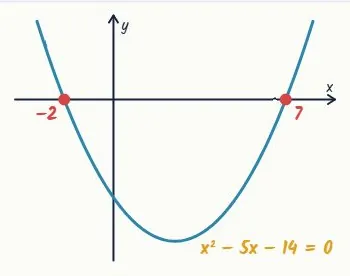
Roots are where the graph crosses
- y = x² − 5x − 14.
- It crosses the x-axis at −2 and 7.
- Those are the solutions of x² − 5x − 14 = 0.
Solving by factorising
- Product −14, sum −5.
- A factor must be zero.
- x² − 5x − 14 = 0
- −7 × 2 = −14, −7 + 2 = −5
- (x − 7)(x + 2) = 0factorise
- x − 7 = 0 or x + 2 = 0a factor is zero
- x = 7 or x = −2
Rearrange to zero first
- Make one side zero.
- Then factorise.
- x(x + 3) = 10
- x² + 3x = 10expand
- x² + 3x − 10 = 0subtract 10
- (x + 5)(x − 2) = 05 × (−2) = −10
- x = −5 or x = 2
- x = 2: 2 × 5 = 10
When it will not factorise
- Write a, b, c with signs.
- Brackets round negatives.
- x = (−b ± √(b² − 4ac))/2a
- 2x² − 3x − 4 = 0
- a = 2, b = −3, c = −4
- b² − 4ac = (−3)² − 4(2)(−4)
- = 9 + 32 = 41
- x = (3 ± √41)/4−b = 3, 2a = 4
- x = (3 + √41)/4 = 2.351
- x = (3 − √41)/4 = −0.851
Working backwards: roots to equation
- Each root gives a factor.
- Clear the fraction first.
- x = 3, so x − 3 = 0
- x = −1/2
- 2x = −1, so 2x + 1 = 0double both sides
- (x − 3)(2x + 1) = 0
- 2x² + x − 6x − 3 = 0expand
- 2x² − 5x − 3 = 0collect
What a fractional root tells you
- A root x = p/q comes from a factor (qx − p).
- So the leading coefficient is a multiple of q.
- Fractional roots mean the equation factorises.
In context: reject what cannot be
- Write the equation first.
- Reject what cannot be.
- x(x + 3) = 40width × length
- x² + 3x − 40 = 0expand, subtract 40
- (x + 8)(x − 5) = 08 × (−5) = −40
- x = −8 or x = 5
- x = −8a width is positive
- x = 5, length 5 + 3 = 8
- 5 m by 8 m
- 5 × 8 = 40 m²
State the equation you formed
- Write the equation before solving it.
- The specification asks for this.
- An answer alone is not enough.
Where the marks are
- Achieved: solve, and form from roots.
- Merit: in context, choosing the method.
- Excellence: modelling a real situation.
What to take away
- Equal to zero first, then factorise or use the formula.
| First | rearrange to = 0 |
| Factorise | when the numbers are friendly |
| Formula | x = (−b ± √(b² − 4ac)) / 2a |
| From roots | each root gives a factor |
| Fractional root | x = p/q gives (qx − p) |
| Context | reject impossible answers |
Your turn: four questions
- Pause here and answer each one.
- Question 3: whole-number coefficients.
- Question 4 needs the formula.
| Question | |
|---|---|
| 1 | Solve x² + 2x − 15 = 0. |
| 2 | Solve 3x² + x − 2 = 0. |
| 3 | Form a quadratic with roots 2 and −3/4. |
| 4 | Solve x² − 4x − 1 = 0, to 3 decimal places. |
Show answer
1. (x + 5)(x − 3) = 0: x = 3 or −5. 2. (3x − 2)(x + 1) = 0: x = 2/3 or −1. 3. (x − 2)(4x + 3) = 4x² − 5x − 6 = 0. 4. x = (4 ± √20)/2 = 2 ± √5: 4.236 or −0.236.
The answers: questions 1 and 2
- 1. x² + 2x − 15 = 0
- (x + 5)(x − 3) = 05 × (−3) = −15, 5 − 3 = 2
- x = −5 or x = 3
- 2. 3x² + x − 2 = 0
- a × c = −6: use 3 and −2
- 3x² + 3x − 2x − 2 = 0split x
- 3x(x + 1) − 2(x + 1) = 0group in pairs
- (3x − 2)(x + 1) = 0common bracket
- x = 2/3 or x = −13x = 2
The answers: questions 3 and 4
- 3. x = 2 gives x − 2
- x = −3/4 gives 4x + 34x = −3
- (x − 2)(4x + 3) = 0
- 4x² + 3x − 8x − 6 = 0expand
- 4x² − 5x − 6 = 0collect
- 4. b² − 4ac = (−4)² − 4(1)(−1)
- = 16 + 4 = 20
- x = (4 ± √20)/2 = 2 ± √5√20 = 2√5
- x = 4.236 or x = −0.2363 decimal places
Is your child on track?
Take the free placement test