The discriminant: how many roots, and what kind

What this lesson covers
- The discriminant b² − 4ac decides how many real roots a quadratic has before it is solved.
- A perfect-square discriminant means the roots are rational; otherwise they are irrational.
Before you solve, count the roots
- Inside the quadratic formula is b² − 4ac.
- It is called the discriminant.
- Its sign decides how many real roots there are.
Three cases, one curve
- Positive: the curve crosses the axis twice.
- Zero: it just touches, once.
- Negative: it never meets the axis.
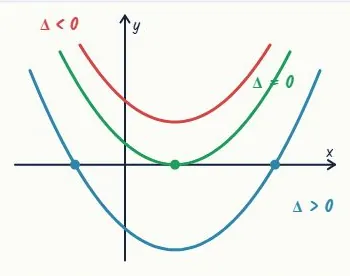
Try it: two, one or no roots
The rule
- Work out b² − 4ac.
- Positive, zero or negative.
- Two roots, one repeated root, or none.
| Discriminant | Roots | Graph |
|---|---|---|
| b² − 4ac > 0 | two real roots | crosses twice |
| b² − 4ac = 0 | one repeated root | touches once |
| b² − 4ac < 0 | no real roots | never meets |
Why it works
- The formula has ± √(b² − 4ac).
- Positive gives two answers; zero gives one.
- Negative has no real square root.
Two quick examples
- Write a, b and c first.
- Then state the nature.
- x² − 6x + 9: a = 1, b = −6, c = 9
- Δ = (−6)² − 4(1)(9)substitute
- = 36 − 36 = 0one repeated root
- x² + 2x + 5: a = 1, b = 2, c = 5
- Δ = 2² − 4(1)(5)substitute
- = 4 − 20 = −16no real roots
Watch the sign when c is negative
- C negative: −4ac adds.
- Bracket negative values.
- 2x² + 3x − 2 = 0
- a = 2, b = 3, c = −2c is negative
- Δ = 3² − 4(2)(−2)substitute
- −4(2)(−2) = +16minus times minus
- Δ = 9 + 16 = 25two real roots
Rational roots: a perfect square
- Perfect square: rational.
- The equation factorises.
- Δ = 25 = 5²a perfect square
- x = (−3 ± √25)/4−b = −3, 2a = 4
- = (−3 ± 5)/4√25 = 5
- x = (−3 + 5)/4 = 1/2
- x = (−3 − 5)/4 = −2
- (2x − 1)(x + 2) = 0it factorises
Irrational roots: not a square
- Not a square: irrational.
- Leave the root as a surd.
- x² − 4x + 1: a = 1, b = −4, c = 1
- Δ = (−4)² − 4(1)(1)substitute
- = 16 − 4 = 12not a perfect square
- x = (4 ± √12)/2−b = 4, 2a = 2
- √12 = √4 × √3 = 2√3
- x = (4 ± 2√3)/2
- = 2 ± √3irrational
Find k for equal roots
- Equal roots: Δ = 0.
- Give both values of k.
- x² + kx + 9 = 0
- a = 1, b = k, c = 9
- Δ = 0equal roots
- k² − 4(1)(9) = 0substitute
- k² − 36 = 0
- k² = 36add 36
- k = 6 or k = −6both square roots
Try it: cut, touch or miss
Find k for no real roots
- No real roots: Δ < 0.
- The answer is a range.
- kx² − 4x + 1 = 0
- a = k, b = −4, c = 1
- Δ < 0no real roots
- (−4)² − 4(k)(1) < 0substitute
- 16 − 4k < 0
- 16 < 4kadd 4k
- 4 < k, so k > 4divide by 4
The words tell you the condition
- "Equal" or "repeated": Δ = 0.
- "Two real" or "distinct": Δ > 0.
- "No real": Δ < 0. "Real": Δ ≥ 0.
Graphing calculator
Where the marks are
- Achieved: calculate Δ and state the nature.
- Merit: use Δ to find an unknown.
- Excellence: link Δ to a real problem.
What to take away
- The sign of b² − 4ac counts the roots.
| Δ = b² − 4ac | from ax² + bx + c = 0 |
| Δ > 0 | two real roots |
| Δ = 0 | one repeated root |
| Δ < 0 | no real roots |
| Δ a perfect square | the roots are rational |
| Unknown k | set up Δ = 0, > 0 or < 0 |
Common mistakes
- 2x² + 3x − 2 = 0: Δ = 3² − 4(2)(2) = 9 − 16 = −7, so no real roots.c is −2, so bracket it: −4(2)(−2) = +16, giving Δ = 9 + 16 = 25 and two real roots.
- Δ = 12 is positive, so the roots are rational.Δ > 0 gives two real roots, but they are rational only when Δ is a perfect square. 12 is not, so the roots are irrational.
- x² + kx + 9 = 0 has equal roots when k² = 36, so k = 6.k² = 36 has two square roots, so k = 6 or k = −6.
- k² − 64 < 0, so k < 8.Values below −8 also make k² bigger than 64, so the answer is the range −8 < k < 8.
Your turn: four questions
- Question 4 has a range of answers.
- Show the discriminant each time.
Describe the roots of 3x² − 5x + 1 = 0.
Describe the roots of x² − 10x + 25 = 0.
Find k so x² + 6x + k = 0 has equal roots.
For which k does 2x² + kx + 8 = 0 have no real roots?
Show answer
1. Δ = 25 − 12 = 13 > 0 and not a square: two irrational roots. 2. Δ = 100 − 100 = 0: one repeated root, x = 5. 3. 36 − 4k = 0, so k = 9. 4. k² − 64 < 0, so −8 < k < 8.
The answers: questions 1 and 2
- 1. a = 3, b = −5, c = 1
- Δ = (−5)² − 4(3)(1)substitute
- = 25 − 12 = 13
- 13 > 0, not a squaretwo irrational roots
- 2. a = 1, b = −10, c = 25
- Δ = (−10)² − 4(1)(25)substitute
- = 100 − 100 = 0one repeated root
- (x − 5)² = 0, so x = 5factorise
The answers: questions 3 and 4
- 3. 6² − 4(1)(k) = 0equal roots: Δ = 0
- 36 − 4k = 0
- 4k = 36, so k = 9
- 4. k² − 4(2)(8) < 0no real roots: Δ < 0
- k² − 64 < 0
- k² < 64add 64
- −8 < k < 8k between −8 and 8
Sample question: Achieved
Find the discriminant of 2x² − 5x − 3 = 0 and use it to describe the roots. Do not solve the equation.
Hint
Use Δ = b² − 4ac with a = 2, b = −5 and c = −3, then ask: is it positive, and is it a perfect square?
Answer
Δ = 49: two different real roots, and they are rational
Step by step
- The discriminant is Δ = b² − 4ac. It tells you about the roots before you solve.
- Read off a = 2, b = −5 and c = −3. Keep the signs with the numbers.
- b² = (−5)² = 25. Squaring a negative gives a positive.
- 4ac = 4 × 2 × (−3) = −24, so −4ac = +24.
- Δ = 25 + 24 = 49.
- Classic mistake: writing 25 − 24 = 1. When c is negative, taking away 4ac adds.
- Δ is positive, so there are two different real roots.
- 49 = 7² is a perfect square, so the roots are rational (whole numbers or fractions).
- Check by solving: (2x + 1)(x − 3) = 0 gives x = −12 and x = 3. Two rational roots, as predicted.
Full working
- a = 2, b = −5, c = −3
- Δ = (−5)² − 4 × 2 × (−3)Δ = b² − 4ac
- Δ = 25 + 24 = 49
- Δ > 0 and 49 = 7²positive and a perfect square
- Two different real rational roots
Sample questions: Merit
Find the values of k for which x² + kx + 2k − 3 = 0 has equal roots. For each value of k, find the root.
Hint
Equal roots means Δ = 0. That gives a quadratic in k to solve.
Answer
k = 2, root x = −1; or k = 6, root x = −3
Step by step
- Equal roots (one repeated root) means the discriminant is zero: b² − 4ac = 0.
- Read off a = 1, b = k and c = 2k − 3. The whole of 2k − 3 is c.
- Δ = k² − 4 × 1 × (2k − 3) = k² − 8k + 12.
- Classic mistake: writing k² − 8k − 12. The −4 multiplies both parts of the bracket, so −4 × −3 = +12.
- Set it to zero: k² − 8k + 12 = 0.
- Factorise: two numbers that multiply to 12 and add to −8 are −2 and −6. So (k − 2)(k − 6) = 0, giving k = 2 or k = 6.
- Now find each root. When Δ = 0 the formula gives x = −b ÷ (2a) = −k2.
- k = 2 gives x = −1. k = 6 gives x = −3.
- Check k = 2: x² + 2x + 1 = (x + 1)², root −1. Check k = 6: x² + 6x + 9 = (x + 3)², root −3. Both are perfect squares, as they should be.
Full working
- Δ = k² − 4(2k − 3) = 0equal roots: Δ = 0
- k² − 8k + 12 = 0
- (k − 2)(k − 6) = 0, so k = 2 or 6
- x = −b ÷ (2a) = −k2the single root when Δ = 0
- k = 2, x = −1; k = 6, x = −3
Find the values of k for which kx² + 4x + (k − 3) = 0 has two different real roots.
Hint
Two different real roots means Δ > 0. Solve the inequality in k, and remember the equation is only a quadratic if k ≠ 0.
Answer
−1 < k < 4, but k ≠ 0
Step by step
- Two different real roots means the discriminant is positive: b² − 4ac > 0.
- Here a = k, b = 4 and c = k − 3.
- Δ = 16 − 4k(k − 3) = 16 − 4k² + 12k.
- Set Δ > 0 and divide every term by −4. Dividing by a negative flips the sign: k² − 3k − 4 < 0.
- Factorise: (k − 4)(k + 1) < 0. The critical values are k = 4 and k = −1.
- Sketch y = (k − 4)(k + 1): a ∪-shaped parabola crossing at −1 and 4. It is below zero between them, so −1 < k < 4.
- Classic mistake: forgetting to flip the inequality when dividing by −4, which gives the outside region instead.
- One more condition: if k = 0 the x² term disappears and the equation is 4x − 3 = 0, a straight line with only one root. So k ≠ 0.
- Check k = 1, inside the range: x² + 4x − 2 = 0 has Δ = 16 + 8 = 24 > 0. Check k = 5, outside: Δ = 16 − 40 < 0. Both agree.
Full working
- Δ = 4² − 4k(k − 3) > 0two different real roots
- 16 + 12k − 4k² > 0
- k² − 3k − 4 < 0divide by −4 and flip the sign
- (k − 4)(k + 1) < 0, so −1 < k < 4a ∪ parabola is negative between its roots
- k ≠ 0otherwise it is not a quadratic
- −1 < k < 4, k ≠ 0
Sample questions: Excellence
Prove that x² + (k − 2)x − k = 0 has two different real roots for every real value of k. Then find the only integer value of k for which the roots are rational, and give those roots.
Hint
Simplify Δ until it is clearly always positive. For rational roots, Δ = k² + 4 must be a perfect square: which two square numbers are 4 apart?
Answer
Δ = k² + 4 > 0 for all k; the roots are rational only for k = 0, and they are x = 0 and x = 2
Step by step
- Here a = 1, b = k − 2 and c = −k.
- Δ = (k − 2)² − 4 × 1 × (−k) = k² − 4k + 4 + 4k.
- The −4k and +4k cancel, so Δ = k² + 4.
- k² is never negative, so k² + 4 is at least 4. Δ is always positive.
- A positive discriminant means two different real roots, whatever k is. That proves the first part.
- Rational roots need Δ to be a perfect square, say k² + 4 = m² for a whole number m.
- Then m² − k² = 4, so two perfect squares are 4 apart.
- List the squares: 0, 1, 4, 9, 16, 25, ... The gaps between them grow (1, 3, 5, 7, ...), and the only pair 4 apart is 0 and 4.
- So k² = 0 and m² = 4, which means k = 0.
- With k = 0 the equation is x² − 2x = 0, so x(x − 2) = 0 and the roots are 0 and 2.
- Classic mistake: testing a few values of k and stopping. The gap argument shows there is no other integer, however large.
- Check: k = 1 gives Δ = 5, not a square, so irrational roots. k = 0 gives Δ = 4 = 2². Consistent.
Full working
- Δ = (k − 2)² + 4kb² − 4ac with c = −k
- Δ = k² + 4−4k and +4k cancel
- k² ≥ 0, so Δ ≥ 4 > 0 for every kalways two different real roots
- k² + 4 = m²rational roots need a perfect square
- m² − k² = 4: only 4 − 0gaps between squares are 1, 3, 5, 7, ...
- k = 0: x² − 2x = 0, x = 0 or 2
- Always two real roots; rational only for k = 0, roots 0 and 2
The expression kx² + 2kx + 3, where k ≠ 0, is positive for every value of x. Find all possible values of k, and explain why each condition you use is needed.
Hint
Positive for every x means the parabola is ∪-shaped and never touches the x-axis. Turn each of those into a condition on k.
Answer
0 < k < 3
Step by step
- Picture y = kx² + 2kx + 3. For y to be positive for every x, the whole graph must sit above the x-axis.
- Condition 1: the parabola must open upwards. A ∩-shaped parabola always goes below zero eventually. So k > 0.
- Condition 2: the graph must never meet the x-axis. That means no real roots, so Δ < 0.
- Here a = k, b = 2k and c = 3, so Δ = (2k)² − 4 × k × 3 = 4k² − 12k.
- Solve 4k² − 12k < 0. Factorise: 4k(k − 3) < 0.
- This is a ∪-shaped parabola in k with roots 0 and 3, so it is negative between them: 0 < k < 3.
- Combine the conditions: k > 0 and 0 < k < 3 give 0 < k < 3.
- Why not k = 3? Then the expression is 3x² + 6x + 3 = 3(x + 1)², which equals 0 at x = −1. Zero is not positive, so 3 is left out.
- Here Δ < 0 already forces k > 0, but do not rely on that in general: a ∩-shaped curve with Δ < 0 sits wholly below the axis. Always check the sign of a as well.
- Check k = 1: x² + 2x + 3 = (x + 1)² + 2, which is always at least 2. Positive, as required.
Full working
- k > 0the parabola must be ∪-shaped
- Δ = (2k)² − 4 × k × 3 < 0it must never meet the x-axis
- 4k(k − 3) < 0, so 0 < k < 3
- k = 3 gives 3(x + 1)², which is 0 at x = −1so 3 is excluded
- 0 < k < 3
Graphing Quadratics
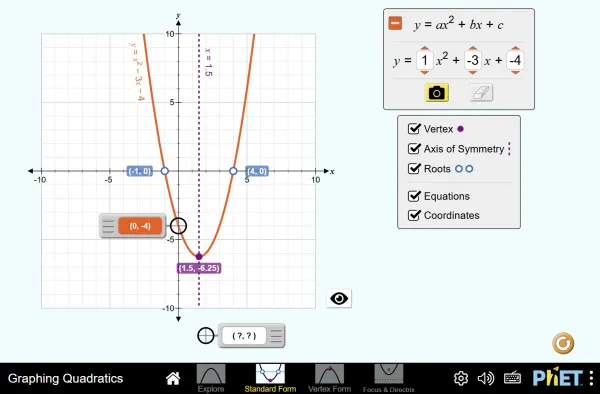
Full screen · PhET Interactive Simulations, University of Colorado Boulder, CC BY 4.0
Practise this
Report a mistake
More in AS 91261
 Index laws, fractional indices and surds7 min
 Expanding, factorising and simplifying algebraic fractions9 min
 Quadratic equations: solving, and forming from the roots8 minThe discriminant: how many roots, and what kind9 min
 Logarithms: what they mean and the log laws7 min
 Exponential growth and decay: interest, depreciation, half-life9 min
 Simultaneous equations: two lines, or a line and a curve8 min
 Algebraic modelling: completing a model from the context9 min
 Indices and surds: 7 exam questions solved step by step11 min
 Algebraic fractions: 7 exam questions solved step by step11 min
 Quadratic equations: 7 exam questions solved step by step11 min
 The discriminant: 7 exam questions solved step by step11 min
 Logarithms: 7 exam questions solved step by step10 min
 Exponential models: 7 exam questions solved step by step10 min
 Simultaneous equations: 7 exam questions solved step by step11 min
 Algebraic modelling: 6 exam questions solved step by step11 min
Is your child on track?
Take the free placement test