Anti-differentiation and why you need + c

What this lesson covers
- Anti-differentiation reverses differentiation, and every answer has a family of curves, so + c is needed.
- A known point on the curve fixes the value of c.
Going backwards
- Differentiating takes a function to its gradient.
- Anti-differentiating goes back the other way.
- Given the gradient, find the function.
The rule, reversed
- Raise the power by one.
- Divide by the new power.
- Then add + c.
| Term | Do | Get |
|---|---|---|
| xⁿ | raise the power by 1 | xⁿ⁺¹ |
| divide by the new power | xⁿ⁺¹/(n + 1) | |
| a constant k | becomes | kx |
| always | add | + c |
Anti-differentiate 6x² − 4x + 3
- Term by term.
- Three terms in, three out.
- 6x² → 6x³/3 = 2x³power 2 to 3, ÷ 3
- −4x → −4x²/2 = −2x²power 1 to 2, ÷ 2
- 3 → 3xa constant k → kx
- 2x³ − 2x² + 3x + cadd + c
- check: 6x² − 4x + 3differentiate back
Fractions, and checking
- Same rule for fractions.
- Differentiate back to check.
- x² → x³/3 + cpower 2 to 3, ÷ 3
- 3 − x/2 = 3 − ½xx/2 is ½x
- 3 → 3xa constant k → kx
- −½x → −½ × x²/2power 1 to 2, ÷ 2
- = −x²/4½ ÷ 2 = ¼
- 3x − x²/4 + c
- check: 3 − 2x/4 = 3 − x/2differentiate back
Why + c: a family of curves
- x², x² + 2 and x² − 2 all have gradient 2x.
- At x = 1 they are all equally steep.
- The gradient cannot tell them apart.
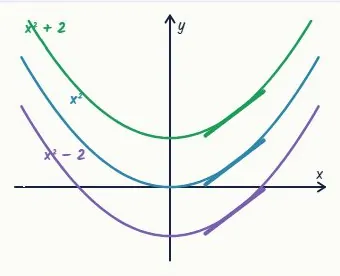
Try it: a family of curves
A point picks one curve
- Suppose the curve passes through (1, 3).
- 1 + c = 3, so c = 2.
- Only y = x² + 2 goes through it.
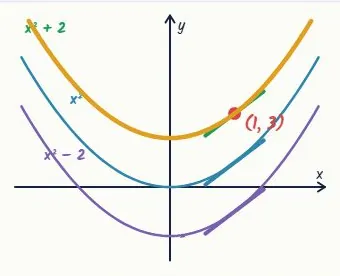
Finding c, written out
- Anti-differentiate, with + c.
- Substitute the point.
- Solve for c.
- f′(x) = 2x + 5
- f(x) = x² + 5x + canti-differentiate
- f(1) = 1² + 5(1) + c = 10through (1, 10)
- 6 + c = 10, so c = 4
- f(x) = x² + 5x + 4
- check: f′(x) = 2x + 5
- check: f(1) = 1 + 5 + 4 = 10
The two ways marks go
- Leaving out + c.
- Dropping a term from a long expression.
- Count terms in, count terms out.
Graphing calculator
In context: filling a tank
- It starts with 50 litres.
- V(0) = 50 fixes c.
- dV/dt = 20 − 2tlitres a minute
- V = 20t − 2t²/2 + canti-differentiate
- = 20t − t² + c
- V(0) = 0 − 0 + c = 5050 L at the start
- c = 50, V = 20t − t² + 50
- V(5) = 20 × 5 − 5² + 50
- = 100 − 25 + 50 = 125 L
Where the marks are
- Achieved: a general anti-derivative with + c.
- Merit: c found from a point.
- Excellence: used in a real problem.
What to take away
- Raise, divide, + c, then let a point fix c.
| Anti-differentiate | raise the power, divide by it |
| Constant k | becomes kx |
| Every time | + c |
| Why | a family of curves, same gradient |
| A point | fixes c |
| Check | differentiate your answer back |
Common mistakes
- 6x² − 4x + 3 anti-differentiates to 2x³ − 2x² + 3xAdd + c every time, because any constant differentiates to 0: the answer is 2x³ − 2x² + 3x + c.
- The constant 3 anti-differentiates to 0.A constant k becomes kx, because 3x differentiates back to 3. Count terms in, count terms out.
- x²/2 anti-differentiates to x³/2 + cRaise the power, then divide by the new power: x²/2 → x³/(2 × 3) = x³/6 + c.
- f′(x) = 6x and f(2) = 15, so f(x) = 3x² + 15Substitute the point to find c: 3 × 2² + c = 15 gives c = 3, so f(x) = 3x² + 3.
Your turn: four questions
- Every answer needs + c, or a value for it.
- Check by differentiating back.
Anti-differentiate 4x³ + 2x.
f′(x) = 6x and f(2) = 15. Find f(x).
Anti-differentiate x²/2.
Gradient 2x − 3, through (0, 4). Find the curve.
Show answer
1. x⁴ + x² + c. 2. f(x) = 3x² + c; 12 + c = 15, so c = 3 and f(x) = 3x² + 3. 3. x³/6 + c. 4. y = x² − 3x + c; at (0, 4), c = 4, so y = x² − 3x + 4.
The answers: questions 1 and 2
- 1. 4x³ → 4x⁴/4 = x⁴power 3 to 4, ÷ 4
- 2x → 2x²/2 = x²power 1 to 2, ÷ 2
- x⁴ + x² + cadd + c
- 2. f(x) = 6x²/2 + c = 3x² + canti-differentiate
- f(2) = 3 × 2² + c = 15f(2) = 15
- 12 + c = 15, so c = 3
- f(x) = 3x² + 3
The answers: questions 3 and 4
- 3. x²/2 → x³/(2 × 3)power 2 to 3, ÷ 3
- = x³/6 + cadd + c
- 4. 2x → x², −3 → −3xanti-differentiate
- y = x² − 3x + c
- 4 = 0² − 3(0) + cthrough (0, 4)
- c = 4
- y = x² − 3x + 4
- check: dy/dx = 2x − 3
Sample question: Achieved
A curve has gradient function dydx = 6x² − 4x + 5 and passes through the point (1, 8). Find the equation of the curve.
Hint
Anti-differentiate each term (add 1 to the power, then divide by the new power), include + c, then use the point to find c.
Answer
y = 2x³ − 2x² + 5x + 3
Step by step
- Anti-differentiating undoes differentiating. The rule for each term: add 1 to the power, then divide by the new power.
- 6x²: the power goes up to 3, then divide by 3, giving 6x³3 = 2x³.
- −4x: the power goes up to 2, then divide by 2, giving −2x². And 5 becomes 5x.
- Add + c, because any constant differentiates to zero. So y = 2x³ − 2x² + 5x + c.
- Classic mistake: leaving out + c. Then the curve cannot be made to pass through (1, 8), and the answer loses marks.
- Use the point: when x = 1, y = 8. So 8 = 2 − 2 + 5 + c, which gives 8 = 5 + c and c = 3.
- The curve is y = 2x³ − 2x² + 5x + 3.
- Check by differentiating: dydx = 6x² − 4x + 5, which is what we started with. And at x = 1, y = 2 − 2 + 5 + 3 = 8. Correct.
Full working
- y = 6x³3 − 4x²2 + 5x + cadd 1 to the power, divide by the new power
- y = 2x³ − 2x² + 5x + c
- 8 = 2 − 2 + 5 + c, so c = 3the point (1, 8)
- y = 2x³ − 2x² + 5x + 3
Sample questions: Merit
Given f′(x) = (2x − 1)(x + 3) and f(2) = 10, find f(x).
Hint
You cannot anti-differentiate a product of brackets term by term. Expand first, then anti-differentiate and use f(2) = 10.
Answer
f(x) = 2x³3 + 5x²2 − 3x + 23
Step by step
- There is no simple rule for anti-differentiating a product, so expand the brackets first.
- (2x − 1)(x + 3) = 2x² + 6x − x − 3 = 2x² + 5x − 3.
- Classic mistake: anti-differentiating each bracket separately and multiplying. That does not undo differentiation.
- Anti-differentiate each term: 2x² gives 2x³3, 5x gives 5x²2, and −3 gives −3x.
- Add + c: f(x) = 2x³3 + 5x²2 − 3x + c.
- Use f(2) = 10. 2 × 83 = 163, 5 × 42 = 10, and −3 × 2 = −6. So 163 + 10 − 6 + c = 10.
- 163 + 4 = 283, so c = 10 − 283 = 303 − 283 = 23.
- So f(x) = 2x³3 + 5x²2 − 3x + 23. Keep the fractions exact; decimals like 0.667 lose accuracy.
- Check by differentiating: 2x² + 5x − 3, which is (2x − 1)(x + 3) expanded. Correct.
Full working
- f′(x) = 2x² + 5x − 3expand first
- f(x) = 2x³3 + 5x²2 − 3x + canti-differentiate each term
- 163 + 10 − 6 + c = 10f(2) = 10
- c = 10 − 283 = 23
- f(x) = 2x³3 + 5x²2 − 3x + 23
Water flows into a tank so that the volume V litres changes at a rate dVdt = 40 − 2t litres per minute, t minutes after the tap is turned on. The tank holds 100 litres at t = 0. Find V in terms of t, the volume after 10 minutes, and the volume when water stops flowing in.
Hint
Anti-differentiate the rate and use V = 100 at t = 0 to find c. The water stops flowing in when the rate is zero.
Answer
V = 40t − t² + 100; 400 litres after 10 minutes; 500 litres when the flow stops at t = 20
Step by step
- The rate dVdt is the derivative of V, so anti-differentiate it to get V.
- 40 becomes 40t, and −2t becomes −2t²2 = −t². So V = 40t − t² + c.
- Use the starting volume: at t = 0, V = 100. So 100 = 0 − 0 + c and c = 100.
- Classic mistake: thinking c is always 0. Here c is the volume already in the tank at the start.
- So V = 40t − t² + 100.
- After 10 minutes: V = 400 − 100 + 100 = 400 litres.
- Water stops flowing in when the rate is zero: 40 − 2t = 0, so t = 20 minutes.
- At t = 20: V = 800 − 400 + 100 = 500 litres.
- Check by differentiating: dVdt = 40 − 2t, as given. And the rate is positive for t < 20, so the volume rises the whole time up to 500 litres.
Full working
- V = 40t − t² + canti-differentiate the rate
- 100 = cV = 100 at t = 0
- V(10) = 400 − 100 + 100 = 400 L
- 40 − 2t = 0, so t = 20the flow stops
- V = 40t − t² + 100; 400 L; 500 L at t = 20
Sample questions: Excellence
A curve has gradient function dydx = 3x² − 12. The local minimum value of the curve is −10. Find the equation of the curve, and the coordinates of its local maximum.
Hint
Find where the gradient is zero and decide which turning point is the minimum. Then anti-differentiate and use the minimum point to find c.
Answer
y = x³ − 12x + 6; the local maximum is (−2, 22)
Step by step
- Turning points are where the gradient is zero: 3x² − 12 = 0, so x² = 4 and x = 2 or x = −2.
- Decide which one is the minimum. Differentiate the gradient: the second derivative is 6x.
- At x = 2 it is 12, which is positive, so x = 2 is a minimum. At x = −2 it is −12, negative, so x = −2 is a maximum.
- Anti-differentiate the gradient: y = x³ − 12x + c.
- The minimum value is the y value at the minimum, so the point (2, −10) is on the curve.
- Substitute: −10 = 8 − 24 + c = −16 + c, so c = 6.
- The curve is y = x³ − 12x + 6.
- Classic mistake: putting y = −10 at x = −2. The question says minimum, so you must first work out which x is the minimum.
- The maximum is at x = −2: y = −8 + 24 + 6 = 22. So the local maximum is (−2, 22).
- Check: the maximum (22) is higher than the minimum (−10), as it must be for a cubic with a positive x³ term.
Full working
- 3x² − 12 = 0, so x = ±2turning points
- d²ydx² = 6x: 12 > 0 at x = 2 (min), −12 < 0 at x = −2 (max)
- y = x³ − 12x + canti-differentiate
- −10 = 8 − 24 + c, so c = 6minimum at (2, −10)
- y(−2) = −8 + 24 + 6 = 22
- y = x³ − 12x + 6; maximum (−2, 22)
A curve has gradient function dydx = kx(x − 4), where k is a constant. The curve has a turning point at (0, 5) and passes through (3, −4). Find k and the equation of the curve. Then find the other turning point and show whether it is a maximum or a minimum.
Hint
Expand, then anti-differentiate with k still in it. The point (0, 5) gives c, and (3, −4) then gives k.
Answer
k = 1, y = x³3 − 2x² + 5; the other turning point is (4, −173), a minimum
Step by step
- Expand the gradient function: dydx = kx² − 4kx. Leave k as a letter for now.
- Anti-differentiate: y = kx³3 − 4kx²2 + c = kx³3 − 2kx² + c.
- There are two unknowns, k and c, so use the two given points.
- (0, 5): every k term is zero at x = 0, so 5 = c.
- (3, −4): −4 = k × 273 − 2k × 9 + 5 = 9k − 18k + 5 = −9k + 5. So −9k = −9 and k = 1.
- The curve is y = x³3 − 2x² + 5.
- The gradient is x(x − 4), which is zero at x = 0 and x = 4. So the other turning point is at x = 4.
- y = 643 − 32 + 5 = 643 − 27 = 643 − 813 = −173. The point is (4, −173).
- Nature: check the gradient either side of x = 4. At x = 3 it is 3 × (−1) = −3 (falling). At x = 5 it is 5 × 1 = 5 (rising).
- Falling then rising means a minimum. So (4, −173) is a local minimum.
- Classic mistake: forgetting that k multiplies every term, and anti-differentiating x(x − 4) without it. Then the point (3, −4) cannot be used to find anything.
- Check: differentiate y to get x² − 4x = x(x − 4), and y(3) = 9 − 18 + 5 = −4. Both fit.
Full working
- dydx = kx² − 4kxexpand
- y = kx³3 − 2kx² + c
- c = 5the point (0, 5)
- −4 = 9k − 18k + 5, so k = 1the point (3, −4)
- x(x − 4) = 0 at x = 4: y = 643 − 27 = −173
- gradient −3 at x = 3, +5 at x = 5falling then rising: minimum
- k = 1, y = x³3 − 2x² + 5; minimum at (4, −173)
Calculus Grapher
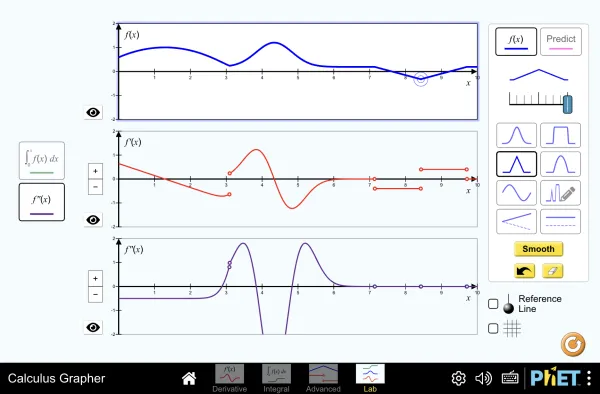
Full screen · PhET Interactive Simulations, University of Colorado Boulder, CC BY 4.0
Practise this
Report a mistake
More in AS 91262
 The derivative: what the gradient function means6 min
 Differentiating polynomials, fractions and all7 min
 Equation of a tangent to a curve, step by step8 min
 Turning points: finding and proving max or min8 min
 Sketching the gradient graph of a function7 min
 Optimisation with calculus: the biggest box8 minAnti-differentiation and why you need + c7 min
 Kinematics: displacement, velocity and acceleration8 min
 The derivative: 7 exam questions solved step by step11 min
 Differentiating: 7 exam questions solved step by step11 min
 Tangents: 7 exam questions solved step by step11 min
 Turning points: 7 exam questions solved step by step12 min
 Gradient graphs: 7 exam questions solved step by step12 min
 Optimisation: 7 exam questions solved step by step11 min
 Anti-differentiation: 7 exam questions solved step by step11 min
 Kinematics: 7 exam questions solved step by step11 min
Is your child on track?
Take the free placement test