Optimisation with calculus: the biggest box
What this lesson covers
- An optimisation problem is solved by writing the quantity as a function of one variable and finding its turning point.
- The answer must be shown to be a maximum or minimum, and must make sense in context.
Optimisation: the best value
- Biggest volume, least material, most profit.
- The best value is at a turning point.
- So form a function and differentiate it.
A box from a 24 cm square card
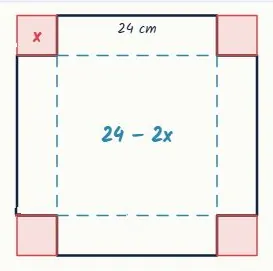
- Cut a square of side x from each corner.
- Fold up the sides: the height is x.
- Each base side is 24 − 2x.
Write the volume in one variable
- Volume = base² × height.
- Square the bracket first.
- Then multiply by x.
- height x, base 24 − 2xx off each end
- V = x(24 − 2x)²height × base²
- (24 − 2x)² = (24 − 2x)(24 − 2x)
- = 576 − 48x − 48x + 4x²expand
- = 576 − 96x + 4x²collect the x terms
- V = x(576 − 96x + 4x²)
- = 4x³ − 96x² + 576x
Differentiate and solve
- Take out 12 first.
- x = 12 leaves no base.
- V = 4x³ − 96x² + 576x
- V′ = 12x² − 192x + 576differentiate
- 12x² − 192x + 576 = 0stationary
- 12(x² − 16x + 48) = 0take out 12
- 12(x − 4)(x − 12) = 0factorise
- x = 4 or x = 12
- x = 12: base 24 − 24 = 0no box
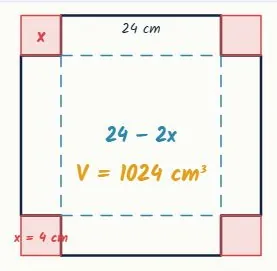
- x = 4: V = 4(24 − 8)²
- = 4 × 256 = 1024 cm³
Check the answer makes sense
- x must be more than 0 and less than 12.
- An answer outside that is not a box.
- Say why you reject it.
Prove it is a maximum
- V″ negative: a maximum.
- Or V′ goes + then −.
- V′ = 12x² − 192x + 576
- V″ = 24x − 192differentiate again
- V″(4) = 24 × 4 − 192
- = 96 − 192 = −96 < 0a maximum
- V′(3) = 108 − 576 + 576
- = 108 > 0rising
- V′(5) = 300 − 960 + 576
- = −84 < 0falling
- x = 4 gives the maximum
Answer the question asked
- Cut 4 cm squares from each corner.
- The box is 16 cm by 16 cm by 4 cm.
- Maximum volume: 1024 cm³.
Another: 60 m of fence against a wall
- The wall is the fourth side.
- Two widths, one length.
- width = x
- x + x + length = 60three sides fenced
- length = 60 − 2x
- A = x(60 − 2x)width × length
- = 60x − 2x²expand
Differentiate and solve
- Set the derivative to zero.
- Check: a maximum.
- A = 60x − 2x²
- A′ = 60 − 4xdifferentiate
- 60 − 4x = 0stationary
- 4x = 60, so x = 15
- A″ = −4 < 0a maximum
- length = 60 − 30 = 30
- A = 15 × 30 = 450 m²
Five steps for any optimisation
- Most marks are lost at step 2 and step 4.
- One variable only, before differentiating.
- Reject what the context rules out.
| Step | |
|---|---|
| 1 | draw it, name the variable |
| 2 | write the quantity in one variable |
| 3 | differentiate, set to zero, solve |
| 4 | reject answers outside the context |
| 5 | prove max or min, answer with units |
Where the marks are
- Achieved: differentiate the given function.
- Merit: find the optimum with working.
- Excellence: form it yourself, justify, check in context.
What to take away
- Form it, solve it, reject what cannot be, prove it.
| Form | one quantity, one variable |
| Solve | derivative equals zero |
| Domain | reject impossible answers |
| Prove | second derivative or gradient test |
| Answer | the question asked, with units |
Your turn: four questions
- Pause here and answer each one.
- Question 3 has an answer to reject.
- Give units.
| Question | |
|---|---|
| 1 | A = x(40 − 2x) m². Find the maximum area. |
| 2 | Profit P = −x² + 50x − 400. Find the maximum profit. |
| 3 | 12 cm card, corners x cut: V = x(12 − 2x)². Best x? |
| 4 | Prove your answer to question 3 is a maximum. |
Show answer
1. A′ = 40 − 4x = 0 at x = 10: A = 10 × 20 = 200 m². 2. P′ = −2x + 50 = 0 at x = 25: P = 225. 3. V′ = (12 − 2x)(12 − 6x) is zero at x = 2 or 6; x = 6 leaves no base, so x = 2 cm and V = 128 cm³. 4. V = 4x³ − 48x² + 144x, V″ = 24x − 96, V″(2) = −48 < 0, so a maximum.
The answers: questions 1 and 2
- 1. A = x(40 − 2x) = 40x − 2x²expand
- A′ = 40 − 4x = 0, so x = 10stationary
- A = 10(40 − 20) = 10 × 20
- = 200 m²
- 2. P′ = −2x + 50differentiate
- −2x + 50 = 0, so x = 25stationary
- P = −625 + 1250 − 400substitute x = 25
- = 225
The answers: question 3
- 3. V = x(12 − 2x)²base 12 − 2x
- (12 − 2x)² = 144 − 48x + 4x²square the bracket
- V = 4x³ − 48x² + 144xmultiply by x
- V′ = 12x² − 96x + 144differentiate
- = 12(x² − 8x + 12)take out 12
- = 12(x − 2)(x − 6) = 0factorise
- x = 6: base 12 − 12 = 0no box
- x = 2: V = 2(12 − 4)² = 2 × 64
- = 128 cm³
The answers: question 4
- V′ = 12x² − 96x + 144
- 4. V″ = 24x − 96differentiate again
- V″(2) = 24 × 2 − 96
- = 48 − 96 = −48
- −48 < 0, so x = 2 is a maximum
Is your child on track?
Take the free placement test