Differentiating polynomials, fractions and all

What this lesson covers
- A polynomial is differentiated term by term, and a constant term differentiates to zero.
- The derivative is a new function; substituting into it gives a gradient, not a y value.
One term at a time
- A polynomial is a sum of terms.
- Differentiate each term separately.
- Then add the results back up.
Differentiate 4x³ − 5x² + 2x − 7
- Power times coefficient.
- Keep each sign.
- A constant goes to 0.
- y = 4x³ − 5x² + 2x − 7
- 4x³ → 3 × 4x² = 12x²
- −5x² → 2 × (−5x) = −10xkeep the sign
- 2x → 1 × 2 = 2
- −7 → 0a constant
- dy/dx = 12x² − 10x + 2
Fractional coefficients
- The rule does not change.
- Multiply, then simplify.
- x³/3 → 3x²/3 = x²cancel the 3
- −x²/2 → −2x/2 = −xcancel the 2
- (2/5)x⁵ → 5 × (2/5)x⁴
- = 2x⁴5 × 2/5 = 2
Try it: slide the tangent
- Move along y = x³ − 3x. The gradient is 0 exactly at the turning points.
Expand brackets first
- No product rule here.
- Expand, then find dy/dx.
- y = (x + 3)(x − 2)
- = x² − 2x + 3x − 6expand
- = x² + x − 6collect x terms
- dy/dx = 2x + 1term by term
Evaluating at fractions and negatives
- Bracket every value.
- Gradient 0: flat there.
- f′(x) = 12x² − 10x + 2
- f′(1/2) = 12(1/2)² − 10(1/2) + 2
- = 12(1/4) − 5 + 2
- = 3 − 5 + 2 = 0flat here
- f′(−1) = 12(−1)² − 10(−1) + 2
- = 12 + 10 + 2 = 24
The −x² trap
- −x² means −(x²).
- Square, then the minus.
- −x² at x = −3
- = −(−3)²bracket the value
- = −(9)square first
- = −9then the minus
- (−3)² = 9lost the minus
The derivative gives gradients
- Substitute into f′ for a gradient.
- Substitute into f for a height.
- Label which you have found.
Where is the gradient 4?
- Set dy/dx equal to 4.
- Height from y, not dy/dx.
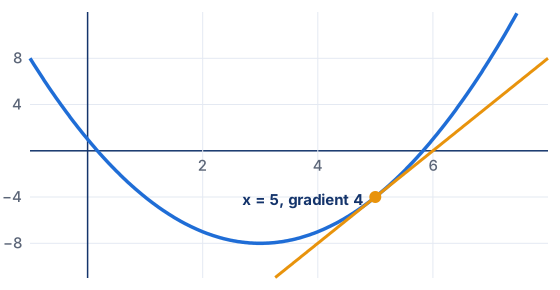
- y = x² − 6x + 1
- dy/dx = 2x − 6
- 2x − 6 = 4gradient 4
- 2x = 10, so x = 5
- y = 5² − 6(5) + 1the original y
- = 25 − 30 + 1 = −4
- the point (5, −4)
Try it: the gradient at every x
Check your derivative
- The power of each term drops by one.
- The constant term has gone.
- The number of terms usually drops by one too.
Where the marks are
- Achieved: differentiate and evaluate correctly.
- Merit: several accurate steps in a row.
- Every step written, not just the answer.
What to take away
- Term by term, and brackets around every substitution.
| Term by term | power down, power minus one |
| Constants | disappear |
| Fractions | multiply, then simplify |
| Brackets | expand before differentiating |
| Substituting | brackets around negatives |
| Given gradient | set dy/dx equal, solve for x |
Common mistakes
- y = 4x³ − 5x² + 2x − 7, so dy/dx = 12x² − 10x + 2 − 7A constant has gradient 0, so the −7 disappears: dy/dx = 12x² − 10x + 2.
- y = (x + 3)(x − 2), so dy/dx = 1 × 1 = 1Expand first, then differentiate term by term: y = x² + x − 6, so dy/dx = 2x + 1.
- −x² at x = −3 is (−3)² = 9−x² means −(x²): square first, then apply the minus, so −(−3)² = −9.
- The gradient of y = x² − 6x + 1 is 4 at x = 5, so the point is (5, 4).4 is the gradient, not the height. Use the original y: 5² − 6(5) + 1 = −4, so the point is (5, −4).
Your turn: four questions
- Question 2 needs expanding first.
- Question 4 wants a point.
Differentiate y = 3x⁴ − 2x² + 9.
Differentiate y = (2x − 1)(x + 4).
f(x) = x³/6. Find f′(−2).
Where on y = x² + 3x is the gradient −1?
Show answer
1. dy/dx = 12x³ − 4x. 2. Expand: y = 2x² + 7x − 4, so dy/dx = 4x + 7. 3. f′(x) = x²/2, so f′(−2) = 4/2 = 2. 4. 2x + 3 = −1 gives x = −2, and y = 4 − 6 = −2: the point (−2, −2).
The answers: questions 1 and 2
- 1. y = 3x⁴ − 2x² + 9
- dy/dx = 4 × 3x³ − 2 × 2xterm by term
- = 12x³ − 4xthe 9 goes
- 2. y = (2x − 1)(x + 4)
- = 2x² + 8x − x − 4expand
- = 2x² + 7x − 4collect x terms
- dy/dx = 4x + 7
The answers: questions 3 and 4
- 3. f′(x) = 3x²/6 = x²/2
- f′(−2) = (−2)²/2brackets round −2
- = 4/2 = 2
- 4. dy/dx = 2x + 3
- 2x + 3 = −1, so 2x = −4gradient −1
- x = −2
- y = (−2)² + 3(−2)the original y
- = 4 − 6 = −2
- the point (−2, −2)
Sample question: Achieved
For f(x) = 2x³ − 5x² + 4x − 1, find f′(x) and the gradient of the curve at x = 2.
Hint
Differentiate term by term: multiply by the power, then take 1 off the power. Then substitute x = 2 into f′(x), not into f(x).
Answer
f′(x) = 6x² − 10x + 4; the gradient at x = 2 is 8
Step by step
- Recall the rule for each term axⁿ: multiply by the power n, then reduce the power by 1. It gives naxⁿ⁻¹.
- 2x³ becomes 3 × 2x² = 6x². −5x² becomes 2 × (−5)x = −10x.
- 4x becomes 4, and the constant −1 becomes 0, because a constant does not change.
- So f′(x) = 6x² − 10x + 4.
- The gradient at x = 2 comes from the derivative: f′(2) = 6 × 4 − 10 × 2 + 4 = 24 − 20 + 4 = 8.
- Classic mistake: substituting into f(x) instead. f(2) = 3 is the height of the curve there, not its gradient.
- So at x = 2 the curve is rising, with gradient 8.
- Check numerically: f(2.01) − f(1.99) ≈ 0.16, and dividing by 0.02 gives about 8. Correct.
Full working
- f′(x) = 3 × 2x² − 2 × 5x + 4multiply by the power, take 1 off
- f′(x) = 6x² − 10x + 4
- f′(2) = 24 − 20 + 4substitute into the derivative
- Gradient = 8
Sample questions: Merit
Find the point on the curve y = (3x − 2)² where the gradient is 6.
Hint
Expand the bracket first, then differentiate. Set the derivative equal to 6 and solve, then find y from the original curve.
Answer
(1, 1)
Step by step
- The rule works term by term, so expand the square first: (3x − 2)² = (3x − 2)(3x − 2) = 9x² − 12x + 4.
- Classic mistake: writing (3x − 2)² = 9x² + 4. A squared bracket always has a middle term.
- Differentiate: dydx = 18x − 12.
- The gradient is 6, so set the derivative equal to 6: 18x − 12 = 6.
- Solve: 18x = 18, so x = 1.
- The question asks for a point, so find y too. Use the original curve, not the derivative: y = (3 × 1 − 2)² = 1² = 1.
- So the point is (1, 1).
- Check: dydx at x = 1 is 18 − 12 = 6. Correct.
Full working
- y = 9x² − 12x + 4expand first
- dydx = 18x − 12
- 18x − 12 = 6, so x = 1gradient 6
- y = (3 − 2)² = 1the original curve
- (1, 1)
Find the coordinates of the points on the curve y = x³3 − 3x²2 − 4x + 2 where the gradient is 6. Give exact values.
Hint
Differentiate (the fractions cancel neatly), set dydx = 6 and solve the quadratic. Use the original curve for the y values.
Answer
(5, −836) and (−2, 43)
Step by step
- Differentiate each term. x³3 gives 3x²3 = x². −3x²2 gives −2 × 3x2 = −3x. −4x gives −4, and 2 gives 0.
- So dydx = x² − 3x − 4.
- Set the gradient to 6: x² − 3x − 4 = 6, so x² − 3x − 10 = 0.
- Factorise: (x − 5)(x + 2) = 0, so x = 5 or x = −2.
- Classic mistake: factorising x² − 3x − 4 = 0 instead. That finds where the gradient is 0, not 6.
- Find y at x = 5 from the original curve: 1253 − 752 − 20 + 2.
- Use a common denominator of 6: 2506 − 2256 = 256, and 256 − 18 = 256 − 1086 = −836.
- Find y at x = −2: −83 − 3 × 42 + 8 + 2 = −83 − 6 + 10 = 4 − 83 = 43.
- So the points are (5, −836) and (−2, 43).
- Check: at x = −2 the gradient is 4 + 6 − 4 = 6, and at x = 5 it is 25 − 15 − 4 = 6. Both correct.
Full working
- dydx = x² − 3x − 43 × x²3 = x², 2 × 3x2 = 3x
- x² − 3x − 10 = 0set dydx = 6
- (x − 5)(x + 2) = 0, so x = 5 or −2
- y(5) = 1253 − 752 − 18 = −836
- y(−2) = −83 − 6 + 10 = 43
- (5, −836) and (−2, 43)
Sample questions: Excellence
The curve y = x³ + ax² + bx has gradient 0 at x = 1 and gradient 8 at x = −1. Find a and b. Hence find the other point where the gradient is 0, giving its coordinates exactly.
Hint
Differentiate with a and b as letters. Each gradient fact gives one equation, so solve the pair simultaneously.
Answer
a = −2, b = 1; the gradient is also 0 at (13, 427)
Step by step
- Differentiate, keeping a and b as constants: dydx = 3x² + 2ax + b.
- Gradient 0 at x = 1: 3 + 2a + b = 0.
- Gradient 8 at x = −1: 3 − 2a + b = 8.
- Classic mistake: substituting into y instead of dydx. These facts are about gradients, so they belong in the derivative.
- Subtract the second equation from the first: (3 + 2a + b) − (3 − 2a + b) = 0 − 8, so 4a = −8 and a = −2.
- Then 3 − 4 + b = 0, so b = 1.
- The curve is y = x³ − 2x² + x and dydx = 3x² − 4x + 1.
- Hence: the gradient is 0 when 3x² − 4x + 1 = 0. Factorise: (3x − 1)(x − 1) = 0.
- x = 1 is the point we were given. The other one is x = 13.
- y at x = 13: 127 − 2 × 19 + 13 = 127 − 627 + 927 = 427.
- So the other point is (13, 427).
- Check the second fact: at x = −1, dydx = 3 + 4 + 1 = 8. Correct.
Full working
- dydx = 3x² + 2ax + b
- 3 + 2a + b = 0 and 3 − 2a + b = 8gradients at x = 1 and x = −1
- 4a = −8, so a = −2 and b = 1subtract the equations
- 3x² − 4x + 1 = (3x − 1)(x − 1) = 0hence
- y(13) = 127 − 627 + 927 = 427
- a = −2, b = 1; (13, 427)
Prove that the curve y = x³ − 6x² + 15x − 2 has a positive gradient at every point. Find the least gradient of the curve and the point where it happens, and explain what this tells you about the curve.
Hint
Differentiate, take out the common factor, and complete the square on the quadratic that is left.
Answer
dydx = 3(x − 2)² + 3 ≥ 3, so the gradient is always positive; the least gradient is 3, at (2, 12); the curve always rises and has no turning points
Step by step
- Differentiate: dydx = 3x² − 12x + 15.
- To show it is always positive, write it in a form where that is obvious. Take out 3 first: 3(x² − 4x + 5).
- Complete the square: x² − 4x + 5 = (x − 2)² − 4 + 5 = (x − 2)² + 1.
- So dydx = 3((x − 2)² + 1) = 3(x − 2)² + 3.
- A square is never negative, so 3(x − 2)² ≥ 0 and dydx ≥ 3. The gradient is always at least 3, so it is always positive.
- Classic mistake: testing a few x values and saying it is positive. Checking examples is not a proof; the completed square covers every x at once.
- Another valid proof: the discriminant of 3x² − 12x + 15 is 144 − 180 = −36 < 0, so it never equals zero, and it is positive because the x² coefficient is positive.
- The least gradient is 3, when (x − 2)² = 0, so x = 2.
- At x = 2: y = 8 − 24 + 30 − 2 = 12. So the least gradient happens at (2, 12).
- Meaning: the curve rises everywhere, so it has no turning points. Its flattest point is (2, 12), where it still climbs with gradient 3.
- Check: at x = 0 the gradient is 15, and at x = 2 it is 12 − 24 + 15 = 3. Both are at least 3.
Full working
- dydx = 3x² − 12x + 15
- = 3(x² − 4x + 5) = 3((x − 2)² + 1)complete the square
- dydx = 3(x − 2)² + 3 ≥ 3 > 0(x − 2)² ≥ 0
- Least gradient 3 at x = 2; y(2) = 12
- Always positive; least gradient 3 at (2, 12); no turning points
Practise this
Report a mistake
More in AS 91262
 The derivative: what the gradient function means6 minDifferentiating polynomials, fractions and all7 min
 Equation of a tangent to a curve, step by step8 min
 Turning points: finding and proving max or min8 min
 Sketching the gradient graph of a function7 min
 Optimisation with calculus: the biggest box8 min
 Anti-differentiation and why you need + c7 min
 Kinematics: displacement, velocity and acceleration8 min
 The derivative: 7 exam questions solved step by step11 min
 Differentiating: 7 exam questions solved step by step11 min
 Tangents: 7 exam questions solved step by step11 min
 Turning points: 7 exam questions solved step by step12 min
 Gradient graphs: 7 exam questions solved step by step12 min
 Optimisation: 7 exam questions solved step by step11 min
 Anti-differentiation: 7 exam questions solved step by step11 min
 Kinematics: 7 exam questions solved step by step11 min
Is your child on track?
Take the free placement test