Equation of a tangent to a curve, step by step
What this lesson covers
- A tangent touches the curve at a point and has the same gradient as the curve there.
- The equation of a tangent needs a point and a gradient, and the gradient comes from the derivative.
What a tangent is
- A straight line that touches the curve at one point.
- It has the curve's gradient at that point.
- To write it you need a point and a gradient.
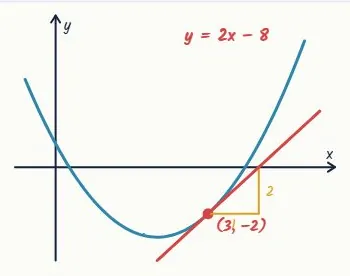
The tangent to y = x² − 4x + 1 at x = 3
- The point: y = −2, so (3, −2).
- The gradient: 2x − 4 = 2.
- Up 2 for every 1 across: that is the tangent.
Four steps, every time
- Point from y, gradient from dy/dx.
- Put both into y − y₁ = m(x − x₁).
- Tidy into y = mx + c.
| Step | Find | How |
|---|---|---|
| 1 | the point | substitute x into y |
| 2 | the gradient | substitute x into dy/dx |
| 3 | the line | y − y₁ = m(x − x₁) |
| 4 | tidy | y = mx + c |
The working, written out
- Point, gradient, line.
- Then tidy to y = mx + c.
- y = 3² − 4(3) + 1the point
- = 9 − 12 + 1 = −2
- point (3, −2)
- dy/dx = 2x − 4the gradient
- m = 2(3) − 4 = 2
- y − (−2) = 2(x − 3)y − y₁ = m(x − x₁)
- y + 2 = 2x − 6expand
- y = 2x − 8subtract 2
Check it
- Does the point fit?
- Do the gradients match?
- Two checks, ten seconds.
- y = 2(3) − 8 = 6 − 8 = −2the point fits
- line m = 2, curve m = 2gradients match
A cubic: y = 2x³ at x = −1
- Brackets round −1.
- The same four steps.
- y = 2(−1)³ = 2(−1) = −2point (−1, −2)
- dy/dx = 6x²
- m = 6(−1)² = 6brackets round −1
- y − (−2) = 6(x − (−1))y − y₁ = m(x − x₁)
- y + 2 = 6(x + 1)
- y + 2 = 6x + 6expand
- y = 6x + 4subtract 2
Where is the gradient 9?
- Set dy/dx equal to 9.
- x² = 4: two points.
- dy/dx = 3x² − 3
- 3x² − 3 = 9gradient 9
- 3x² = 12, so x² = 4
- x = 2 or x = −2two solutions
- x = 2: y = 2³ − 3(2) = 8 − 6 = 2
- x = −2: y = (−2)³ − 3(−2)
- = −8 + 6 = −2
- points (2, 2) and (−2, −2)
Using the tangent
- On the x-axis, y = 0.
- Keep the tangent tidy.
- y = 2x − 8
- 0 = 2x − 8set y = 0
- 2x = 8, so x = 4
- crosses at (4, 0)
A flat tangent: y = 3x² − x³ at x = 2
- Gradient 0: flat tangent.
- The curve turns there.
- y = 3(2)² − 2³ = 12 − 8 = 4
- dy/dx = 6x − 3x²
- m = 6(2) − 3(2)² = 12 − 12 = 0
- y − 4 = 0(x − 2)
- y = 4horizontal
Where the marks are
- Achieved: the gradient at the point.
- Merit: the equation of the tangent.
- Excellence: using it to solve a problem.
What to take away
- A point from y, a gradient from dy/dx, then the line.
| Point | from y |
| Gradient | from dy/dx |
| Line | y − y₁ = m(x − x₁) |
| Given gradient | set dy/dx equal to it |
| Check | the point satisfies your line |
Your turn: four questions
- Pause here and answer each one.
- Use the four steps.
- Question 3 wants a point, not a line.
| Question | |
|---|---|
| 1 | Find the tangent to y = x² at x = 2. |
| 2 | Find the tangent to y = x³ at x = 1. |
| 3 | Where on y = x² + 2x is the gradient 6? |
| 4 | Find the tangent to y = x² − 4x + 1 at x = 0. |
Show answer
1. Point (2, 4), gradient 2x = 4, so y − 4 = 4(x − 2): y = 4x − 4. 2. Point (1, 1), gradient 3x² = 3, so y = 3x − 2. 3. 2x + 2 = 6, x = 2, and y = 4 + 4 = 8: the point (2, 8). 4. Point (0, 1), gradient −4, so y = −4x + 1.
The answers: questions 1 and 2
- 1. y = 2² = 4: point (2, 4)
- dy/dx = 2x, m = 2(2) = 4
- y − 4 = 4(x − 2) = 4x − 8
- y = 4x − 4add 4
- 2. y = 1³ = 1: point (1, 1)
- dy/dx = 3x², m = 3(1)² = 3
- y − 1 = 3(x − 1) = 3x − 3
- y = 3x − 2add 1
The answers: questions 3 and 4
- 3. dy/dx = 2x + 2
- 2x + 2 = 6, so 2x = 4, x = 2gradient 6
- y = 2² + 2(2) = 4 + 4 = 8
- the point (2, 8)
- 4. y = 0 − 0 + 1 = 1, so (0, 1)
- dy/dx = 2x − 4, m = 2(0) − 4 = −4
- y − 1 = −4(x − 0)
- y = −4x + 1add 1
Is your child on track?
Take the free placement test