Sketching the gradient graph of a function
What this lesson covers
- The gradient graph is zero where the function turns, positive where it rises and negative where it falls.
- A cubic has a quadratic gradient graph and a quadratic has a straight-line gradient graph.
The gradient graph
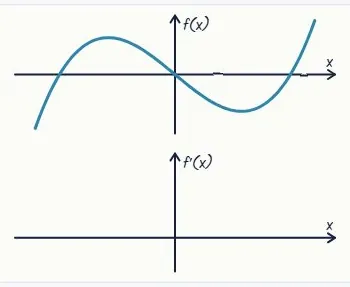
- Underneath a function, draw its gradient.
- Same x-axis, new y-axis: the gradient.
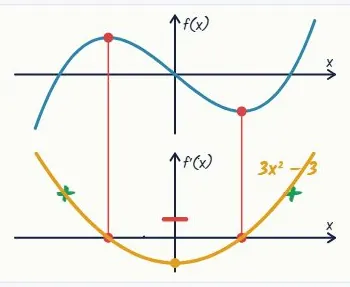
- Start with f(x) = x³ − 3x.
Turning points become x-intercepts
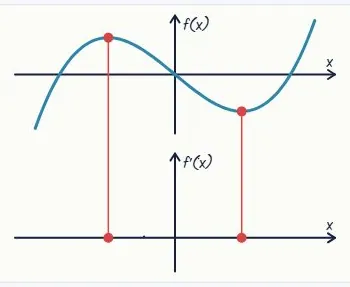
- At a turning point the gradient is zero.
- f turns at x = −1 and x = 1.
- So the gradient graph crosses there.
Rising is positive, falling is negative
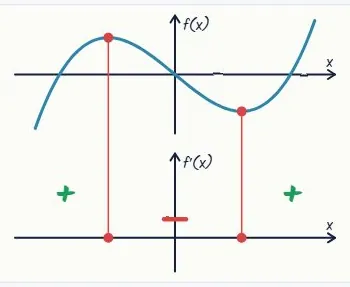
- Before −1, f is rising: gradient positive.
- Between −1 and 1, f falls: gradient negative.
- After 1, rising again: positive.
Join it as one smooth curve
- Lowest where f falls most steeply, at x = 0.
- Through both intercepts, symmetric.
- A parabola: f′(x) = 3x² − 3.
Check it with the derivative
- Differentiate to check.
- Zeros under the turns.
- Symmetric about x = 0.
- f(x) = x³ − 3x
- f′(x) = 3x² − 3differentiate
- = 3(x − 1)(x + 1)factorise
- = 0 at x = −1 and x = 1the intercepts
- f′(0) = 3(0)² − 3 = −3the lowest point
- f′(2) = 3(2)² − 3 = 9
- f′(−2) = 3(−2)² − 3 = 9symmetric
The degree drops by one
- A cubic has a quadratic gradient graph.
- A quadratic has a straight-line gradient graph.
- Knowing the shape stops wild sketches.
| Function | Gradient is | So draw |
|---|---|---|
| Cubic | quadratic | a parabola |
| Quadratic | linear | a straight line |
| Straight line | constant | a flat line |
A quadratic: the gradient is a line
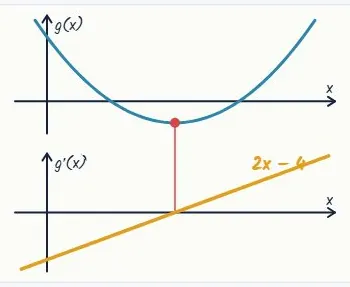
- g(x) = x² − 4x + 3 turns at x = 2.
- Falling before 2, rising after.
- So g′ is a line through (2, 0), going up.
Confirm it by differentiating
- Differentiate to confirm.
- Then check the signs.
- g(x) = x² − 4x + 3
- g′(x) = 2x − 4differentiate
- 2x − 4 = 0, so x = 2the intercept
- g(2) = 4 − 8 + 3 = −1the minimum
- g′(0) = −4 < 0falling
- g′(3) = 2 > 0rising
Steep means far from the axis
- Gentle slope: gradient graph near zero.
- Steep slope: gradient graph far from zero.
- Steep and falling: far below.
Four ways sketches lose marks
- The examiner wants one smooth curve.
- Intercepts exactly under the turning points.
- A parabola that is symmetric.
| Mistake | Instead |
|---|---|
| Copying the curve | the gradient graph is a new shape |
| Intercepts in the wrong place | they sit under the turning points |
| Two separate pieces | one smooth curve |
| Lopsided parabola | symmetric about its lowest point |
The reverse: from gradient to function
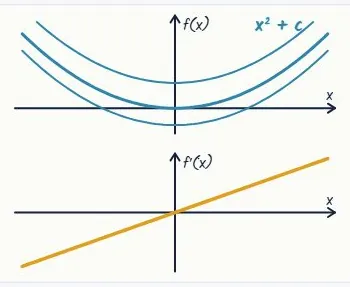
- Here f′(x) = 2x: negative, then positive.
- So f falls, turns at 0, then rises.
- Any curve x² + c fits: the height is unknown.
Reading a gradient graph
- Where it is zero, the function turns.
- The sign change says max or min.
- Minus to plus is a minimum.
| Gradient graph | Function |
|---|---|
| f′ = 0 | f has a turning point |
| f′ above the axis | f is rising |
| f′ below the axis | f is falling |
| − then + | a minimum |
| + then − | a maximum |
How the grades step up
- Achieved: intercepts and signs correct.
- Merit: the right shape, checked by differentiating.
- Excellence: justify every feature you draw.
What to take away
- Turning points first, then signs, then one smooth curve.
| Turning points | become x-intercepts |
| Rising | gradient graph above the axis |
| Falling | gradient graph below the axis |
| Steepest | furthest from the axis |
| Degree | drops by one |
| Draw | one smooth, symmetric curve |
| Reverse | sign change tells max or min |
Your turn: four questions
- Pause here and answer each one.
- Sketch where it helps.
- Question 4: think about the sign change.
| Question | |
|---|---|
| 1 | f(x) = x² − 6x + 5. Where does f′ cross the x-axis? |
| 2 | Cubic: max at x = −2, min at x = 4. Where is f′ < 0? |
| 3 | f(x) = x³ − 12x. Find f′(x) and where it is zero. |
| 4 | f′ goes from − to + at x = 1. Max or min? |
Show answer
1. f′(x) = 2x − 6, which is zero at x = 3. 2. Between the turning points, −2 < x < 4, where the cubic is falling. 3. f′(x) = 3x² − 12 = 3(x − 2)(x + 2), crossing at x = −2 and x = 2. 4. A minimum: the function falls, then rises.
The answers
- 1. f′(x) = 2x − 6differentiate
- 2x − 6 = 0, so x = 3crosses here
- 2. f falls from max to min
- f′ < 0 for −2 < x < 4
- 3. f′(x) = 3x² − 12differentiate
- = 3(x² − 4) = 3(x − 2)(x + 2)factorise
- zero at x = −2 and x = 2
- 4. f′: − then + at x = 1
- f falls, then rises: a minimum
Is your child on track?
Take the free placement test