Turning points: finding and proving max or min
What this lesson covers
- At a turning point the gradient is zero.
- Whether it is a maximum or a minimum is proved by the second derivative or the gradients either side.
Where a curve turns
- At a turning point the curve is flat.
- Flat means the gradient is zero.
- So solve f′(x) = 0.
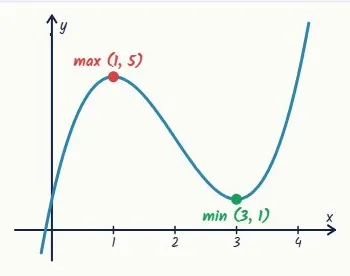
f(x) = x³ − 6x² + 9x + 1
- It rises, turns, falls, then turns again.
- A maximum at x = 1.
- A minimum at x = 3.
Finding them
- Set f′(x) = 0.
- Heights from f, not f′.
- f′(x) = 3x² − 12x + 9differentiate
- 3x² − 12x + 9 = 0gradient zero
- 3(x² − 4x + 3) = 0take out 3
- 3(x − 1)(x − 3) = 0factorise
- x = 1 or x = 3
- f(1) = 1 − 6 + 9 + 1 = 5heights from f
- f(3) = 27 − 54 + 27 + 1 = 1
- (1, 5) and (3, 1)
Method 1: the second derivative
- f″ < 0: a maximum.
- f″ > 0: a minimum.
- f″(x) = 6x − 12differentiate again
- f″(1) = 6 − 12 = −6 < 0a maximum
- f″(3) = 18 − 12 = 6 > 0a minimum
- max (1, 5), min (3, 1)
Method 2: the gradient either side
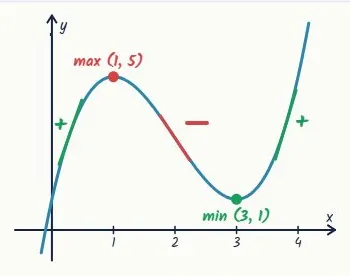
- Before x = 1 the gradient is positive; after, negative.
- Up then down: a maximum.
- Down then up at x = 3: a minimum.
The gradient test, in numbers
- Test either side.
- The signs give the nature.
- f′(x) = 3x² − 12x + 9
- f′(0) = 0 − 0 + 9 = 9 > 0rising
- f′(2) = 12 − 24 + 9 = −3 < 0falling
- f′(4) = 48 − 48 + 9 = 9 > 0rising
- x = 1: + then −, a maximum
- x = 3: − then +, a minimum
A quadratic: y = −2x² + 8x − 3
- One turning point.
- y″ < 0: a maximum.
- dy/dx = −4x + 8differentiate
- −4x + 8 = 0, so x = 2
- y = −2(2)² + 8(2) − 3the height
- = −8 + 16 − 3 = 5
- y″ = −4 < 0a maximum
- maximum at (2, 5)
Always justify the nature
- "It is a maximum" needs a reason.
- A second derivative, a gradient test or a sketch.
- Excellence answers do this unasked.
Another cubic: y = x³ − 3x²
- Factorise y′.
- Classify each with y″.
- y′ = 3x² − 6x = 3x(x − 2)factorise
- 3x(x − 2) = 0: x = 0 or 2
- x = 0: y = 0the height
- x = 2: y = 8 − 12 = −4
- y″ = 6x − 6
- x = 0: y″ = −6 < 0max (0, 0)
- x = 2: y″ = 6 > 0min (2, −4)
When there are no turning points
- y = x³ + 3x has y′ = 3x² + 3.
- 3x² + 3 is never zero: it is always at least 3.
- So the curve never turns: it always rises.
Where the marks are
- Achieved: find where the gradient is zero.
- Merit: the coordinates of each point.
- Excellence: the nature, justified.
What to take away
- Find, then prove, every turning point.
| Find | set f′(x) = 0 and solve |
| Height | substitute into f, not f′ |
| f″ < 0 | maximum |
| f″ > 0 | minimum |
| Either side | + then − is max, − then + is min |
| Always | state the nature, with a reason |
Your turn: four questions
- Pause here and answer each one.
- Give coordinates and the nature.
- Justify with a reason every time.
| Question | |
|---|---|
| 1 | Find the turning point of y = x² − 10x + 4. |
| 2 | Find both turning points of y = x³ − 12x. |
| 3 | Use the second derivative to classify the one at x = 2. |
| 4 | Find and classify the turning point of y = −x² + 6x. |
Show answer
1. 2x − 10 = 0, x = 5, y = 25 − 50 + 4 = −21: a minimum at (5, −21), since y″ = 2 > 0. 2. 3x² − 12 = 0, x = ±2: (−2, 16) and (2, −16). 3. y″ = 6x = 12 at x = 2, positive, so (2, −16) is a minimum (and (−2, 16) a maximum). 4. −2x + 6 = 0, x = 3, y = 9: a maximum, since y″ = −2 < 0.
The answers: questions 1 and 2
- 1. dy/dx = 2x − 10 = 0, x = 5
- y = 25 − 50 + 4 = −21
- y″ = 2 > 0: min (5, −21)
- 2. dy/dx = 3x² − 12 = 0
- 3x² = 12, x² = 4, x = ±2
- x = −2: y = −8 + 24 = 16
- x = 2: y = 8 − 24 = −16
- (−2, 16) and (2, −16)
The answers: questions 3 and 4
- 3. y″ = 6xdifferentiate 3x² − 12
- x = 2: y″ = 12 > 0min (2, −16)
- x = −2: y″ = −12 < 0max (−2, 16)
- 4. dy/dx = −2x + 6 = 0, x = 3
- y = −9 + 18 = 9
- y″ = −2 < 0: max (3, 9)
Is your child on track?
Take the free placement test