Inverse normal: finding a value, the mean or the standard deviation
What this lesson covers
- An inverse normal problem starts from a probability and works back to a value.
- The z-value for a known probability links the unknown mean or standard deviation to the data.
Backwards: from area to value
- So far: a value in, a probability out.
- Inverse normal: a probability in, a value out.
- "Top 10%", "fastest 15%", "only 2% under".
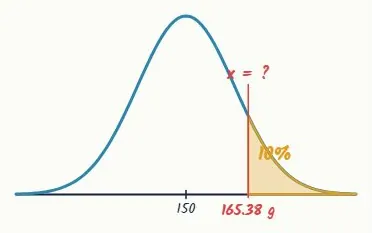
The heaviest 10% of apples
- Shade the top 10% first.
- The cut-off is unknown: call it x.
- z = 1.2816, so x = 165.38 g.
The working
- Area to the left: 0.9.
- Then x = μ + zσ.
- P(X < x) = 1 − 0.1 = 0.9top 10%
- left tail, area 0.9σ = 1, μ = 0
- z = 1.2816
- z = (x − μ) ÷ σ, so x = μ + zσ
- x = 150 + 1.2816 × 12substitute
- = 150 + 15.3792
- = 165.38 g
The lightest 5%: a negative z
- Below the mean: z < 0.
- Check: x is below 150.
- left tail, area 0.05σ = 1, μ = 0
- z = −1.6449below the mean
- x = μ + zσ
- = 150 + (−1.6449) × 12
- = 150 − 19.7388
- = 130.26 g
- 130.26 < 150below the mean
An unknown standard deviation
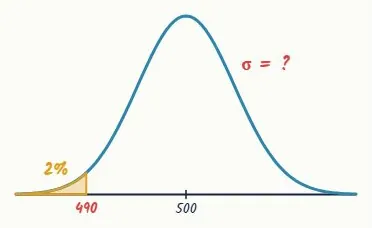
- Bottles: mean 500 ml, 2% under 490 ml.
- z for 0.02 is −2.0537.
- σ = 10 ÷ 2.0537 = 4.869 ml.
The steps for σ
- z from the probability.
- Substitute, solve for σ.
- left tail, area 0.02σ = 1, μ = 0
- z = −2.0537490 is below 500
- z = (x − μ) ÷ σ
- −2.0537 = (490 − 500) ÷ σsubstitute
- −2.0537 = −10 ÷ σ
- −2.0537σ = −10× σ
- σ = −10 ÷ −2.0537÷ −2.0537
- = 4.869 ml
- σ > 0as it must be
An unknown mean
- σ known, μ unknown.
- Same equation: solve for μ.
- σ = 4, P(X < 490) = 0.01given
- left tail, area 0.01σ = 1, μ = 0
- z = −2.3263below the mean
- −2.3263 = (490 − μ) ÷ 4substitute
- −9.3052 = 490 − μ× 4
- μ = 490 + 9.3052rearrange
- = 499.31 mlround up
The sign of z does the work
- A value below the mean has negative z.
- Get the sign wrong and σ comes out negative.
- A negative σ is impossible: a free check.
Where the marks are
- Achieved: find the z-value.
- Merit: use it for a value or a missing σ.
- Excellence: interpret the answer in context.
What to take away
- Area first, z with its sign, then solve.
| Start | with the area, not the value |
| Left area | the calculator's inverse normal |
| Sign of z | negative below the mean |
| A value | x = μ + zσ |
| Unknown σ or μ | z = (x − μ) ÷ σ, then solve |
| Check | does the answer sit on the right side? |
Your turn: four questions
- Sketch and shade each one first.
- Pause here and answer each one.
- Watch the sign of z.
| Question | |
|---|---|
| Data | Race times: normal, mean 42 min, sd 6 min. |
| 1 | Fastest 15% get a medal. What time must they beat? |
| 2 | The slowest 5% take longer than what time? |
| 3 | Another race: mean 60 min, 10% take over 75 min. Find σ. |
| 4 | A third: σ = 3 min, and 2.5% take over 20 min. Find μ. |
Show answer
1. z = −1.0364: 42 − 1.0364 × 6 = 35.78 min. 2. z = 1.6449: 42 + 1.6449 × 6 = 51.87 min. 3. 1.2816 = 15 ÷ σ, so σ = 11.70 min. 4. 1.96 = (20 − μ) ÷ 3, so μ = 20 − 5.88 = 14.12 min.
The answers: questions 1 and 2
- 1. left area 0.15: z = −1.0364
- x = 42 − 1.0364 × 6
- = 42 − 6.2184 = 35.78 min
- 2. left area 0.95: z = 1.6449
- x = 42 + 1.6449 × 6
- = 42 + 9.8694 = 51.87 min
The answers: questions 3 and 4
- 3. left area 0.9: z = 1.2816
- 1.2816 = (75 − 60) ÷ σsubstitute
- 1.2816σ = 15× σ
- σ = 15 ÷ 1.2816 = 11.70 min
- 4. left area 0.975: z = 1.96
- 1.96 = (20 − μ) ÷ 3substitute
- 5.88 = 20 − μ× 3
- μ = 20 − 5.88 = 14.12 min
Is your child on track?
Take the free placement test