A line and a curve
What this lesson covers
- Substitute the line into the curve.
- Solve the quadratic for x, then find y.
- A discriminant of zero means the line is a tangent.
Two crossings
- y = x + 1 and y = x² − 1.
- x² − 1 = x + 1
- x² − x − 2 = 0
- (x − 2)(x + 1) = 0
- points (2, 3) and (−1, 0)
Try it: two crossings
A tangent
- Find k so that y = 2x + k touches y = x².
- x² − 2x − k = 0
- b² − 4ac = 4 + 4k
- 4 + 4k = 0one touching point
- k = −1
Try it: the line y = k
Two meeting points
- y = x + 1 crosses y = x² − 1 at (2, 3) and (−1, 0).
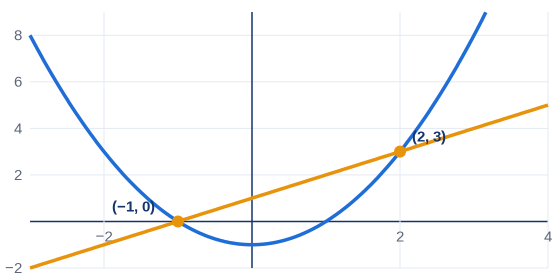
Graphing calculator
Common mistakes
- Giving only the x values.Each intersection is a point, so give y too.
- Substituting x into the curve and forgetting the line check.Put your point into both equations.
Your turn
Solve y = x and y = x².
How many roots has x² + 2x + 5 = 0?
Find k so y = x + k touches y = x².
Solve y = 2 and y = x² − 2.
Show answer
1. (0, 0) and (1, 1) 2. b² − 4ac = −16, so none 3. 1 + 4k = 0, so k = −1/4 4. (2, 2) and (−2, 2)
Sample question: Achieved
Solve y = x + 6 and y = x² simultaneously.
Hint
Both equations give y, so set x² = x + 6 and solve the quadratic.
Answer
(3, 9) and (−2, 4)
Step by step
- Both equations start with y =, so their right sides must be equal where they meet: x² = x + 6.
- Move everything to one side to get a quadratic equal to zero: x² − x − 6 = 0.
- Factorise: two numbers that multiply to −6 and add to −1 are −3 and 2. So (x − 3)(x + 2) = 0.
- x = 3 or x = −2.
- Find y for each, using the line because it is simpler: x = 3 gives y = 9, and x = −2 gives y = 4.
- The classic mistake is to give only x = 3 and x = −2. Each answer is a point, so give y too.
- Check in the curve: 3² = 9 and (−2)² = 4. Both points are on both graphs.
Full working
- x² = x + 6both equal y
- x² − x − 6 = 0
- (x − 3)(x + 2) = 0, x = 3 or −2
- y = 9 or 4from y = x + 6
- (3, 9) and (−2, 4)
Sample questions: Merit
Solve xy = 12 and x + y = 7 simultaneously.
Hint
Make y the subject of the line, substitute into xy = 12, and clear the result into a quadratic.
Answer
(3, 4) and (4, 3)
Step by step
- The line is the easy one to rearrange: y = 7 − x.
- Substitute into the curve: x(7 − x) = 12.
- Expand: 7x − x² = 12.
- Rearrange so the x² term is positive: x² − 7x + 12 = 0.
- Factorise: numbers that multiply to 12 and add to −7 are −3 and −4. So (x − 3)(x − 4) = 0.
- x = 3 or x = 4.
- Find y from y = 7 − x: x = 3 gives y = 4, and x = 4 gives y = 3.
- The classic mistake is to pair the values wrongly, such as (3, 3). Always find each y from its own x.
- Check: 3 × 4 = 12 and 3 + 4 = 7; 4 × 3 = 12 and 4 + 3 = 7. Both points work in both equations.
Full working
- y = 7 − xrearrange the line
- x(7 − x) = 12substitute
- x² − 7x + 12 = 0
- (x − 3)(x − 4) = 0, x = 3 or 4
- y = 4 or 3check: 3 × 4 = 12
- (3, 4) and (4, 3)
Find the value of k for which the line y = x + k is a tangent to the curve y = x² − 3x + 5, and find the point where they touch.
Hint
Substitute to get one quadratic. A tangent touches once, so the discriminant b² − 4ac is 0.
Answer
k = 1; they touch at (2, 3)
Step by step
- Set the two expressions for y equal: x² − 3x + 5 = x + k.
- Rearrange to a quadratic equal to zero: x² − 4x + (5 − k) = 0. So a = 1, b = −4 and c = 5 − k.
- Recall: the number of solutions depends on the discriminant b² − 4ac. Positive gives two, zero gives one, negative gives none.
- A tangent touches the curve at exactly one point, so b² − 4ac = 0.
- (−4)² − 4 × 1 × (5 − k) = 0, so 16 − 20 + 4k = 0 and 4k = 4. k = 1.
- To find the point, put k = 1 back in: x² − 4x + 4 = 0, which is (x − 2)² = 0. So x = 2.
- y from the line: y = 2 + 1 = 3. The point is (2, 3).
- The classic mistake is to forget the bracket in −4ac: it is −4 × (5 − k), so the k term is +4k.
- Check in the curve: 2² − 3 × 2 + 5 = 4 − 6 + 5 = 3. Correct.
Full working
- x² − 3x + 5 = x + kboth equal y
- x² − 4x + (5 − k) = 0
- 16 − 4(5 − k) = 0tangent: b² − 4ac = 0
- k = 1
- (x − 2)² = 0, x = 2, y = 3
- k = 1, touching at (2, 3)
Sample questions: Excellence
Find the values of m for which the line y = mx − 1 meets the curve y = x² + 3 at two different points. Explain what happens at the boundary values of m.
Hint
Substitute to get a quadratic in x with m in it. Two points means b² − 4ac > 0.
Answer
m < −4 or m > 4; at m = ±4 the line is a tangent
Step by step
- Set the two expressions equal: x² + 3 = mx − 1.
- Rearrange: x² − mx + 4 = 0. Here a = 1, b = −m and c = 4.
- Recall: two different real solutions need b² − 4ac > 0.
- (−m)² − 4 × 1 × 4 > 0, so m² − 16 > 0, so m² > 16.
- m² > 16 is true when m is more than 4 or less than −4. So m < −4 or m > 4.
- The classic mistake is to write only m > 4. Squaring hides the negative case: m = −5 gives m² = 25, which is also more than 16.
- Another mistake is to write −4 < m < 4. That is where m² < 16, the lines that miss the curve.
- Boundary: at m = 4 the discriminant is 0, so the line is a tangent. x² − 4x + 4 = 0 gives x = 2, touching at (2, 7). At m = −4 it touches at (−2, 7).
- Picture: every line passes through (0, −1), below the curve. Steep lines cut the parabola twice, shallow ones pass under it, and m = ±4 just touch.
- Check with m = 5: x² − 5x + 4 = 0 gives x = 1 or 4, two points. With m = 0: x² + 4 = 0 has no real solution.
Full working
- x² + 3 = mx − 1both equal y
- x² − mx + 4 = 0
- m² − 16 > 0two points: b² − 4ac > 0
- m² > 16, so m < −4 or m > 4
- m = ±4: b² − 4ac = 0, tangent at (2, 7) and (−2, 7)
- m < −4 or m > 4
A ball is thrown up a grass bank. Its path is y = −0.05x² + x + 2 and the bank is the line y = 0.4x + 0.2, where x is the horizontal distance in metres and y is the height in metres, for x ≥ 0. Find the exact x-value where the ball lands on the bank, and its height there to 2 decimal places. Find the greatest vertical distance between the ball and the bank during the flight.
Hint
Set the two heights equal to find the landing point. For the gap, write ball − bank as a quadratic and find its maximum.
Answer
Lands at x = 6 + 6√2 ≈ 14.49 m, at height ≈ 5.99 m; the greatest gap is 3.6 m, at x = 6
Step by step
- The ball lands where its height equals the bank's height: −0.05x² + x + 2 = 0.4x + 0.2.
- Move everything to one side: −0.05x² + 0.6x + 1.8 = 0.
- Multiply by −20 to get whole numbers and a positive x² term: x² − 12x − 36 = 0.
- This does not factorise, so use the quadratic formula: x = 12 ± √(144 + 144)2 = 12 ± √2882.
- √288 = √(144 × 2) = 12√2, so x = 6 ± 6√2.
- 6 − 6√2 is negative, but x ≥ 0, so reject it. The ball lands at x = 6 + 6√2 ≈ 14.49 m.
- Height: y = 0.4 × 14.485 + 0.2 = 5.99 m.
- Now the gap. Ball minus bank: d = −0.05x² + 0.6x + 1.8.
- This is a parabola that opens down, so its maximum is at the turning point, halfway between its roots: x = 6.
- d = −0.05 × 36 + 0.6 × 6 + 1.8 = −1.8 + 3.6 + 1.8 = 3.6 m.
- The classic mistake is to find the top of the ball's path instead. The question asks for the height above the sloping bank, not above flat ground.
- Check: at x = 0 the ball is at 2 m and the bank at 0.2 m, so the ball starts 1.8 m above the bank, which agrees with d = 1.8.
Full working
- −0.05x² + x + 2 = 0.4x + 0.2the ball meets the bank
- x² − 12x − 36 = 0× −20
- x = 6 ± 6√2; reject 6 − 6√2 < 0x ≥ 0
- y = 0.4 × 14.485 + 0.2 = 5.99
- d = −0.05x² + 0.6x + 1.8, maximum at x = 6midway between the roots
- d(6) = 3.6
- x = 6 + 6√2 ≈ 14.49 m, height 5.99 m; greatest gap 3.6 m
What to take away
- Substitute to get one quadratic.
- The discriminant counts the meeting points.
Practise this
Report a mistake
More in AS 91269
Is your child on track?
Take the free placement test