Simultaneous linear equations
What this lesson covers
- Elimination adds or subtracts equations to remove a variable.
- Substitution puts one equation into the other.
- Check the answer in both equations.
Two methods
- Elimination: match the coefficients of one variable, then add or subtract.
- Substitution: make one variable the subject, then replace it.
Elimination
- 2x + y = 7 and x − y = 2.
- 3x = 9add the equations
- x = 3
- 3 − y = 2
- y = 1
Try it: one line at a time
The solution is the crossing
- 2x + y = 7 and x − y = 2 meet at (3, 1).
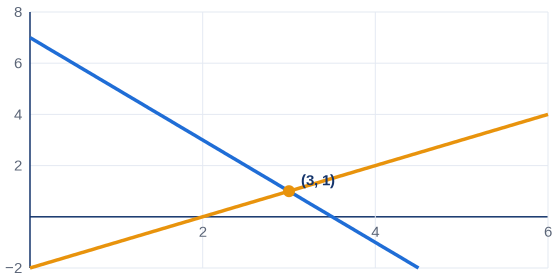
Try it: move the lines
- Change the gradients and intercepts, and find where the lines cross.
Graphing calculator
Common mistakes
- Subtracting when the signs differ.Opposite signs cancel by adding.
- Stopping after finding x.Find both values and check them.
Your turn
Solve x + y = 5 and x − y = 1.
Solve 2x + y = 8 with y = 2.
Solve y = 2x and x + y = 9.
Solve 3x + 2y = 12 and x + 2y = 8.
Show answer
1. (3, 2) 2. x = 3 3. (3, 6) 4. (2, 3)
Sample question: Achieved
Solve 3x + 2y = 16 and x − y = 2.
Hint
Make x the subject of the second equation and substitute it into the first.
Answer
x = 4, y = 2
Step by step
- Two equations, two unknowns. Choose the method that makes the working short.
- The second equation has x on its own with a coefficient of 1, so substitution is quick: x = y + 2.
- Replace x in the first equation: 3(y + 2) + 2y = 16.
- Expand and collect: 3y + 6 + 2y = 16, so 5y = 10 and y = 2.
- Put y = 2 back into x = y + 2: x = 4.
- The classic mistake is to stop after finding y. The answer needs both values.
- Check in both equations: 3 × 4 + 2 × 2 = 16 and 4 − 2 = 2. Both work.
Full working
- x = y + 2from the second equation
- 3(y + 2) + 2y = 16substitute
- 5y = 10, y = 2
- x = 2 + 2 = 4check: 12 + 4 = 16
- x = 4, y = 2
Sample questions: Merit
Solve 4x − 3y = 5 and 6x + 5y = 17.
Hint
No coefficient is 1, so use elimination. Multiply so the x terms match: the first by 3, the second by 2.
Answer
x = 2, y = 1
Step by step
- No variable is on its own, so substitution would bring fractions. Elimination is cleaner.
- Choose a variable to remove. The x coefficients are 4 and 6, and both go into 12.
- Multiply the first equation by 3: 12x − 9y = 15.
- Multiply the second equation by 2: 12x + 10y = 34.
- The x terms have the same sign, so subtract: (12x + 10y) − (12x − 9y) = 34 − 15, which gives 19y = 19.
- So y = 1.
- Substitute into the first equation: 4x − 3 = 5, so 4x = 8 and x = 2.
- The classic mistake is a sign slip when subtracting: 10y − (−9y) is 19y, not y.
- Check in the second equation, the one not used to find x: 6 × 2 + 5 × 1 = 17. Correct.
Full working
- 12x − 9y = 15first × 3
- 12x + 10y = 34second × 2
- 19y = 19, y = 1subtract to remove x
- 4x − 3 = 5, x = 2
- check: 6 × 2 + 5 × 1 = 17
- x = 2, y = 1
Solve x2 + y3 = 4 and x4 − y6 = 0.
Hint
Clear the fractions first: multiply each equation by the lowest common denominator of its fractions.
Answer
x = 4, y = 6
Step by step
- Fractions make elimination messy, so clear them first.
- First equation: the denominators are 2 and 3, so multiply every term by 6: 3x + 2y = 24.
- Second equation: the denominators are 4 and 6, so multiply every term by 12: 3x − 2y = 0.
- Now the y terms are 2y and −2y, opposite signs, so add the equations: 6x = 24.
- So x = 4.
- Substitute into 3x − 2y = 0: 12 − 2y = 0, so y = 6.
- The classic mistake is to multiply only the fractions and forget the right-hand side. The 4 must become 24 too.
- Check in the original equations: 42 + 63 = 2 + 2 = 4, and 44 − 66 = 1 − 1 = 0. Both work.
Full working
- 3x + 2y = 24first × 6
- 3x − 2y = 0second × 12
- 6x = 24, x = 4add to remove y
- 12 − 2y = 0, y = 6
- check: 42 + 63 = 4
- x = 4, y = 6
Sample questions: Excellence
Solve 2x + 3y = 2 and 4x − 3y = 1.
Hint
The equations are not linear in x and y, but they are linear in 1x and 1y. Let u = 1x and v = 1y.
Answer
x = 2, y = 3
Step by step
- These are not straight-line equations in x and y, because x and y are in the denominators.
- But 2x is 2 × 1x. So if we write u = 1x and v = 1y, the equations become linear: 2u + 3v = 2 and 4u − 3v = 1.
- The v terms are 3v and −3v, so add: 6u = 3 and u = 12.
- Substitute into 2u + 3v = 2: 1 + 3v = 2, so v = 13.
- Now undo the substitution. u = 1x = 12, so x = 2. v = 1y = 13, so y = 3.
- The classic mistake is to stop at u and v and give 12 and 13 as the answer.
- Note x and y cannot be 0, because we divide by them. Our answers are not 0, so they are allowed.
- Check in the original equations: 22 + 33 = 1 + 1 = 2, and 42 − 33 = 2 − 1 = 1. Both work.
Full working
- u = 1x, v = 1ymakes the system linear
- 2u + 3v = 2 and 4u − 3v = 1
- 6u = 3, u = 12add to remove v
- 1 + 3v = 2, v = 13
- x = 1u = 2, y = 1v = 3check: 22 + 33 = 2
- x = 2, y = 3
The lines 2x + y = 7, x − y = 2 and ax + 3y = 15 all pass through the same point. Find a. Then find the area of the triangle formed by the first two lines and the y-axis.
Hint
The common point is where the first two lines cross. For the area, find where each of the first two lines meets the y-axis.
Answer
a = 4; area = 13.5 square units
Step by step
- All three lines share one point, and the first two lines alone fix that point. So solve them first.
- Add 2x + y = 7 and x − y = 2: 3x = 9, so x = 3. Then 3 − y = 2, so y = 1. The point is (3, 1).
- The third line must pass through (3, 1) too, so substitute: 3a + 3 = 15, so 3a = 12 and a = 4.
- Now the triangle. Its corners are (3, 1) and the two points where the lines cross the y-axis.
- On the y-axis x = 0. First line: y = 7, so (0, 7). Second line: 0 − y = 2, so y = −2 and the point is (0, −2).
- Take the base along the y-axis, from −2 up to 7. Its length is 7 − (−2) = 9.
- The height is the horizontal distance from the y-axis to (3, 1), which is 3.
- Area = 12 × base × height = 12 × 9 × 3 = 13.5 square units.
- The classic mistake is a base of 7 − 2 = 5. The second intercept is −2, so the base crosses zero.
- Check a: 4 × 3 + 3 × 1 = 15. Correct.
Full working
- 3x = 9, x = 3, y = 1add the first two equations
- 3a + 3 = 15, a = 4the third line passes through (3, 1)
- y-intercepts: (0, 7) and (0, −2)set x = 0
- base = 7 − (−2) = 9, height = 3
- area = 12 × 9 × 3 = 13.5
- a = 4; area = 13.5 square units
What to take away
- Line up the equations and remove one variable.
- Check in both originals.
Practise this
Report a mistake
More in AS 91269
Is your child on track?
Take the free placement test