Adaptation: how New Zealand plants and animals fit their way of life
What this lesson covers
- Structural, physiological and behavioural adaptations, and how natural selection produces them.
- Way of life, ecological niche and the eight life processes the standard lists.
- The two ways to set up the task: one life process across three groups, or two linked processes in one group.
- New Zealand examples: mangroves, kiwi, alpine plants, mountain stone wētā and tuatara.
- Explaining how each adaptation helps survival, with its advantages and its limitations, for Merit and Excellence.
What counts as an adaptation
- An adaptation is a feature together with what it does: it helps the organism carry out a life process, and so survive and reproduce in its habitat and niche.
- Structural adaptations are body parts and shapes. Physiological adaptations are chemical or internal processes. Behavioural adaptations are things the organism does.
- Adaptations arise by natural selection: individuals whose inherited features suit the habitat survive and breed more, so those features become more common over many generations. An individual cannot grow a new adaptation because it needs one.
- AS 91155 is a 3-credit internal. You research organisms in a context your teacher sets, then write a report explaining their adaptations.
| Kind | New Zealand example | Life process it helps |
|---|---|---|
| Structural | Mangrove breathing roots poking up out of the mud | Gas exchange |
| Structural | Kiwi nostrils at the tip of the bill | Nutrition |
| Physiological | Mountain stone wētā surviving ice in its body | Survival through winter, so it can reproduce |
| Behavioural | Kiwi feeding at night | Nutrition |
Way of life, life processes and the two task options
- Way of life means how an organism carries out all of its life processes: how it feeds, breathes, moves, senses, reproduces and gets rid of waste, and how it relates to predators, competitors, parasites and partners.
- The eight life processes to choose from: nutrition, gas exchange, internal transport, excretion, transpiration in plants, sensitivity and co-ordination, support and movement, and reproduction.
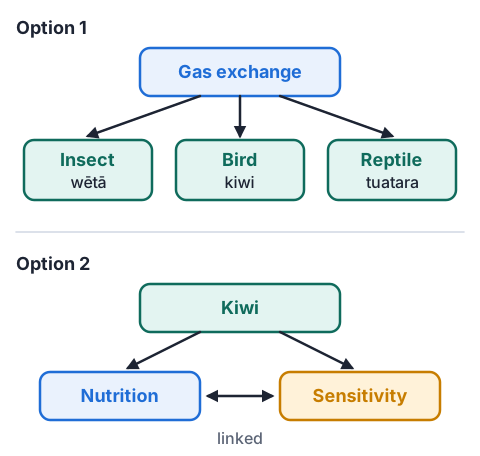
- Option 1: one life process compared across three groups of plants or of animals, such as gas exchange in an insect, a bird and a reptile.
- Option 2: two related life processes in one group, such as nutrition and sensitivity in kiwi, showing how each process makes the other work better.
- Your teacher names the groups in the task. Keep to all plants or all animals, never a mix.
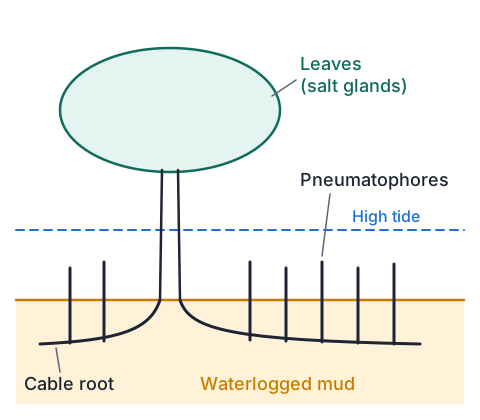
Example: mānawa, the mangrove, breathing in mud
- Mānawa (Avicennia marina) grows in estuaries, where tides cover the mud twice a day. The mud is waterlogged, so it holds almost no oxygen, and root cells still need oxygen for respiration.
- Structural: pneumatophores are vertical roots that grow up out of the mud from cable roots spreading underneath. At low tide air enters them through small pores called lenticels.
- Structural: spongy tissue with large air spaces inside the roots lets oxygen diffuse down from the pneumatophores to the buried roots.
- Physiological: glands on the leaves get rid of salt taken in with the sea water, so salt does not build up in its cells.
- Limitation: pneumatophores only work when the tide is out. Mangroves need the mud uncovered for at least half of each tide, which limits how far down the shore they can grow.
| Fact | Detail |
|---|---|
| Where it grows | Intertidal forests in far-north estuaries; stunted shrubland at its southern limits, Kāwhia and Ōhiwa Harbour |
| Breathing roots | Vertical pneumatophores take in air at low tide |
| Tide needed | Roots must be uncovered for at least half the tidal cycle to absorb oxygen |
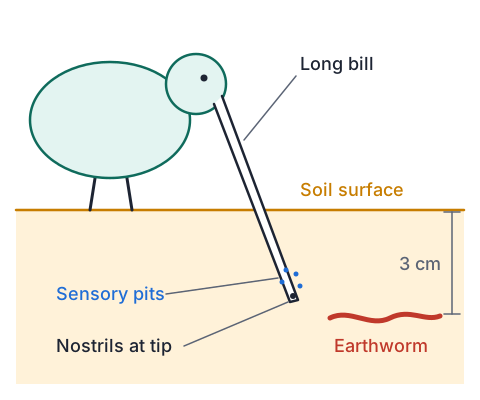
Example: kiwi, where nutrition and sensitivity work together
- Kiwi feed on invertebrates such as earthworms hidden in soil and leaf litter, mostly at night, probing the ground with their long bills.
- Structural: kiwi are the only birds with nostrils at the tip of the bill, so they can smell prey while the bill is deep in the soil.
- Structural: sensory pits around the bill tip detect the vibrations of moving prey, and the part of the brain used for smell is unusually large for a bird.
- The two processes are linked: sensitivity (smell and touch at the tip) finds the food, and nutrition depends on it, because the kiwi cannot see prey underground and forages in the dark.
- Limitations: soil blocks the nostrils, so kiwi snort loudly to clear them, and probing works best in soft, moist ground.
| Feature | Detail |
|---|---|
| Nostrils | At the tip of the long bill; the only bird with this |
| Sense of smell | Olfactory bulb second largest of all birds relative to forebrain size, after the condor |
| Touch | Sensory pits at the bill tip sense prey moving underground |
| Reach | Can find an earthworm up to 3 cm underground |
| Digestion | Grit and small stones in the gizzard help grind food |
Alpine plants: cold, wind and few pollinators
- Above the bushline, plants face frost, strong wind, intense sunlight and short summers.
- Structural: many alpine leaves are woolly. The hairs trap a layer of still air, which keeps the leaf warmer and cuts water loss by transpiration.
- Structural: vegetable sheep (Raoulia and Haastia) grow as hard, tightly packed cushions of tiny woolly leaves, which reduces evaporation, while fine roots in the moist core take up rain.
- Physiological: some make soluble sugars that work like antifreeze in their cells, and their photosynthesis works best at lower temperatures than lowland plants'.
- Reproduction: 77% of New Zealand's alpine flowering plants have white flowers, which suits pollinators like flies and short-tongued bees that visit many kinds of flower; making coloured pigment costs resources that bring no extra pollinators here.
| Feature | What it does |
|---|---|
| Woolly leaves | Trap heat, reduce transpiration, protect from wind, grit and UV |
| Antifreeze sugars | Stop cells freezing below 0 °C |
| Long life | Energy can be stored, so they need not flower every year |
| White flowers | 77% of alpine species, about twice the world average |
Mountain stone wētā: frozen and alive
- The mountain stone wētā (Hemideina maori) lives under rocks high in the mountains of the South Island, where it can be frozen for long periods in winter.
- Physiological: it is freeze tolerant. In laboratory tests up to about 82% of its body water turned to ice at −6 °C, and it survived −9 °C for at least 20 hours.
- Research suggests the ice forms in the fluid around the cells rather than inside them, so the cells lose water and shrink but are not ripped apart by ice crystals.
- Advantage: it can live where few predators or competitors can, and become active again when it thaws. Limitation: if too much of its body water freezes it probably dies, so there is a limit to how cold it can survive.
| Measurement | Result |
|---|---|
| Ice at −1 °C | About 15% of body water |
| Ice at −6 °C | About 82% of body water |
| Survived | −9 °C for at least 20 hours |
Tuatara: a reptile that copes with the cold
- Tuatara are reptiles, so their body temperature follows their surroundings. Most reptiles slow almost to a stop in the cold, but tuatara stay active at low temperatures.
- Behavioural: they are active at night, the coolest part of the day, and bask in the sun near their burrows to warm up.
- Physiological: in winter their breathing can slow to about one breath an hour, and they may not eat for up to six months, saving energy.
- Limitation: a slow, cool body means slow growth and slow breeding. A female produces eggs only about every four years, so tuatara populations recover slowly from losses to predators such as rats.
| Feature | Detail |
|---|---|
| Activity in cold | Seen out of burrows at 6 °C, moving slowly |
| Breathing in winter | Can slow to about one breath an hour |
| Feeding in winter | May not eat for up to six months |
| Breeding | Eggs about once every four years; they take about another year to hatch |
Excellence: comparing one process across three groups
- Option 1 at Excellence compares how different groups meet the same demand, and weighs the advantages and limitations of each feature. Here the demand is gas exchange: getting oxygen into the body and carbon dioxide out.
- Wētā (insect): air enters through spiracles and travels down branching tubes called tracheae straight to the cells, so blood does not carry oxygen. Spiracles can close to save water. Diffusion along tubes is slow over long distances, which is one reason insects stay small.
- Kiwi (bird): air sacs push air through the lungs in one direction, so fresh air passes the exchange surface on both breathing in and breathing out. This suits a warm-blooded body, which uses far more energy than a reptile's and needs a steady oxygen supply, but it has to be fuelled by a lot of food.
- Tuatara (reptile): sac-like lungs with a smaller exchange surface supply a cool, slow body that needs little oxygen, which is why breathing can drop to about one breath an hour in winter; the cost is slow activity in the cold.
- The comparison: each group's gas exchange suits its body temperature and activity. Tracheae suit small active insects, one-way lungs suit warm-blooded birds, and simple lungs suit cool, slow reptiles.
Example: one adaptation written at three grades
- Each grade below describes the same adaptation, the mangrove's pneumatophores. Notice how each adds a level of explanation.
- Achieved describes the feature and names the life process. Merit explains how it works with biology. Excellence links ideas, weighs the limitation and compares.
| Grade | What the student wrote |
|---|---|
| Achieved | Mangroves have pneumatophores, roots that stick up out of the mud. They help with gas exchange so the mangrove can survive in the estuary. |
| Merit | Waterlogged estuary mud has little oxygen, but root cells need it for respiration. Pneumatophores grow above the mud, and at low tide air enters through lenticels and diffuses through air spaces down to the buried roots, so the roots can keep respiring. |
| Excellence | Pneumatophores let mānawa live in mud where most trees' roots would die from lack of oxygen, but they only work when uncovered, so mangroves need the mud exposed for at least half of each tide. This restricts them to the upper shore. Like the wētā's spiracles, they open the body to air directly, while the kiwi relies on lungs. |
Common mistakes
- Kiwi grew nostrils at the end of their bills because they needed to smell worms.Kiwi with nostrils nearer the tip found more food and bred more, so over many generations natural selection made the feature common.
- The mangrove has pneumatophores. (and nothing more)Name the life process and explain how the feature helps it, for example getting oxygen to roots in waterlogged mud.
- Feeding at night is a physiological adaptation of kiwi.It is behavioural, something the kiwi does; physiological means an internal or chemical process, such as the wētā's freeze tolerance.
- For Option 1 I compared a mangrove, a kiwi and a tuatara.Keep to all plants or all animals; compare one life process across three groups within that one kingdom.
Model a cushion plant's water saving
You need: 2 paper towels the same size, water, a tablespoon, 2 plates, kitchen scales, a timer or phone
- Wet each paper towel with 3 tablespoons of water so both are evenly damp.
- Spread one towel flat on a plate. Squeeze the other into a tight ball and put it on the second plate.
- Weigh each plate with its towel and write the masses down.
- Leave both plates side by side in a sunny, breezy spot for 30 minutes, then weigh them again and work out how much mass each lost.
- Look for: the tight ball loses less water, because less of its surface is open to the sun and wind. That is the idea behind compact cushion plants like vegetable sheep, which save water on dry mountain rock.
Safety: Wipe up any spilled water straight away so nobody slips, and keep the wet towels away from power points and appliances.
Your turn
Classify each as structural, physiological or behavioural: (a) tuatara basking near their burrows, (b) woolly alpine leaves, (c) antifreeze sugars in alpine plant cells.
Which life process do mangrove pneumatophores help, and how?
Explain how nostrils at the tip of the bill help a kiwi's nutrition.
Give one limitation of pneumatophores.
Why does gas exchange through tracheae limit how big an insect like a wētā can grow?
Most of New Zealand's alpine plants have white flowers. Which life process does this help, and why?
Show answer
1. (a) behavioural, (b) structural, (c) physiological. 2. Gas exchange: at low tide air enters through lenticels and oxygen diffuses down through air spaces to roots buried in oxygen-poor mud, so they can respire. 3. The kiwi can smell worms and other prey while its bill is pushed into the soil, so it finds food it cannot see, even at night. 4. They only work when the tide is out, so mangroves need the mud uncovered for at least half of each tide and cannot grow lower on the shore. 5. Oxygen moves along the tracheae mainly by diffusion, which is fast only over short distances, so cells deep inside a large body would not get enough oxygen. 6. Reproduction: white flowers attract the flies and short-tongued bees that pollinate most alpine plants, without spending resources on coloured pigment.
Natural Selection
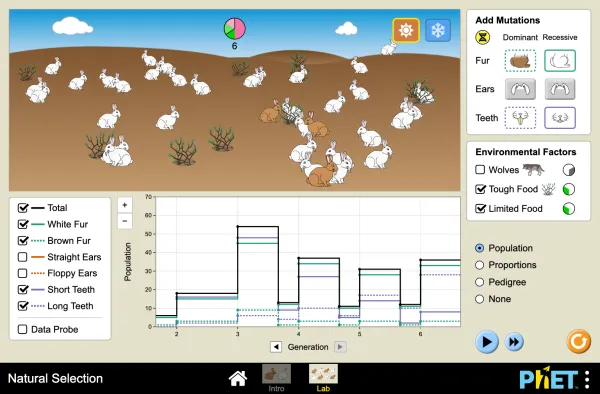
Full screen · PhET Interactive Simulations, University of Colorado Boulder, CC BY 4.0
Recap
- An adaptation is a feature and its function: it helps a life process, so the organism survives in its habitat and niche.
- Say whether it is structural, physiological or behavioural, and that it arose by natural selection.
- Achieved describes and links to a life process; Merit explains how with biology; Excellence compares and weighs advantages and limitations.
- Option 1 is one process across three groups; Option 2 is two linked processes in one group.
| Organism | Adaptation | Kind | Life process |
|---|---|---|---|
| Mānawa (mangrove) | Pneumatophores | Structural | Gas exchange |
| Kiwi | Nostrils at bill tip | Structural | Nutrition, sensitivity |
| Mountain stone wētā | Freeze tolerance | Physiological | Survival through winter |
| Tuatara | Slow breathing in winter | Physiological | Gas exchange |
| Alpine plants | Woolly leaves | Structural | Transpiration |
How is NCEA Level 2 maths going?
See the NCEA Level 2 maths guide