Biological validity: judging the science in public claims
What this lesson covers
- What biological validity means, and how to name the producer, purpose and target audience of a piece of information.
- Labelling each biological claim as accurate, inaccurate or biased, and correcting the inaccurate ones with Level 7 biology.
- Checking the evidence: peer review, sample size, control groups, replication, and correlation against cause.
- Spotting bias and vested interest, and explaining the consequences of misleading biology for the public.
- Prioritising claims by significance and evaluating the overall impact of an article, as Excellence needs.
What biological validity means
- Information is biologically valid when the science in it is correct and it is used fairly, without being slanted to push a point of view.
- For AS 91154 (3 credits, internal) you analyse at least three pieces of information presented to the public, such as adverts, news stories, websites, social media posts or documentaries. Your teacher provides them or approves the ones you choose.
- For each one, find the biological features (the claims about living things) and label each as accurate, inaccurate or biased, using what you know.
- Also name its purpose: who produced it, why, and who it is aimed at. 'The general public' is too vague; say something like 'parents of young children' or 'adults who go to the gym'.
What each grade needs
- Achieved is about recognising: find the biology, label it and fix what is wrong.
- Merit is about explaining why, and what it could do to people.
- Excellence is about judging: which claims matter most, and whether the whole piece helps or misleads its audience.
| Grade | What your analysis does |
|---|---|
| Achieved | Describes the biological claims in each article, labels them accurate, inaccurate or biased, corrects the inaccurate ones, and names who produced it and for whom |
| Merit | Explains with biology why each claim is accurate, inaccurate or biased; explains how inaccuracy or bias could affect the public; explains how vested interest shows in the article |
| Excellence | Ranks the claims by how significant they are in the context, with reasons, and evaluates the article's overall effect on its audience from its bias and its balance of accurate and inaccurate biology |
Example: analysing an alkaline water advert
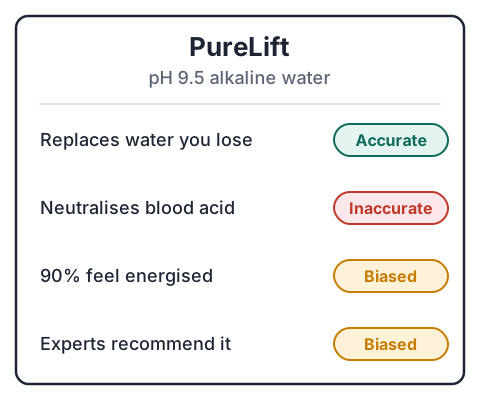
- A gym poster (written for this lesson) sells PureLift pH 9.5 alkaline water with four claims: it replaces the water you lose in sweat, urine and breath; it neutralises the acid in your blood; 90% of customers say they feel more energetic; experts recommend it.
- Purpose: produced by the company that sells the water, to persuade people to buy it. Audience: adults who exercise and care about their health.
- The table labels each claim and gives the reason, using the normal blood pH range.
| Claim | Label | Why |
|---|---|---|
| Replaces water you lose | Accurate | The body loses water in sweat, urine and breath every day, and drinking water replaces it; any clean water does this |
| Neutralises the acid in your blood | Inaccurate | Blood is normally slightly basic, about pH 7.35 to 7.45, held there by buffers, breathing and the kidneys; stomach acid also neutralises the water long before it reaches the blood |
| 90% of customers feel more energetic | Biased | Only buyers were asked, with no control group drinking ordinary water; feeling better is self-reported, and people who paid more expect to feel better |
| Experts recommend it | Biased | No expert, study or organisation is named, so the claim borrows trust without evidence |
Checking the evidence behind a claim
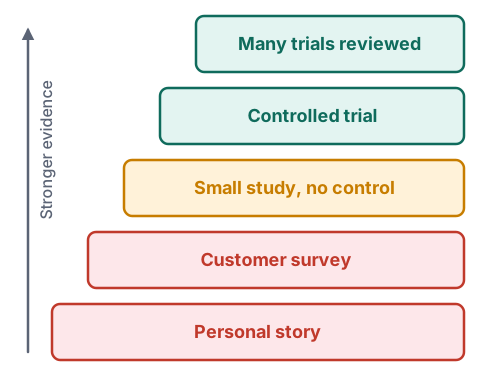
- Ask where the claim comes from. Peer review means other scientists checked the work before it was published in a journal; a company's own website or a social media post has had no such check.
- Ask how many were tested. A small sample can show a difference by chance, so a result from 12 people is far weaker than one from thousands.
- Ask what it was compared with. Without a control group, you cannot tell whether the product made the difference or something else did, such as people simply expecting to feel better.
- Ask whether others have found the same. A result that independent groups repeat is much stronger than a single study.
- Ask whether it shows cause or only a link. Two things rising together (a correlation) does not prove one causes the other.
Example: a peer-reviewed paper that was wrong
- In 1998 The Lancet, a respected medical journal, published a paper by Andrew Wakefield that suggested a link between the MMR vaccine and autism.
- The paper had passed peer review, but it was based on only 12 children, with no control group, so it could never show that the vaccine caused anything.
- Investigators later found serious misconduct. The Lancet retracted the paper on 2 February 2010, and Wakefield was struck off the UK medical register.
- Many large studies since have found no link, but the scare had already spread through the media: MMR uptake in the UK fell from 92% to below 80%.
- The lesson for this standard: peer review lowers the risk of bad science but does not remove it. Sample size, controls and whether other studies agree all count.
| Question | The 1998 paper |
|---|---|
| Sample size | 12 children |
| Control group | None |
| Repeated by others | No; later large studies found no link |
| Outcome | Retracted on 2 February 2010 |
Consequences for the public
- Merit asks how inaccurate or biased biology could affect the people who read it. Think about health, money, the environment and trust in science.
- Inaccurate health claims can lead people to skip a treatment that works, take one that does not, or waste money. The alkaline water advert costs buyers money, and someone with a real health problem might trust the water instead of seeing a doctor.
- When fewer people are immunised, diseases like measles can spread again. In 2019 New Zealand had 2,174 confirmed measles cases, and 765 people were hospitalised.
- Name the specific group affected and explain how: 'parents who read the article may delay their child's MMR vaccine, leaving the child unprotected against measles, a highly infectious disease'.
| New Zealand, 2019 | Number |
|---|---|
| Confirmed measles cases | 2,174 |
| Hospitalisations | 765 |
Bias and vested interest
- A vested interest is something the producer gains if you believe them: sales, donations, votes, clicks or support for a cause.
- Bias shows in how the biology is used: only the evidence that suits the producer is given (cherry-picking), the other side is left out, emotional words replace evidence ('toxic', 'natural', 'miracle'), or a true fact is stretched beyond what it shows.
- Accurate biology can still be biased. 'Your body needs water' is true, but on the PureLift poster it is there to make the false blood claim look trustworthy.
- Vested interest does not make a claim wrong by itself. A dairy company saying milk contains calcium is accurate; your job is to check the biology and point out what has been left out.
Example: from Merit to Excellence
- Prioritising means ranking the claims by how much they matter in this context, and saying why.
- Evaluating the overall impact means weighing the accurate claims against the inaccurate and biased ones, and judging how well the piece informs its audience.
| Grade | What the student wrote about the PureLift poster |
|---|---|
| Achieved | The claim that the water neutralises acid in your blood is inaccurate. Blood is slightly basic, with a pH of about 7.35 to 7.45. The poster was made by the company to sell water to gym members. |
| Merit | The blood claim is inaccurate because buffers, the lungs and the kidneys keep blood pH between 7.35 and 7.45, and stomach acid neutralises the water before it is absorbed. The company has a vested interest in sales, so it uses only its own customer survey, with no control group. Gym members may spend money on a product that does nothing more than tap water. |
| Excellence | The most significant claim is the blood one, because it is the main reason given to buy the product and it is wrong. The survey is next, since it is the only evidence offered and is biased. The water claim is accurate but least important; it lends trust to the false claim. Overall the poster has low biological validity: one accurate claim is outweighed by an inaccurate main claim and biased evidence, so it misleads its audience. |
Common mistakes
- The intended audience is the general public.Name a specific group, such as parents of young children or adults who go to the gym, and say what in the article tells you.
- The company wants to sell it, so everything it says is inaccurate.Vested interest makes bias likely, but each claim must still be checked against the biology; some will be accurate.
- It was in a peer-reviewed journal, so it must be true.Peer review lowers the risk but does not remove it; check sample size, controls and whether other studies agree.
- For Excellence I summarised every claim again at the end.Excellence ranks the claims by significance with reasons, then judges the overall effect on the audience.
Test a kitchen claim: does lemon juice stop browning?
You need: a ripe banana, lemon juice, water, 3 saucers, a teaspoon, a timer or phone
- Peel the banana and break it by hand into three pieces of similar size, one on each saucer.
- Spoon lemon juice over the broken end of the first piece and the same amount of water over the second; leave the third dry.
- Leave all three side by side, away from the sun, and check the broken ends at 10, 20 and 30 minutes.
- Look for: the lemon piece browns least, because its acid slows the enzyme that turns the flesh brown, but it may still darken a little. The water piece is the control for wetting the fruit. So does 'lemon stops browning' hold up, or is 'slows browning' the accurate claim?
Safety: Lemon juice stings in the eyes and in cuts, so keep your hands away from your face and wash them afterwards.
Your turn
A social media post says: 'Antibiotics will help you get over the flu faster.' Label the claim and correct it.
A dairy company's website says milk contains calcium, which is needed to build strong bones. Label the claim, and say who produced it and a likely audience.
A supplement's website says: 'In our study of 15 people, 12 felt less tired after two weeks.' Give two weaknesses in this evidence.
A student writes: 'The Wakefield paper was peer reviewed, so its findings were valid.' What is wrong with this?
An article contains three claims: a true one about vitamin C, an untrue one saying its product cures colds, and a vague quote from 'scientists'. Which should rank first for Excellence, and why?
Why does a vested interest not automatically make a claim inaccurate?
Show answer
1. Inaccurate: flu is caused by a virus, and antibiotics only work against bacteria, so they will not shorten the flu. 2. Accurate, but from a company with a vested interest in selling milk; a likely audience is parents buying food for their children. 3. For example: the sample is small (15 people), and there is no control group, so the 12 who felt less tired might have improved anyway or expected to; the study was also run by the seller, not peer reviewed. 4. Peer review does not guarantee validity: the paper used only 12 children with no control group, involved misconduct and was retracted in 2010. 5. The claim that the product cures colds: it is the main selling point and it is inaccurate, so it is the one most likely to mislead readers. 6. A claim is judged on its biology; a producer with something to gain may still state an accurate fact, so you check the science and note what has been left out.
Recap
- Name the producer, the purpose and a specific audience for each article.
- Label every biological claim accurate, inaccurate or biased, and correct the inaccurate ones with biology.
- Check the evidence: peer review, sample size, control groups, replication, and cause against correlation.
- Merit explains why and what it could do to people; Excellence ranks the claims and judges the overall impact.
| Label | Meaning | PureLift example |
|---|---|---|
| Accurate | Matches accepted biology | Drinking water replaces water you lose |
| Inaccurate | Contradicts accepted biology | Water neutralises acid in blood |
| Biased | Slanted to suit the producer | A customer survey with no control group |
The maths behind it
How is NCEA Level 2 maths going?
See the NCEA Level 2 maths guide