DNA replication, mitosis and the cell cycle
What this lesson covers
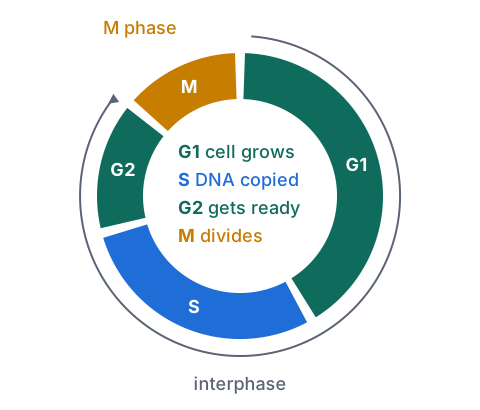
- The cell cycle is interphase (growth, DNA replication, getting ready) followed by mitosis and cytokinesis.
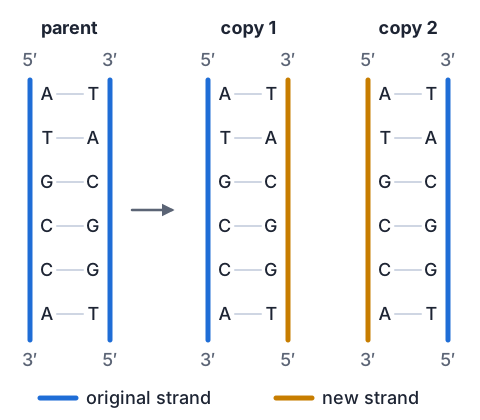
- DNA is copied before division by semi-conservative replication: the strands unzip, each acts as a template, and complementary nucleotides are added in the antiparallel direction.
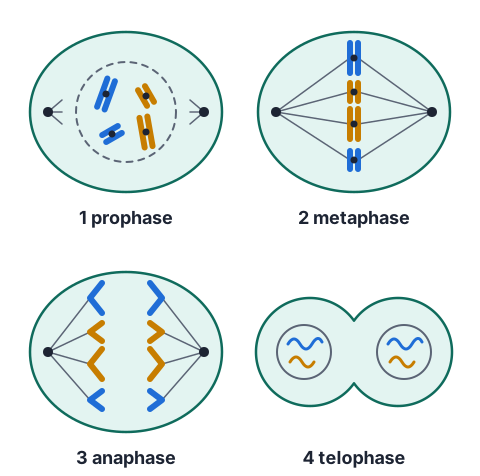
- In mitosis the chromosomes condense, line up at the equator, have their sister chromatids pulled to opposite poles, and end up in two new nuclei.
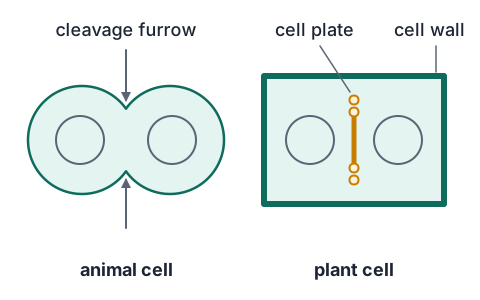
- Animal cells split by a cleavage furrow; plant cells build a cell plate that becomes a new cell wall.
- Mitosis makes two genetically identical cells, which is how organisms grow, repair damage and keep each cell small enough for a high surface area to volume ratio.
The cell cycle
- The cell cycle is the life of a dividing cell, from the moment it is made until it splits into two.
- Most of the time is interphase, which is not a resting stage: in G1 the cell grows and makes new organelles and proteins, in S it copies all of its DNA, and in G2 it keeps growing and makes the proteins it needs for division.
- The short M phase is mitosis (sharing the copied chromosomes between two nuclei) followed by cytokinesis (splitting the cytoplasm to make two cells).
- Cells that no longer divide, such as most nerve cells and mature muscle cells, leave the cycle after G1 and stay in a non-dividing state often called G0.
- Checkpoints between the stages stop the cycle if the DNA is damaged or not fully copied; when those controls fail, cells can keep dividing and form a tumour.
- The exam does not need the stage names, but using them correctly makes a description clear and precise.
DNA replication: copying before dividing
- DNA is two strands of nucleotides held together by hydrogen bonds between complementary bases: adenine pairs with thymine and cytosine pairs with guanine. The strands are antiparallel, running in opposite directions (5′ to 3′ and 3′ to 5′).
- In the S phase, the enzyme helicase unwinds the double helix and breaks the hydrogen bonds, unzipping the two strands.
- Each old strand is a template: free DNA nucleotides in the nucleus pair with the exposed bases (A with T, C with G), and DNA polymerase joins them into a new strand.
- DNA polymerase can only add nucleotides to the 3′ end of a growing strand, so the two new strands are built in opposite directions; one is made in short pieces that the enzyme ligase joins together.
- Each new molecule has one original strand and one new strand, so replication is called semi-conservative.
- Because each base can pair with only one partner, both copies have exactly the same base sequence as the original, which is why the cells mitosis makes carry identical genetic information.
Chromosomes, chromatids and centromeres
- A chromosome is one long DNA molecule wrapped around proteins; human body cells have 46, in 23 pairs, and onion cells have 16.
- During interphase the DNA is spread out as thin threads so its genes can be read; just before mitosis it coils up tightly into short, thick chromosomes that can be moved without tangling or breaking.
- After replication each chromosome is two identical sister chromatids joined at a point called the centromere, so the cell still has 46 chromosomes but 92 DNA molecules.
- In mitosis the sister chromatids are separated, and each daughter cell gets one chromatid of every chromosome: 46 chromosomes, the same as the parent cell.
Example: counting through one cycle
- A human skin cell has 46 chromosomes when it is made.
- Track the number of chromosomes and DNA molecules in the cell from G1 to the end of cytokinesis.
| Stage | Chromosomes | DNA molecules |
|---|---|---|
| G1 | 46 | 46 |
| G2 (after S) | 46 | 92 |
| Metaphase | 46 | 92 |
| Anaphase (whole cell) | 92 | 92 |
| Each daughter cell | 46 | 46 |
- G1: 46 chromosomes, each one DNA moleculenothing has been copied yet
- S: 46 × 2 = 92 DNA moleculesevery chromosome is copied into two sister chromatids
- chromosomes still 46the two chromatids stay joined at one centromere, so they count as one chromosome
- anaphase: 92 ÷ 2 = 46 move to each polesister chromatids separate, and each is now a chromosome in its own right
- each daughter cell: 46 chromosomes, 46 DNA molecules
- same number as the parent cell in G1, so mitosis keeps the chromosome number constant
The stages of mitosis
- Prophase: the chromosomes coil up and become visible as two sister chromatids, the nuclear membrane breaks down, and spindle fibres (made of protein) start to form between the two poles of the cell.
- Metaphase: the chromosomes line up in a single row across the middle of the cell, the equator, with a spindle fibre from each pole attached to each centromere.
- Anaphase: each centromere splits and the spindle fibres shorten, pulling the sister chromatids to opposite poles, so each pole gets one copy of every chromosome.
- Telophase: a nuclear membrane forms round each group of chromosomes at the poles, and the chromosomes uncoil again.
- Cytokinesis then divides the cytoplasm and organelles, such as mitochondria, between the two new cells.
Plant and animal cells divide differently
- Mitosis itself is the same in both, but animal cells organise their spindle from a pair of centrioles at each pole, while plant cells have no centrioles and still form a spindle.
- An animal cell divides its cytoplasm by a ring of protein filaments that tightens round its middle, making a cleavage furrow that pinches the cell in two.
- A plant cell cannot pinch because its cell wall is rigid, so vesicles from the Golgi body, full of cell wall material, line up along the equator and join to form a cell plate, which grows outwards to become a new wall between the two cells.
- In plants, mitosis happens mainly in meristems: the root tips, shoot tips and buds, and the cambium that makes stems thicker. In animals, it happens in most tissues while they grow, and in tissues that are worn away all the time, such as skin, the gut lining and the bone marrow that makes blood cells.
Why mitosis matters: identical cells, growth and repair
- Mitosis makes two daughter cells that are genetically identical to each other and to the parent cell, because the DNA was copied exactly and each cell gets one chromatid of every chromosome.
- Identical DNA means every new cell has the full set of instructions for making the proteins and enzymes its job needs, such as digestive enzymes in a gut cell.
- Organisms grow by making more cells, not by making cells bigger: as a cell grows its volume rises faster than its surface area, so its surface area to volume ratio falls and diffusion can no longer supply its needs or remove its wastes fast enough.
- Dividing gives two smaller cells with a higher ratio, so oxygen, glucose and carbon dioxide can move in and out quickly enough to keep each cell alive.
- Mitosis also repairs damage and replaces worn-out cells, such as a healing cut or new skin cells, with cells identical to the ones lost.
- Rates of mitosis are highest when an organism is growing or repairing: an embryo, a teenager in a growth spurt, plants putting out new shoots and roots in spring, or tissue around a wound.
Example: counting cells in an onion root tip
- A Year 12 class grew onion roots in water, stained a squashed root tip and counted 200 cells under a microscope.
- The mitotic index is the percentage of cells that are in mitosis. Because the cells divide at random times, the share of cells in a stage also shows the share of the cycle that stage takes.
- Calculate the mitotic index, and use the counts to compare how long each stage lasts.
| Stage | Number of cells |
|---|---|
| Interphase | 168 |
| Prophase | 18 |
| Metaphase | 6 |
| Anaphase | 3 |
| Telophase | 5 |
- cells in mitosis = 18 + 6 + 3 + 5 = 32every stage except interphase
- mitotic index = 32 ÷ 200 × 100 = 16%dividing cells as a percentage of all cells counted
- interphase: 168 ÷ 200 × 100 = 84% of the cyclemost of the cycle is spent growing and copying DNA
- prophase: 18 ÷ 200 × 100 = 9%; anaphase: 3 ÷ 200 × 100 = 1.5%anaphase is the shortest stage
- mitotic index 16%; interphase takes 84% of the cycle and prophase is the longest stage of mitosis
- 168 + 18 + 6 + 3 + 5 = 200
What Achieved, Merit and Excellence look like
- Achieved describes: when DNA is copied, what mitosis makes, and what it is for. Merit explains how and why, with template strands, base pairing and enzymes, and with surface area to volume ratio. Excellence links these ideas to keep each cell alive, and then links each cell's survival to the survival of the whole organism.
- Use the context you are given: name the actual tissue, life stage or injury in the question, rather than writing about cells in general.
| Grade | A model answer |
|---|---|
| Achieved | The DNA is copied in interphase before the cell divides. Mitosis makes two identical cells so the root can grow. |
| Merit | Before mitosis, helicase unzips the DNA and each strand acts as a template; DNA polymerase adds complementary nucleotides, A with T and C with G, so each new cell gets an identical full copy. The root grows by making more cells, because a cell that kept growing would have too low a surface area to volume ratio for diffusion to supply it. |
| Excellence | Each root tip cell must have a complete, identical copy of the DNA to make the proteins and enzymes it needs, and must stay small so its high surface area to volume ratio lets water, minerals and oxygen diffuse in and wastes out quickly enough. Copying DNA first and then dividing by mitosis meets both needs at once. Only if the cells survive and keep dividing can the root grow down to reach water and anchor the young tree, so the whole plant depends on this cycle. |
Common mistakes
- DNA replication happens during prophase, when the chromosomes appear.DNA is copied in the S phase of interphase, before mitosis starts; in prophase the already-copied chromosomes only coil up and become visible.
- Interphase is when the cell rests between divisions.Interphase is the busiest part of the cycle: the cell grows, makes organelles and proteins, and copies all its DNA.
- Mitosis makes four cells that are all genetically different.That is meiosis, which makes gametes; mitosis makes two cells identical to the parent, for growth and repair.
- Each daughter cell gets half of the parent cell's DNA.The DNA was doubled first, so each daughter cell gets a complete copy, with the same number of chromosomes as the parent.
Model replication and mitosis with paper chromosomes
You need: a sheet of paper, scissors, a blue pen and a red pen, 4 paperclips, a piece of string or wool about 50 cm long
- Cut four paper strips, two long and two short; colour one long and one short strip blue (from one parent) and the others red (from the other), and write a different short base sequence such as ATTGC along each one. This is a cell in G1 with 4 chromosomes.
- Replicate: for each strip, cut a new strip the same length and colour, write the identical sequence on it, and clip the pair together in the middle with a paperclip as the centromere.
- Lay the string across the table as the equator and line the four clipped chromosomes up along it, one chromatid on each side of the string.
- Unclip each pair and slide one chromatid to each end of the table, then gather each end into its own group as a new nucleus.
- Look for: each new cell has a long blue, a short blue, a long red and a short red strip with the same sequences as the first cell, so the two cells are identical; then try it without the copying step and see that the chromosomes cannot be shared out fairly.
Safety: Take care cutting with scissors, and keep the paperclips away from any small children, who could choke on them.
Your turn
At what point in the cell cycle is DNA copied?
A cell has 8 chromosomes. How many DNA molecules does it contain at metaphase, and how many chromosomes does each daughter cell get?
One DNA strand reads 5′ ATGCCTA 3′. Write the new strand built on it during replication, with its ends labelled.
In a root tip squash, 45 of the 300 cells counted are in mitosis. Calculate the mitotic index.
Explain why a growing root makes more cells rather than making its cells bigger.
Show answer
1. In the S phase of interphase, before mitosis begins. 2. 16 DNA molecules at metaphase (8 chromosomes, each two chromatids); each daughter cell gets 8 chromosomes. 3. 3′ TACGGAT 5′: A pairs with T and C with G, and the new strand runs antiparallel to the template. 4. 45 ÷ 300 × 100 = 15%. 5. A bigger cell has a lower surface area to volume ratio, so substances could not diffuse in and out fast enough; dividing keeps each cell small with a high ratio.
Exam-style question: a copper skink
- Copper skinks are small lizards common in Auckland gardens. Like most New Zealand skinks, they give birth to live young, and a newborn is only a fraction of its adult size. When a bird grabs its tail, the skink can drop the tail and escape, then slowly grow a new one.
Describe when DNA replication happens in the cell cycle, and how the DNA is copied.
Explain why DNA replication must happen before mitosis.
Explain why the young skink grows by making more cells rather than by its cells getting larger.
Discuss why mitosis is needed throughout the skink's life, linking the survival of its cells to the survival of the whole skink.
Show answer
1. DNA is copied in the S phase of interphase, before mitosis (Achieved). Helicase unzips the double helix by breaking the hydrogen bonds between bases; each strand is a template, and DNA polymerase joins free nucleotides to it by complementary pairing, A with T and C with G, building each new strand antiparallel to its template. Each new molecule has one old and one new strand, so replication is semi-conservative (Merit for template, base pairing and enzymes together). 2. Mitosis shares one chromatid of every chromosome between the two daughter cells, so the DNA must be doubled first; otherwise each new cell would get only half the genes and could not make all the proteins and enzymes it needs to work (Merit). 3. As a cell grows, its volume increases faster than its surface area, so its surface area to volume ratio falls. Oxygen and glucose could not diffuse in, or carbon dioxide out, fast enough for a large cell, so the skink makes more small cells, each with a high ratio (Merit). 4. Mitosis is needed at every stage, at different rates (Excellence for linking the ideas). While the young skink grows, mitosis is fast, making many new small cells whose high surface area to volume ratio keeps diffusion fast enough to supply them. When the tail is lost, mitosis at the wound makes new cells to close it and rebuild the tail, and in the adult it keeps replacing worn-out skin and gut cells after growth slows. Because the DNA was copied exactly, every new cell has the full instructions to make the proteins its job needs. Cells that were too large or missing DNA would die, and if enough cells failed, tissues and organs would fail and the skink could not survive.
Recap
- The cell cycle is interphase (G1, S, G2) and then mitosis and cytokinesis.
- DNA is copied in the S phase: helicase unzips it, each strand is a template, and DNA polymerase adds complementary nucleotides in the antiparallel direction, so replication is semi-conservative.
- In mitosis, chromosomes condense, line up at the equator, and have their sister chromatids pulled to opposite poles into two new nuclei.
- Animal cells pinch in two at a cleavage furrow; plant cells build a cell plate.
- Mitosis makes identical cells for growth and repair, and keeps cells small enough to have a high surface area to volume ratio.
| Stage | What happens |
|---|---|
| Interphase | cell grows; DNA copied in S phase |
| Prophase | chromosomes condense; nuclear membrane breaks down; spindle forms |
| Metaphase | chromosomes line up on the equator |
| Anaphase | sister chromatids pulled to opposite poles |
| Telophase | two new nuclei form; chromosomes uncoil |
| Cytokinesis | cleavage furrow (animal) or cell plate (plant) makes two cells |
How is NCEA Level 2 maths going?
See the NCEA Level 2 maths guide