Meiosis, mutation and inheritance
What this lesson covers
- Genes, alleles and loci, and how homologous chromosomes come in pairs in diploid cells.
- How meiosis makes four haploid gametes, and how crossing over, independent assortment and segregation make each one different.
- Mutation as the only source of brand new alleles, and which mutations can be inherited.
- Monohybrid crosses with complete dominance, incomplete dominance, codominance, multiple alleles and lethal alleles, and dihybrid crosses with and without linkage.
- Test crosses, pedigrees and probabilities, and why a small family can hide the real ratio.
Genes, alleles and chromosome pairs
- A gene is a length of DNA coding for one characteristic, and its position on a chromosome is called its locus.
- Alleles are different versions of the same gene, such as the allele for tall and the allele for short stems in pea plants.
- Body cells are diploid: human body cells hold 46 chromosomes in 23 pairs, one of each pair from each parent. The two chromosomes in a pair are homologous: same genes, same loci, but not always the same alleles.
- Gametes (sperm and eggs) are haploid, with one chromosome from each pair, so a human gamete has 23; fertilisation restores 46.
- Homozygous means both alleles for a gene are the same (TT or tt); heterozygous means they differ (Tt). The genotype is the alleles; the phenotype is the trait you can see or measure.
| Term | Meaning | Example |
|---|---|---|
| Dominant allele | shows in the phenotype whenever it is present | T (tall pea) |
| Recessive allele | shows only when there is no dominant allele | t (short pea) |
| Genotype | the two alleles an organism carries | Tt |
| Phenotype | the characteristic that results | tall |
Meiosis: one cell, four different gametes
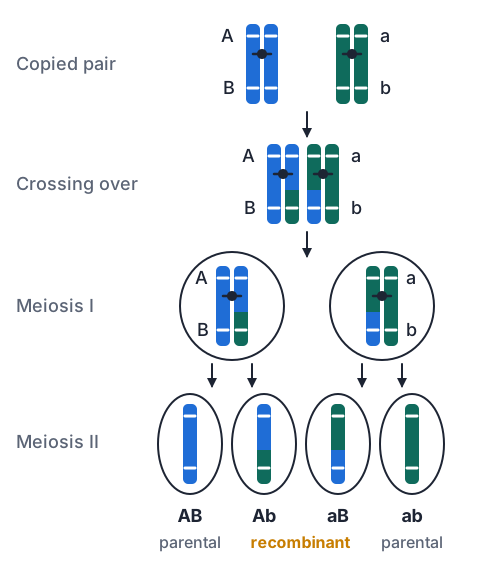
- Before meiosis the DNA is copied, so each chromosome becomes two identical sister chromatids joined at a centromere.
- In meiosis I the homologous chromosomes pair up side by side, and non-sister chromatids can swap matching sections (crossing over).
- Still in meiosis I, the homologous pairs are pulled apart into two cells, so the two alleles of every gene separate (segregation), and each new cell is haploid.
- In meiosis II the sister chromatids separate, giving four haploid cells.
- Because of crossing over, the four gametes in the figure are all different: two keep the parent's combinations (AB and ab) and two are recombinant (Ab and aB).
Where the variation comes from
- Crossing over makes new combinations of alleles on a single chromosome, which did not exist in either of the parent's own chromosomes.
- Independent assortment: each homologous pair lines up on the middle of the cell in meiosis I in a random orientation, independently of every other pair, so the chromosomes from mum and dad are shuffled into the gametes.
- With 23 pairs, independent assortment alone gives 2²³ = 8 388 608 possible combinations of chromosomes in a human gamete.
- Random fertilisation then joins any one sperm with any one egg: about 8.4 million × 8.4 million ≈ 70 trillion possible zygotes, before crossing over adds even more.
- None of this makes new alleles; it reshuffles the alleles that are already in the gene pool into new combinations.
Mutation: the source of new alleles
- A mutation is any lasting change to the base sequence of DNA. It is the only way a brand new allele appears.
- Gene mutations include a substitution (one base swapped for another), an insertion (an extra base) and a deletion (a base lost). Insertions and deletions shift the reading frame, so every codon after them changes.
- Mutations happen at random when DNA is copied, and more often with mutagens such as UV light, X-rays and some chemicals.
- Only mutations in gametes, or in the cells that make gametes, are passed on to offspring. A mutation in a skin cell can harm the person but is never inherited.
- Most mutations are neutral or harmful, but a few give an advantage in a particular environment, and those are the raw material natural selection works on.
Example: a monohybrid cross with complete dominance
- In pea plants, the allele for tall stems (T) is dominant to the allele for short stems (t). Two heterozygous tall plants are crossed.
- Find the gametes, the genotype ratio and the phenotype ratio of the offspring.
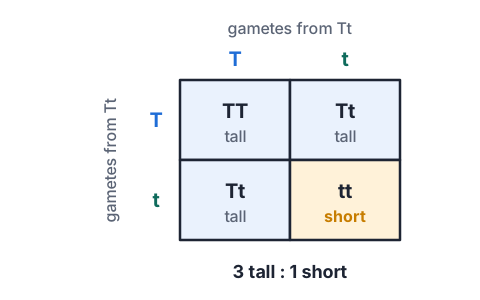
- parents: Tt × Ttheterozygous means one of each allele
- gametes: T or t from each parentsegregation puts one allele of the gene in each gamete
- offspring: TT, Tt, Tt, ttfill the Punnett square
- genotypes: 1 TT : 2 Tt : 1 tt
- phenotypes: 3 tall : 1 short
- each offspring has a 3 in 4 (75%) chance of being talla ratio is a probability for each offspring, not a promise for a small family
Example: a test cross
- A tall pea plant could be TT or Tt, and the two look the same. A test cross finds out which, by crossing it with a homozygous recessive (tt) plant.
- Work out what each possible genotype would give.
- TT × tt: all gametes T and t, so all offspring Ttevery offspring gets a T from the tall parent
- all tall
- Tt × tt: gametes T or t, and tthe tt parent can only give t
- offspring 1 Tt : 1 tt, so 1 tall : 1 short
- any short offspring means the tall parent is Tt; all tall (in a large number of offspring) suggests TT
Codominance, incomplete dominance, multiple and lethal alleles
- Incomplete dominance: neither allele fully masks the other, so the heterozygote is in between. Red snapdragons (CᴿCᴿ) crossed with white (CᵂCᵂ) give all pink (CᴿCᵂ); pink × pink gives 1 red : 2 pink : 1 white.
- Codominance: both alleles are fully expressed side by side in the heterozygote. Roan Shorthorn cattle (RW) have a mix of red hairs and white hairs, not pink hairs.
- Multiple alleles: a gene has three or more alleles in the population, though each person still carries only two. The ABO blood group gene has Iᴬ, Iᴮ and i; Iᴬ and Iᴮ are codominant and both are dominant to i.
- Lethal alleles: a genotype that kills the embryo. In mice, the yellow allele Aʸ is dominant for coat colour but AʸAʸ embryos die, so yellow × yellow gives 2 yellow : 1 non-yellow instead of 3 : 1.
- In every case, show your symbols in a key: capital letters with superscripts for codominant or incompletely dominant alleles.
| Cross | Pattern | Offspring ratio |
|---|---|---|
| Tt × Tt | complete dominance | 3 : 1 |
| CᴿCᵂ × CᴿCᵂ | incomplete dominance | 1 red : 2 pink : 1 white |
| RW × RW | codominance | 1 red : 2 roan : 1 white |
| Aʸa × Aʸa | lethal allele | 2 yellow : 1 non-yellow |
| Tt × tt | test cross | 1 : 1 |
Example: ABO blood groups
- A mother with blood group A (genotype Iᴬi) and a father with blood group B (genotype Iᴮi) have a child.
- What blood groups could their children have, and with what probability?
| Iᴮ | i | |
|---|---|---|
| Iᴬ | IᴬIᴮ (AB) | Iᴬi (A) |
| i | Iᴮi (B) | ii (O) |
- mother's gametes: Iᴬ or i; father's gametes: Iᴮ or i
- IᴬIᴮ is AB, because Iᴬ and Iᴮ are codominantboth antigens are made
- Iᴬi is A and Iᴮi is B, because i is recessive
- 1 AB : 1 A : 1 B : 1 O, so 25% each
- two parents who are neither AB nor O can have children of all four groups
Two genes at once: dihybrid crosses and linkage
- If two genes are on different chromosomes, independent assortment means AaBb makes four kinds of gamete (AB, Ab, aB, ab) in equal numbers, so AaBb × AaBb gives 9 : 3 : 3 : 1 and a test cross (AaBb × aabb) gives 1 : 1 : 1 : 1.
- Linked genes sit close together on the same chromosome, so they tend to be inherited together and the parental combinations turn up far more often than 1 : 1 : 1 : 1 predicts.
- Crossing over between the two loci makes a few recombinant gametes. The further apart the genes are, the more often a crossover lands between them and the more recombinants there are.
- Genes far apart on the same chromosome cross over so often that they behave as if unlinked.
- test cross AaBb × aabb (A and B on the same chromosome), 200 offspringa made-up practice cross
- 82 AB, 80 ab, 19 Ab, 19 aBobserved phenotypes
- unlinked would give 50 of each1 : 1 : 1 : 1
- recombinants = (19 + 19) ÷ 200 × 100% = 19%
- mostly parental types, so the genes are linked; 19% recombinants comes from crossing over between them
Example: reading a pedigree
- Squares are males, circles are females, and shaded symbols are affected. In this family neither parent (I-1, I-2) is affected, but their daughter II-2 is.
- Decide whether the trait is dominant or recessive, give the parents' genotypes, and find the chance that their unaffected son II-3 is a carrier.
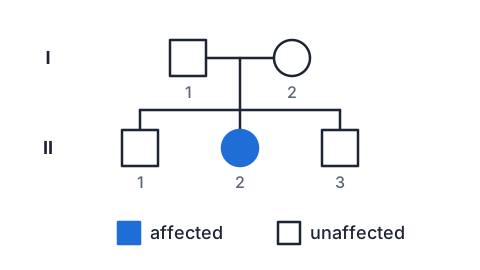
- two unaffected parents have an affected childthe allele was hidden in both parents
- the trait is recessive; II-2 is aa
- II-2 got one a from each parent, so I-1 and I-2 are both Aa
- Aa × Aa gives 1 AA : 2 Aa : 1 aathe Punnett square
- II-3 is unaffected, so he is AA or Aa, not aarule out the aa box
- chance II-3 is a carrier = 2 ÷ 3 ≈ 67%
What Achieved, Merit and Excellence look like
- Achieved defines and describes; Merit explains how or why; Excellence links the ideas together, often comparing two processes or two crosses, and uses the numbers in the question.
- The examiners mark each question as a whole, so one strong linked discussion beats a list of definitions.
| Grade | A model answer |
|---|---|
| Achieved | Crossing over is when non-sister chromatids of homologous chromosomes swap sections. Independent assortment is when the chromosome pairs line up randomly in meiosis I. |
| Merit | Crossing over swaps alleles between homologous chromosomes, so a chromatid ends up with a combination of alleles neither parental chromosome had. Independent assortment means which parent's chromosome goes into a gamete is random for each pair, so the gametes get different mixes of chromosomes. |
| Excellence | Crossing over makes new allele combinations within one chromosome, while independent assortment shuffles whole chromosomes; together they mean a person can make far more than the 2²³ chromosome combinations that independent assortment alone allows. Segregation then puts one allele of each gene in each gamete, so every gamete is a unique set of alleles, and random fertilisation multiplies the variety again. |
Common mistakes
- Crossing over happens between sister chromatids.It happens between non-sister chromatids of a homologous pair; sister chromatids are identical, so swapping between them would change nothing.
- A 3 : 1 ratio means a family with four children will have exactly three with the dominant trait.Each child has a 3 in 4 chance; ratios only show up reliably in large numbers of offspring.
- Codominance and incomplete dominance are the same, because the heterozygote looks different from both parents.Incomplete dominance blends to an in-between phenotype (pink); codominance shows both phenotypes fully at once (red and white hairs).
- Independent assortment creates new alleles.Only mutation makes new alleles; meiosis and fertilisation reshuffle existing alleles into new combinations.
Model a monohybrid cross with two coins
You need: two coins, a pen and paper, a phone or calculator
- Each coin is a heterozygous Aa parent: heads gives a gamete with A, tails gives a gamete with a.
- Toss both coins together and record the offspring as AA (two heads), Aa (one of each) or aa (two tails).
- Do 40 tosses and tally the three genotypes, then work out the phenotype ratio, counting AA and Aa as dominant.
- Compare your first 8 tosses with all 40, and add a family member's 40 to make 80.
- Look for: about 1 AA : 2 Aa : 1 aa and close to 3 : 1 in the large sample, but often something quite different in the first 8, which is why small families do not show neat ratios.
Safety: Keep the coins away from toddlers and babies, who can choke on a coin or swallow it.
Your turn
A human skin cell has 46 chromosomes. How many does a human sperm cell have?
In guinea pigs, black (B) is dominant to brown (b). What percentage of the offspring of Bb × bb would you expect to be brown?
A pink snapdragon (CᴿCᵂ) is crossed with a white snapdragon (CᵂCᵂ). Give the phenotype ratio.
Two yellow mice (Aʸa) are crossed and 12 pups survive. How many would you expect to be yellow, and how many non-yellow (agouti)?
Genes A and B are on different chromosomes. What percentage of the offspring of AaBb × aabb would be aabb?
Two parents are both carriers (Aa) of a recessive condition. What is the chance their next child is affected?
Show answer
1. 23 (gametes are haploid: one chromosome from each pair). 2. Bb × bb gives 1 Bb : 1 bb, so 50% brown. 3. Gametes Cᴿ or Cᵂ, and Cᵂ: offspring 1 CᴿCᵂ : 1 CᵂCᵂ, so 1 pink : 1 white. 4. 1 AʸAʸ (dies) : 2 Aʸa : 1 aa, so the survivors are 2 yellow : 1 agouti; 2/3 of 12 is 8 yellow and 4 agouti. 5. The AaBb parent makes AB, Ab, aB and ab equally; only ab gives aabb, so 1 in 4 = 25%. 6. Aa × Aa gives 1 AA : 2 Aa : 1 aa, so 1 in 4 = 25% for each child.
Exam-style question: Shorthorn cattle
- A Waikato farmer breeds Shorthorn cattle. Coat colour shows codominance: RR is red, WW is white and RW is roan, with red and white hairs mixed. Polled (no horns, P) is dominant to horned (p). The two genes are on different chromosomes.
Describe codominance, using roan cattle as the example.
Two roan cattle are mated many times. Give the expected ratio of coat colours in their calves, using a Punnett square.
The farmer's new bull is polled. Explain how a test cross would show whether he is PP or Pp.
The bull is mated with three horned cows and all three calves are polled. Discuss whether the farmer can now be sure the bull is PP, using probabilities.
Show answer
1. In codominance both alleles are fully expressed in the heterozygote: a roan (RW) animal grows red hairs (from R) and white hairs (from W) side by side, rather than one blended colour (Achieved). 2. RW × RW: gametes R or W from each parent; offspring RR, RW, RW, WW, so 1 red : 2 roan : 1 white, or 25% red, 50% roan, 25% white (Achieved for the ratio with phenotypes). 3. Mate him with horned (pp) cows, which can only give p gametes. If he is PP, every calf gets P and is polled. If he is Pp, each calf has a 1 in 2 chance of getting his p and being horned (pp). So any horned calf proves he is Pp (Merit: uses the gametes from both parents). 4. No. If he were Pp, each calf would still have a 1/2 chance of being polled, so three polled calves in a row happens with probability (1/2)³ = 1/8 = 12.5%. That is unlikely but far from impossible, so three calves cannot prove he is PP. Each calf is a separate random event, because segregation at meiosis puts P or p into each sperm by chance. With more calves the evidence gets stronger: seven polled calves from a Pp bull would happen only (1/2)⁷ = 1/128, about 0.8% of the time, but a single horned calf at any point would prove Pp (Excellence: links segregation, gametes from both parents and probability to why the result is not guaranteed).
Recap
- Meiosis halves the chromosome number and makes four genetically different haploid gametes.
- Crossing over, independent assortment, segregation and random fertilisation reshuffle alleles; only mutation makes new ones.
- Learn the ratios, and always give a key, the gametes and the Punnett square.
- A ratio is a probability for each offspring, so small families often do not match it.
| Cross | Expect |
|---|---|
| Aa × Aa, complete dominance | 3 : 1 |
| Aa × aa, test cross | 1 : 1 |
| incomplete or codominance, heterozygote × heterozygote | 1 : 2 : 1 |
| lethal homozygote, heterozygote × heterozygote | 2 : 1 |
| AaBb × AaBb, unlinked | 9 : 3 : 3 : 1 |
| AaBb × aabb, linked | mostly parental types, few recombinants |
The maths behind it
How is NCEA Level 2 maths going?
See the NCEA Level 2 maths guide